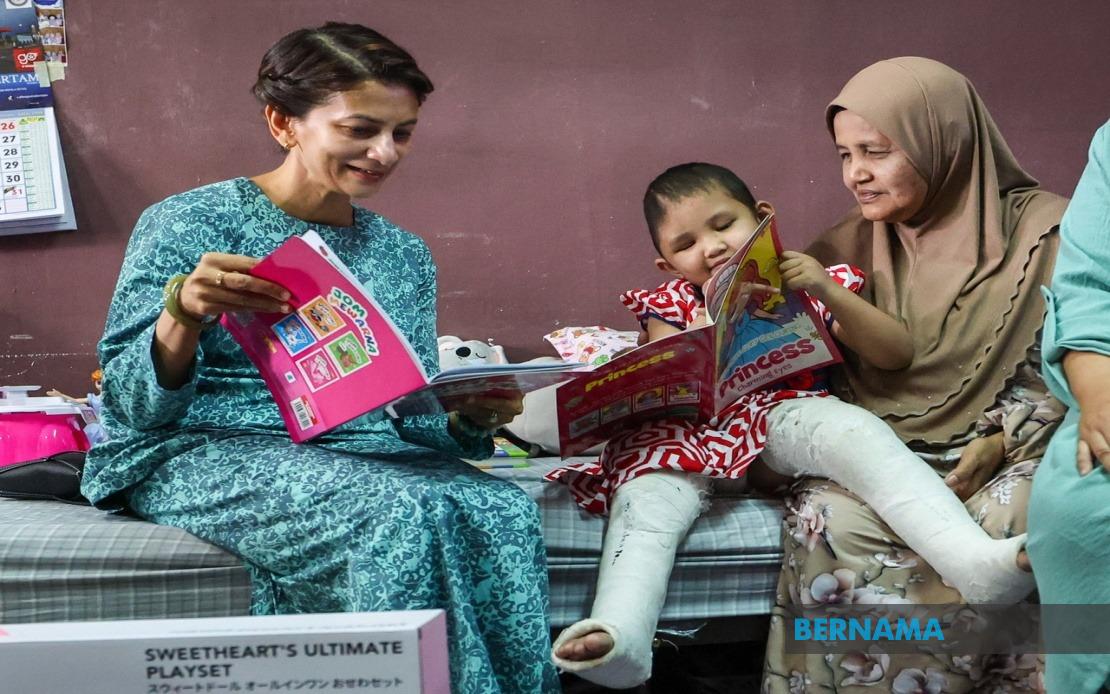
Three-year-old Aulia Sofia Ahmad Shafiq has emerged as a symbol of resilience following one of Kedah's most tragic road accidents. The girl, sole survivor of a collision that claimed six members of her immediate family last month, continues to show encouraging progress in her recovery more than a month after being discharged from hospital care in early July.
Aulia Sofia remains under the guardianship of her paternal aunt, Siti Nor Atikah Ahmad Syukri, 32, at her home in Taman Bandar Bertam Putra. After nearly four weeks of intensive medical treatment at Sultanah Bahiyah Hospital in Alor Setar, the young girl was released on July 2 and has since demonstrated the kind of physical vitality and mental resilience that has left her extended family deeply moved. Despite the physical limitations imposed by her injuries, those caring for her describe a child whose spirit appears largely undiminished by her ordeal.
The extent of Aulia Sofia's physical injuries reflects the severity of the June 7 collision. Both her legs sustained fractures in the crash, a condition that continues to restrict her mobility and will require extended rehabilitative care. Her aunt has explained that ongoing orthopaedic treatment remains essential, with specialist follow-up appointments scheduled well into the recovery period. Beyond the skeletal injuries, the girl sustained significant head trauma and suffered a ruptured eyeball in her left eye—injuries that could have permanent consequences for her vision and quality of life.
Medical intervention has been partially successful in preserving the eye itself. Surgeons performed delicate surgical procedures to salvage the eye from permanent loss, yet uncertainty persists regarding whether full or partial vision will be restored. The extent of any visual impairment will only become clear through additional medical assessments currently underway. Siti Nor Atikah has indicated that doctors have offered cautious optimism about the possibility of sight recovery, though they cannot rule out scenarios ranging from blurred vision to complete vision loss in that eye.
The psychological dimension of Aulia Sofia's recovery presents its own challenges. The child regained consciousness approximately two weeks after the catastrophic accident and has since been informed of her parents' deaths—a conversation no three-year-old should face. Her aunt and uncle, Ibrahim Ghazali, 39, have resolved to raise the girl as their own daughter and are currently navigating legal guardianship procedures to formalise this arrangement. The extended family's commitment to treating her as a full member of their household has provided crucial emotional grounding during an unimaginable transition.
The June 7 accident itself was a stark reminder of the dangers that linger on Malaysian roads. The newly purchased Proton X50 sport utility vehicle carrying Aulia Sofia's family was struck by a lorry at approximately 3.50 pm near Sungai Petani while en route from Penang to Merbok. Six occupants perished in the collision: her parents Ahmad Shafiq Ahmad Shukri, 27, and Jamaliah Sannusi, 29; her two-month-old brother Ahmad Mikail; her grandmother Nora Mhd Husin, 55; her uncle Ahmad Fahim Ahmad Shukri, 27; and her seven-year-old cousin Iskandar Affan Ibrahim. That Aulia Sofia survived at all seems to defy the odds, given the violence of the impact and the total loss of life among the other passengers.
The tragedy has not been without its glimmers of human kindness and institutional compassion. On July 18, the Raja Muda of Kedah, Tengku Sarafudin Badlishah ibni Al Aminul Karim Sultan Sallehuddin, accompanied by the Raja Puan Muda of Kedah, Che Puan Muda Zaheeda Mohamad Ariff, and their daughter, Tunku Zara Bahiyah, made a personal visit to Aulia Sofia's home. The royal family presented material assistance to support the child's ongoing care and established a National Education Savings Scheme (SSPN) account designed to secure her future educational opportunities. For the extended family, the visit represented recognition of their burden and a tangible investment in the child's prospects.
Siti Nor Atikah's own loss compounds the family's grief. Her youngest son, Iskandar Affan Ibrahim, seven years old, also perished in the same crash. She and her husband now find themselves not only mourning a child but also assuming custodial responsibility for a traumatised toddler navigating her own profound loss. Despite this dual burden, both parents express determination to provide Aulia Sofia with as normal a childhood as circumstances permit. Ibrahim Ghazali has noted that the girl has settled well into the household, buoyed by the presence of her cousins with whom she has always been close.
The slow but steady progress of Aulia Sofia's physical recovery offers some measure of hope to a family devastated by loss. Her increased activity levels and improving alertness suggest that the critical phase of her recovery may be transitioning toward longer-term rehabilitation and adjustment. Nevertheless, the road ahead remains uncertain in several respects. The orthopaedic specialists treating her will determine the timeline and completeness of her physical rehabilitation. Ophthalmologists continue to assess the implications of her eye trauma. Psychologists will guide the family in supporting her emotional processing of the catastrophe that took her parents and baby brother.
For Malaysian society more broadly, Aulia Sofia's story raises uncomfortable questions about road safety infrastructure, vehicle safety standards, and the continuing toll of traffic accidents on families. Her survival against the odds provides no comfort to the six family members who did not survive. It does, however, underscore the critical importance of medical care, family support systems, and community compassion during tragedy. As her recovery progresses through the months and years ahead, the young girl's resilience may yet inspire broader reflection on how to prevent similar collisions from claiming other families.

