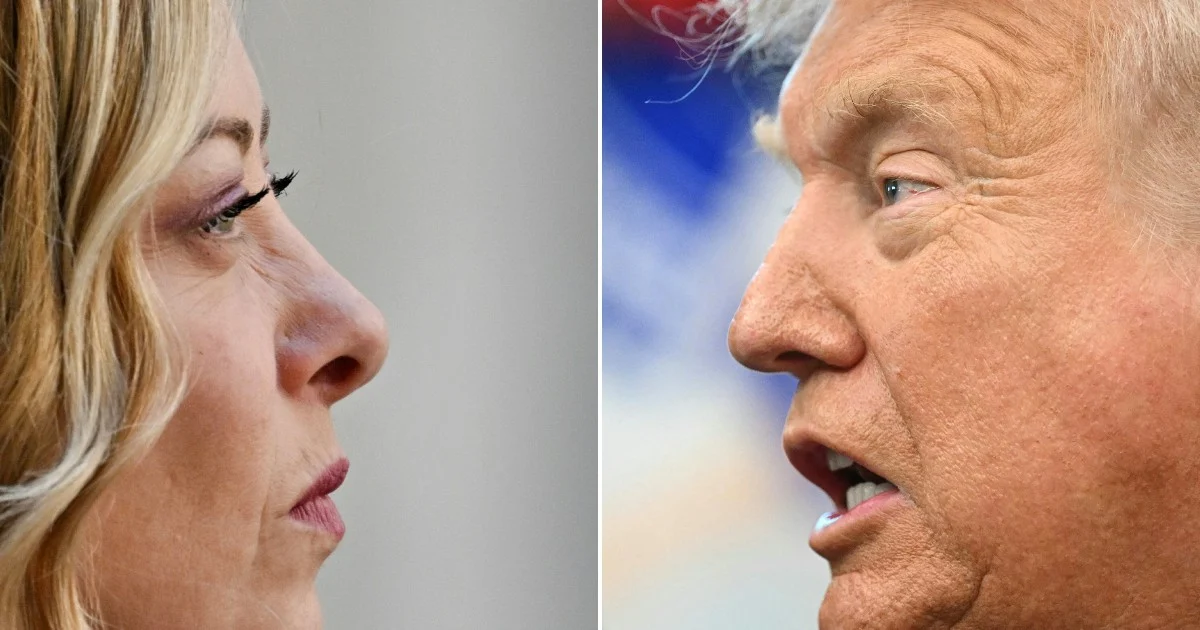
The diplomatic tension between Washington and Rome has entered a new phase as US President Donald Trump publicly amplified his criticism of Italian Prime Minister Giorgia Meloni on Saturday, moving beyond a personal scheduling dispute to encompass substantive foreign policy differences. Trump's decision to escalate the row publicly rather than contain it within diplomatic channels signals a shift in the administration's approach to managing relations with European allies, raising concerns about the stability of transatlantic partnerships that have long underpinned regional security arrangements in the Mediterranean and beyond.
The immediate cause of the friction centres on Trump's assertion that Meloni has repeatedly approached him seeking a photograph. While such requests might ordinarily be dismissed as routine diplomatic courting, Trump's choice to air the complaint publicly suggests deeper frustrations with the Italian leadership. The accusation carries an undertone that Meloni is prioritizing symbolic gestures of alignment with Washington over substantive policy coordination—a critique that, if believed in European capitals, could undermine her standing among fellow EU leaders who already navigate complex calculations regarding American engagement with the bloc.
What distinguishes this quarrel from typical diplomatic theatre is Trump's linkage of the photograph dispute to weightier matters of global consequence. By tethering his grievance to disagreements over Iran policy, the president has injected questions about missile proliferation, nuclear weapons development, and strategic deterrence into what might otherwise be dismissed as mere petulance. Italy's historical balancing act within Europe—serving simultaneously as a NATO member, an EU anchor, and a Mediterranean power with energy interests tied to Middle Eastern stability—suddenly appears more fraught as it becomes entangled in Washington's broader strategic competition with Tehran.
The NATO dimension of Trump's complaint carries particular significance for Malaysia and the broader Indo-Pacific region. Trump's repeated demands that European members increase defence spending have become a hallmark of his approach to the alliance, and any suggestion that Meloni's government is failing to meet his expectations on NATO contributions could presage additional pressure on other allies. For Southeast Asian nations like Malaysia that increasingly look to both American security guarantees and European economic partnerships, signals of strain within NATO reverberate across maritime security arrangements and trade frameworks that touch the region's vital interests.
Italy's position as a G7 member and Mediterranean heavyweight means that friction between Rome and Washington carries implications extending beyond bilateral relations. The Group of Seven represents a coalition of major industrialized democracies, and internal disagreements over foreign policy—particularly regarding Iran, a nation with influence stretching from the Levant to the Arabian Sea—affect the coherence of responses to global challenges. When the cohesion of such forums fractures over personal grievances amplified into policy disputes, the capacity of Western democracies to present unified positions on issues affecting global stability diminishes accordingly.
Meloni's government has navigated a delicate path since taking office in 2022, attempting to maintain Italy's traditional role as a bridge between Europe and America while also demonstrating commitment to EU institutions and policies that sometimes diverge from Washington's preferences. The photograph controversy, viewed through this lens, may represent a microcosm of the broader challenge facing European leaders seeking to maintain relevance in American strategic thinking while avoiding the impression of supplicant deference that would alienate domestic political constituencies and fellow European capitals. Trump's public airing of the complaint suggests an administration less concerned with affording diplomatic cover to allied leaders managing such balancing acts.
The expansion of the dispute to encompass Iran policy hints at a substantive disagreement between Rome and Washington that predates this specific row. Italy, like much of Europe, has sought to preserve space for diplomatic engagement with Iran, viewing absolute economic isolation as counterproductive to regional stabilization objectives. Trump's maximum pressure approach, by contrast, seeks to constrain Iranian influence through sanctions and military posturing. These competing visions for managing Iranian assertiveness have implications for trade routes, energy security, and proxy conflicts that affect countries across the Middle East, the Horn of Africa, and potentially beyond.
For Malaysia and regional observers, the Trump-Meloni dispute serves as a reminder that the architecture of global governance remains vulnerable to disruption by personalities and unconventional diplomatic tactics. Where previous American administrations might have managed such disagreements through quiet back-channel discussions or simply overlooked minor slights, Trump's preference for public confrontation elevates routine frictions into geopolitical moments. This approach has already reshaped relationships between Washington and Seoul, Washington and Mexico City, and Washington and various European capitals—and there appears little reason to believe Italy will be treated as an exception.
The longer-term implications depend considerably on whether this dispute remains confined to rhetoric or metastasizes into concrete policy shifts affecting trade, defence cooperation, or alliance management. Should Trump follow through with tangible consequences for Italy—whether through NATO burden-sharing demands, trade adjustments, or exclusion from key diplomatic forums—the reverberations could extend well beyond Europe. A demonstrated willingness to punish allies perceived as insufficiently deferential might trigger recalibration of strategic calculations across the world, including among Asian nations weighing their own relationships with an unpredictable Washington.
As this dispute unfolds, Meloni faces the unenviable task of managing an American president who appears willing to subordinate alliance management to personal satisfaction while simultaneously maintaining Italy's standing within European institutions that increasingly define themselves against certain American policy preferences. Her response will likely set a template for how other European leaders navigate similar pressures, shaping the contours of Atlantic relations for months to come.
%22%2F%3E%3C%2Fpattern%3E%3C%2Fdefs%3E%3Crect%20width%3D%22100%25%22%20height%3D%22100%25%22%20fill%3D%22url(%23ph504jeg)%22%2F%3E%3Crect%20width%3D%22100%25%22%20height%3D%22100%25%22%20fill%3D%22url(%23ph504jep)%22%2F%3E%3Ctext%20x%3D%2250%25%22%20y%3D%2250%25%22%20text-anchor%3D%22middle%22%20dominant-baseline%3D%22central%22%20fill%3D%22rgba(255%2C255%2C255%2C0.95)%22%20font-family%3D%22Georgia%2C%20'Times%20New%20Roman'%2C%20serif%22%20font-weight%3D%22700%22%20font-size%3D%22320%22%20letter-spacing%3D%22-0.02em%22%3EMOH%3C%2Ftext%3E%3C%2Fsvg%3E)
%22%2F%3E%3C%2Fpattern%3E%3C%2Fdefs%3E%3Crect%20width%3D%22100%25%22%20height%3D%22100%25%22%20fill%3D%22url(%23ph1idx5g)%22%2F%3E%3Crect%20width%3D%22100%25%22%20height%3D%22100%25%22%20fill%3D%22url(%23ph1idx5p)%22%2F%3E%3Ctext%20x%3D%2250%25%22%20y%3D%2250%25%22%20text-anchor%3D%22middle%22%20dominant-baseline%3D%22central%22%20fill%3D%22rgba(255%2C255%2C255%2C0.95)%22%20font-family%3D%22Georgia%2C%20'Times%20New%20Roman'%2C%20serif%22%20font-weight%3D%22700%22%20font-size%3D%22320%22%20letter-spacing%3D%22-0.02em%22%3EIJN%3C%2Ftext%3E%3C%2Fsvg%3E)
%22%2F%3E%3C%2Fpattern%3E%3C%2Fdefs%3E%3Crect%20width%3D%22100%25%22%20height%3D%22100%25%22%20fill%3D%22url(%23ph2ia34g)%22%2F%3E%3Crect%20width%3D%22100%25%22%20height%3D%22100%25%22%20fill%3D%22url(%23ph2ia34p)%22%2F%3E%3Ctext%20x%3D%2250%25%22%20y%3D%2250%25%22%20text-anchor%3D%22middle%22%20dominant-baseline%3D%22central%22%20fill%3D%22rgba(255%2C255%2C255%2C0.95)%22%20font-family%3D%22Georgia%2C%20'Times%20New%20Roman'%2C%20serif%22%20font-weight%3D%22700%22%20font-size%3D%22272%22%20letter-spacing%3D%22-0.02em%22%3EPerak%3C%2Ftext%3E%3C%2Fsvg%3E)