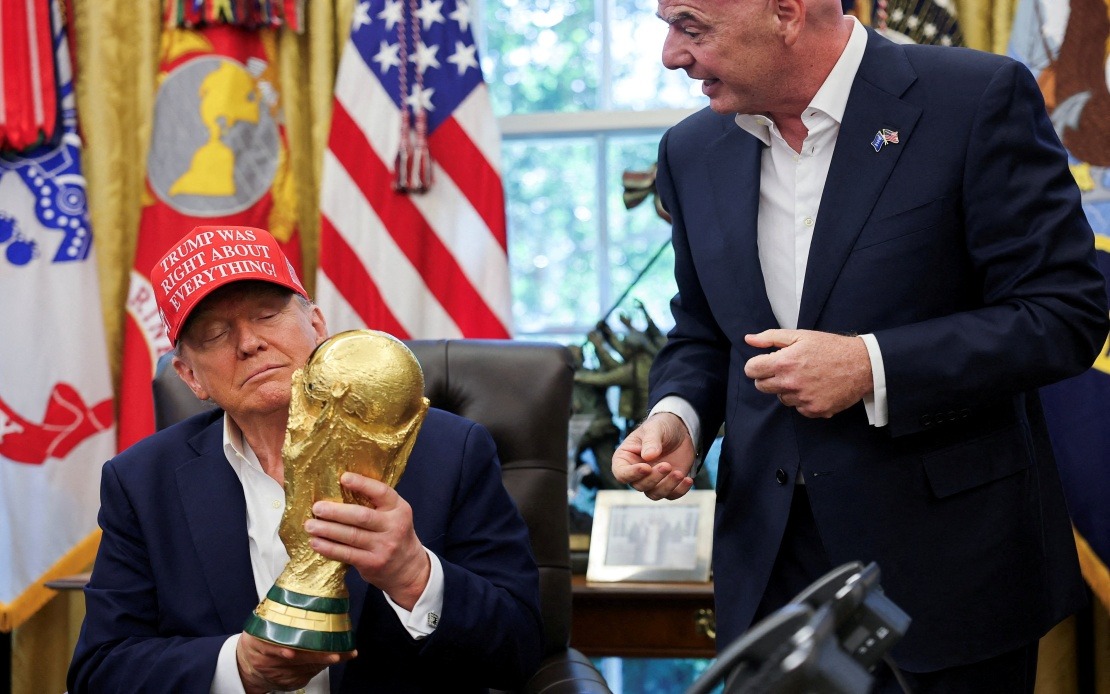
President Donald Trump significantly softened his stance toward Spain on Sunday, congratulating Prime Minister Pedro Sanchez on his nation's FIFA World Cup triumph just days after launching a scathing public attack on Madrid's commitment to NATO and bilateral relations. Speaking to reporters in Istanbul following Spain's narrow 1-0 victory over Argentina, Trump declared that he harboured no ill will toward Sanchez or Spanish leadership, attempting to draw a line under a diplomatic spat that had dominated headlines at the NATO summit in Ankara, Türkiye earlier in the month.
The abrupt tonal shift reveals the precarious nature of Trump's bilateral diplomacy, where public disputes can pivot rapidly based on sporting outcomes and immediate geopolitical calculation. His reversal underscores how the US president uses direct engagement with international leaders and strategic messaging to navigate complex relationships, even when fundamental grievances remain unresolved. The comment that Spain "played better" in the final, despite the match being "very close," suggested Trump was attempting to validate Spanish achievement while maintaining his earlier position that Spain had disappointed Washington.
Trump's earlier critiques, delivered during his NATO summit appearance, had been notably harsh and undiplomatic in tone. He had denounced Spain as a "wasted cause" and labelled Spanish officials "hopeless, bad people" after they declined to grant American forces expanded access to military bases during the Iran conflict and resisted committing to a 5 per cent defence spending target. His demand to "cut off all trade with Spain" and instruction that officials should "don't even talk to them" represented an extraordinarily aggressive posture from a sitting US president toward a NATO ally.
For Southeast Asian observers, particularly Malaysia, this episode offers instructive lessons about Trump's diplomatic methodology. His willingness to publicly denounce allies while simultaneously claiming personal friendship suggests that economic and military disputes may be negotiable through channels of personal rapport and symbolic gestures. The World Cup congratulations functioned as a diplomatic reset mechanism, allowing both parties to step back from escalating rhetoric without addressing the underlying defence spending and military access disputes that precipitated the original conflict.
Spain's position within NATO has grown increasingly complicated under Trump's scrutiny. Madrid has historically been more reluctant than some European counterparts to commit to defence spending increases, partly reflecting domestic political constraints and economic realities. The Trump administration's explicit linkage between sporting achievements and diplomatic courtesy suggests that Washington may be willing to separate military-strategic issues from broader bilateral relations, providing Madrid with a potential pathway to eventual reconciliation.
The geographical distance between Istanbul and Ankara in Trump's public messaging timeline—from harsh condemnation to warm congratulations within days—indicates that no permanent rupture between Washington and Madrid necessarily follows from the president's critical remarks. This fluidity could provide some reassurance to other NATO members who might fear permanent ostracism following critical comments from Trump, though it also creates uncertainty about the reliability of American commitments and the stability of transatlantic relationships.
For Malaysia's diplomatic community, the episode illuminates how economic and defence matters can become entangled with cultural and sporting narratives in international relations. The World Cup victory provided an unexpected opportunity for Trump to reframe the relationship without making concrete concessions on the defence spending targets or military base access that had prompted his original criticism. Spain's ability to generate positive international attention through sporting success created diplomatic space for both parties to adjust their public positions.
Trump's characterization of the final match as "exciting" and "great event" served a dual purpose: it allowed him to celebrate a high-profile sporting moment while offering an implicit acknowledgement that Spain had performed admirably, thereby providing both nations with a dignified exit from their recent confrontation. The president's claim to maintain "no tension with anybody" rang somewhat hollow given the stark contrast with his remarks from weeks earlier, yet it represented an attempt to establish a baseline of civility going forward.
The underlying issues—defence spending commitments, military base access, and the broader question of Europe's security burden-sharing within NATO—remain fundamentally unresolved. Trump's sunny comments about Spanish performance did not constitute a reversal of his substantive demands or a withdrawal of his criticism about Spanish defence contributions. Instead, they reflected a tactical pivot designed to prevent the dispute from hardening into permanent institutional dysfunction.
For regional powers like Malaysia observing great power diplomacy, this episode underscores the importance of understanding that public rhetoric and private negotiations often operate on different timelines and according to different logics. A harsh public condemnation need not signal the end of diplomatic engagement, nor should warm congratulations be mistaken for resolution of serious disputes. The Trump-Sanchez dynamic suggests that bilateral relationships among major powers retain considerable resilience and flexibility, even when rhetoric becomes extraordinarily pointed.
Moving forward, observers will watch whether the World Cup détente translates into actual movement on the defence spending and military base access questions that prompted Trump's initial criticism. Spain's government faced domestic political pressures that made immediate acquiescence to American demands difficult, yet the World Cup victory and subsequent diplomatic thaw may create political space for Madrid to move closer to Washington's defence spending expectations. The episode demonstrates that international diplomacy operates across multiple domains simultaneously, and that sporting triumphs can sometimes provide convenient vehicles for strategic recalibration.

