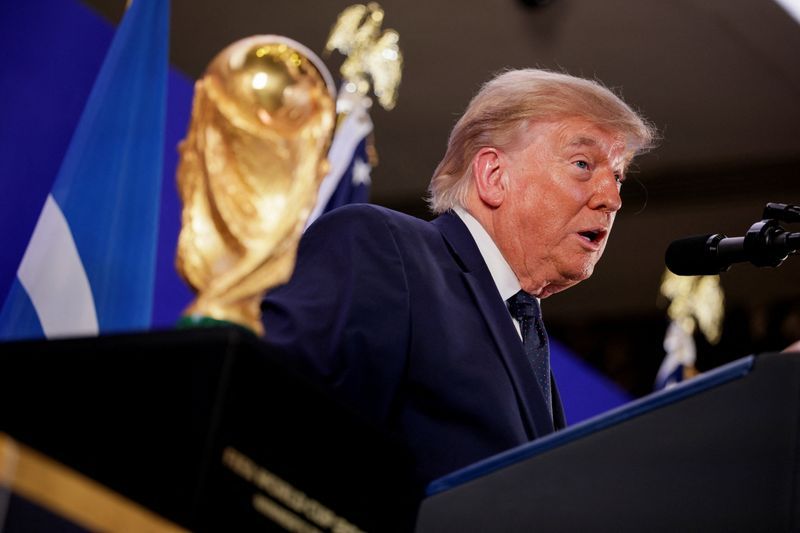
Donald Trump's presence at Sunday's World Cup final between Argentina and Spain at New York/New Jersey Stadium represents another chapter in his increasingly prominent role throughout a tournament that has become as defined by political theatre as by sporting excellence. FIFA President Gianni Infantino confirmed that Trump will sit alongside him during the match and present the trophy to the victors, reprising his role from last year's Club World Cup ceremony.
The United States President's appearance arrives at a particularly charged moment for the tournament. Days earlier, Trump publicly acknowledged that he had personally requested Infantino to reconsider the red card issued to American striker Folarin Balogun, a disclosure that ignited widespread debate about the integrity of match officiating and whether political influence was compromising the competition's fairness. Despite the firestorm, FIFA maintained that Trump exerted no influence over the subsequent decision to suspend Balogun's ban, a assertion that drew considerable scepticism from observers.
Trump and Infantino's mutual admiration was on full display at a lavish reception held Friday inside Trump Tower in Manhattan, where FIFA has maintained an office since the previous year. Before approximately 300 attendees—a gathering that included Brazilian football legend Ronaldo alongside various FIFA dignitaries—Infantino offered effusive praise for Trump's role in the tournament's unprecedented success. The World Cup has shattered attendance records, establishing itself as the competition's largest iteration to date. Trump reciprocated the compliments, remarking with evident satisfaction that America had proven itself fundamentally a soccer nation, a statement that underscored his investment in reshaping the nation's sporting identity.
The relationship between Trump and Infantino has weathered numerous controversies both preceding and during the tournament, which is being jointly hosted by Canada, Mexico, and the United States. One year before the competition commenced, American municipalities grappled with serious concerns about reassuring international visitors who harboured apprehensions regarding Trump's stringent immigration enforcement measures and travel restrictions targeting several nations. This tension highlighted the potential vulnerability of a major sporting event to geopolitical pressures and domestic political divisions.
As the tournament progressed, Trump escalated his involvement by threatening to relocate matches away from cities governed by Democratic administrations—a move that FIFA swiftly countered by asserting that such decisions fell entirely outside his purview. On Friday, Trump reiterated his ambitions for American soccer dominance by suggesting the United States should host the World Cup again in 2038, though he added a provocative condition: "This time we'll leave Mexico and Canada out." The remark, seemingly intended as humorous, reflected a deeper pattern of nationalist sentiment and raised uncomfortable questions about the collaborative spirit ostensibly central to international sporting cooperation.
Trump's escalating presence at major sporting events over the past eighteen months appears strategically calculated to counteract declining approval ratings throughout his second presidential term. His appearance at last year's Ryder Cup on Long Island generated precisely the reception he sought—enthusiastic cheers from the American crowd that energised his political base. However, his sporting visibility has yielded decidedly mixed results elsewhere. During Game 3 of the NBA Finals last month, he encountered loud booing from spectators. His attendance at last year's US Open men's tennis final at Flushing Meadows similarly sparked frustration among fans kept outside the venue well past the match's commencement owing to presidential security protocols.
The logistics of Trump's World Cup appearance present genuine operational challenges for American broadcaster Fox Sports, which relies on a global feed rather than producing its own match coverage. Play-by-play announcer John Strong articulated the fundamental dilemma facing broadcasters: since Fox receives a standardised international transmission, decisions about whether to include camera cutaways showing Trump seated beside Infantino and other dignitaries remain beyond the network's control. This arrangement creates an unusual situation where American viewers may encounter images of the President without the broadcaster having deliberately chosen to feature him—a circumstance that carries considerable implications for audience reception.
Strong's commentary highlighted the deeply polarised nature of Trump's public persona within America. He observed that "there are no neutral opinions" regarding the President, noting that segments of the television audience would welcome his presence at the final while others would prefer his absence from their screens. This observation captures a broader reality about Trump's role in contemporary American sports culture: his involvement automatically transforms any sporting event into a political statement, regardless of intent. The World Cup, conceived globally as a unifying force transcending national divisions, becomes instead a platform reflecting the fractious state of American political discourse.
The World Cup's American hosting rights themselves represent a point of considerable pride for Trump, who has repeatedly emphasised his instrumental role in securing the tournament for the United States, Canada, and Mexico during his first presidential term in 2018. That FIFA awarded the hosting rights during his administration has become a signature accomplishment he regularly invokes when discussing his sporting legacy. The 2026 tournament thus carries personal significance for Trump beyond its sporting dimensions, functioning as a validation of his abilities to deliver globally significant events—a narrative he has consistently leveraged in rebuilding his political standing.
For Malaysia and Southeast Asian observers, Trump's prominent role at the World Cup illustrates how major international sporting competitions have become increasingly intertwined with domestic political dynamics in host nations. The spectacle of a sitting president directly intervening in match officials' decisions—even if indirectly—raises uncomfortable questions about the autonomy of global sporting governance. It also reflects broader anxieties about whether international organisations can maintain independence when hosted by powerful political actors with vested interests in particular outcomes. As Southeast Asian nations continue developing their own sporting infrastructure and potentially bidding for major tournaments, the Trump example underscores the importance of establishing robust governance structures that insulate sporting integrity from political pressure.

