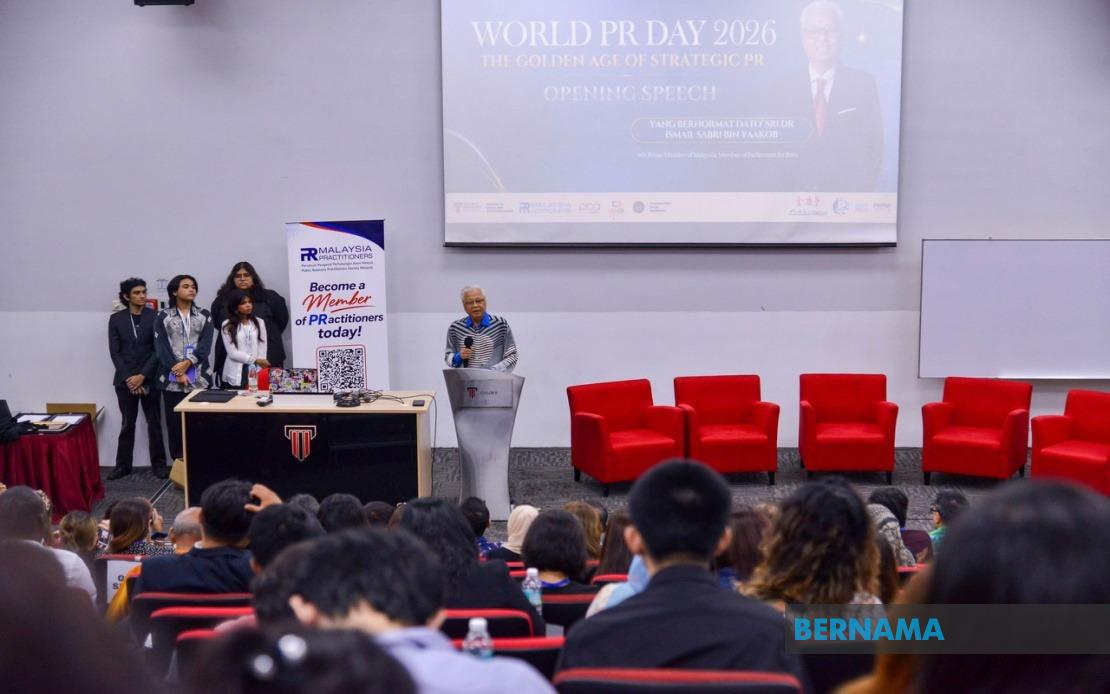
The modern challenge facing governments and organisations extends far beyond conventional economic rivalry, according to former Prime Minister Datuk Seri Dr Ismail Sabri Yaakob, who instead identifies a fundamental struggle for public confidence as the defining characteristic of contemporary leadership. Speaking at the launch of World PR Day 2026 celebrations at Taylor's University in Subang Jaya, Ismail Sabri articulated a vision of institutional success that transcends traditional metrics of achievement and performance. In his view, the capacity to sustain and strengthen public trust through transparent, honest dialogue has become the ultimate measure of organisational vitality in an interconnected world.
The distinction Ismail Sabri draws between the twentieth and twenty-first centuries carries profound implications for how Malaysian public institutions and private entities must operate going forward. Where past decades prioritised competitive economic advantage and market positioning, contemporary organisations face what he characterises as a competition centred entirely on trustworthiness. This reframing reflects a broader global recognition that stakeholder confidence—whether among citizens, consumers, employees, or investors—determines long-term viability more decisively than short-term financial returns or operational efficiency metrics alone.
The role of public relations professionals has undergone substantial transformation, moving beyond the historical function of simply disseminating prepared statements or announcements to the public. Modern PR practitioners, in Ismail Sabri's assessment, occupy a more influential strategic position within institutional hierarchies, serving as architects of organisational narrative and guardians of institutional reputation. This evolution acknowledges that how organisations communicate their values, decisions, and responses to challenges shapes external perceptions as fundamentally as their actual performance does. The implications extend across all sectors—government ministries, multinational corporations, nonprofit entities, and educational institutions increasingly recognise that communications strategy directly influences their credibility and social licence to operate.
Ismail Sabri's tenure as Prime Minister during the height of COVID-19 lockdowns and restrictions provides a concrete illustration of how communication quality determines policy effectiveness. The rapid succession of modifications to standard operating procedures created genuine public confusion and warranted scepticism about government direction. His daily media engagements were not mere formalities but essential interventions designed to clarify rationale, provide consistent updates, and maintain citizen confidence during an unprecedented period of uncertainty. This experience crystallised his understanding that transparent communication serves purposes far beyond information transfer—it functions as a vital mechanism for generating public acceptance of difficult decisions and sustaining societal cohesion during crises when institutional legitimacy faces maximum strain.
The integrity dimension proves particularly crucial in Malaysia's current media environment, where digital platforms have fractured traditional information hierarchies and empowered previously marginalised voices whilst simultaneously amplifying deliberate falsehoods. Ismail Sabri emphasises that communication grounded in honesty and moral principle represents the only sustainable foundation for institutional credibility. Without this integrity baseline, organisations inevitably face escalating scepticism, declining stakeholder engagement, and reputational damage that proves extraordinarily difficult to reverse once public trust erodes.
The technological revolution simultaneously offers unprecedented analytical capabilities and unprecedented threats to informational integrity. Ismail Sabri advocates for public relations professionals to develop sophisticated competency with artificial intelligence systems capable of rapid sentiment analysis and predictive modelling of public reaction. These tools, properly deployed, enable organisations to understand stakeholder concerns in near real-time and respond with greater precision and contextual awareness. However, this technological sophistication must remain subordinate to ethical principles and human-centred values rather than replace them as decision-making drivers.
The proliferation of sophisticated digital deception presents perhaps the most insidious contemporary challenge to trust-building efforts. Deepfake technology, manipulated imagery, synthetic media, and coordinated disinformation campaigns have created an information environment where distinguishing authentic from fabricated content requires sustained critical evaluation even from sophisticated audiences. For Malaysian organisations and institutions, this reality demands heightened vigilance regarding their own digital communications and greater transparency regarding sourcing and verification of information they distribute.
Ismail Sabri's endorsement of the government's proposed AI Governance Bill reflects recognition that technological regulation represents one essential component of protecting digital integrity and public discourse quality. Such governance frameworks can establish accountability mechanisms, define ethical boundaries for AI application, and provide legal consequences for deliberate misuse of artificial intelligence for deceptive purposes. However, regulatory approaches alone cannot remedy trust deficits; they must accompany broader cultural shifts emphasising honesty, transparency, and institutional accountability across both public and private sectors.
For Malaysian news organisations, corporate communicators, and government spokespersons, Ismail Sabri's intervention carries specific relevance as Southeast Asian societies navigate rapid digitalisation and rising information complexity. The region faces particular vulnerability to coordinated disinformation campaigns, foreign influence operations, and domestic bad-faith actors exploiting digital platforms to undermine institutional legitimacy. Building resilience against these threats requires that all institutional communicators embrace integrity not merely as a marketing differentiator but as a foundational operational principle.
The implications of Ismail Sabri's analysis extend to Malaysian civil society's ongoing debates regarding institutional reform, media regulation, and digital governance. His emphasis on trust competition suggests that institutions earning genuine public confidence through consistent integrity will ultimately prove more resilient and effective than those relying on propaganda, censorship, or information control to manage their public image. This perspective aligns with empirical research demonstrating that transparency and honest acknowledgement of institutional limitations generate stronger long-term stakeholder loyalty than defensive or evasive communication strategies.
Looking forward, Malaysian organisations across sectors would be well-advised to evaluate their communication practices against the integrity standard Ismail Sabri articulates. This assessment should encompass not only explicit messaging but also institutional alignment—whether actions consistently reflect stated values, whether leaders demonstrate accountability for mistakes, and whether communication genuinely serves stakeholder interests rather than merely protecting institutional reputation. Such honest self-evaluation provides the foundation for building the trust that, in the twenty-first century, represents the true competitive advantage.

