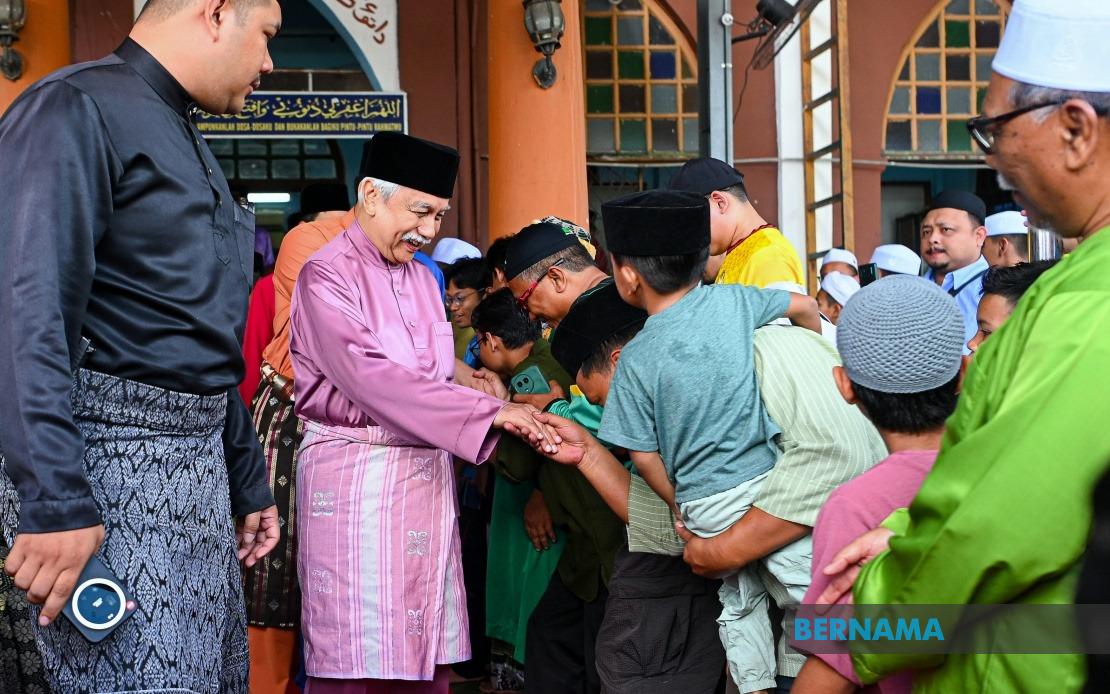
The Yang Dipertuan Besar Negeri Sembilan, Tuanku Muhriz Tuanku Munawir, participated in Friday prayers at Masjid Kariah Pantai in Seremban on July 17, attending the service alongside more than 500 congregants in a display of religious observance that underscores the constitutional role of Malay rulers as custodians of Islam in their respective states.
Accompanying the sovereign were his two sons, Tunku Besar Seri Menanti Tunku Ali Redhauddin and Tunku Zain Al-'Abidin, reflecting the royal family's commitment to participating in community religious activities. The presence of multiple family members at the congregation sends a symbolic message about the importance of maintaining Islamic traditions within the state's leadership hierarchy.
The occasion also drew several key figures from Negeri Sembilan's political and administrative establishment. Datuk Klana Petra Muhammad Faris Johari, the Undang of Luak Sungei Ujong, attended alongside Menteri Besar Datuk Seri Aminuddin Harun, indicating the coordinated engagement of state leadership in religious observances that remain central to Malaysia's constitutional framework and public life.
The imam leading the service, Amru Zubair Abu Hanifah, directed his sermon toward contemporary spiritual concerns, specifically addressing what he described as existing threats to faith. This thematic choice reflects broader conversations taking place across Malaysian religious institutions about safeguarding Islamic values amid rapid social and technological change, a conversation that extends across the region.
Following the conclusion of formal prayers, Tuanku Muhriz and his accompanying family members engaged directly with attendees, creating an informal space for interaction between the royal household and ordinary congregants. This practice of post-prayer engagement is emblematic of how constitutional monarchies in Malaysia maintain grassroots connections with their subjects, moving beyond ceremonial functions to demonstrate accessibility and personal involvement in community life.
The royal household's subsequent distribution of contributions to children present at the service illustrates a philanthropic dimension often integrated into such public appearances. These gestures, though modest in individual terms, reinforce the traditional role of Malay rulers as patrons and protectors of their communities, a responsibility that carries both symbolic and practical weight in Malaysian society.
For Negeri Sembilan specifically, such participation by the Yang Dipertuan Besar in congregational prayers carries particular significance given the state's distinctive constitutional position. As one of Malaysia's constituent states with its own sovereign ruler, Negeri Sembilan maintains a governance structure that integrates Islamic leadership more visibly than federal arrangements, making the ruler's religious participation a matter of considerable local importance.
The attendance of over 500 worshippers speaks to sustained interest in Friday prayers despite urbanization and competing demands on time and attention. In the Malaysian context, such turnout figures often reflect not only religious devotion but also the integration of prayer into the rhythm of weekly community life, particularly in smaller urban centers and traditional communities like Seremban.
The event also demonstrates the continued willingness of political leaders to position themselves within religious settings and activities. In Malaysia's multi-faith society, where Islam holds constitutional prominence but religious pluralism remains an operating reality, such public appearances by political figures at Islamic functions serve to acknowledge and affirm the religious dimension of the state's identity and governance structure.
Tuanku Muhriz's participation underscores the enduring relevance of constitutional monarchy in Southeast Asian governance, where the institution of the Malay rulers persists as a stabilizing force that bridges traditional authority with modern state structures. Through activities like leading Friday prayers, the Yang Dipertuan Besar performs a dual role as both temporal administrator and custodian of religious tradition.
The gathering at Masjid Kariah Pantai exemplifies how routine religious observances in Malaysia frequently intersect with political significance and state ceremony. What might appear in other contexts as a straightforward congregational prayer becomes in the Malaysian context a performance of state identity, religious commitment, and community leadership that carries meanings extending well beyond the immediate spiritual act.

