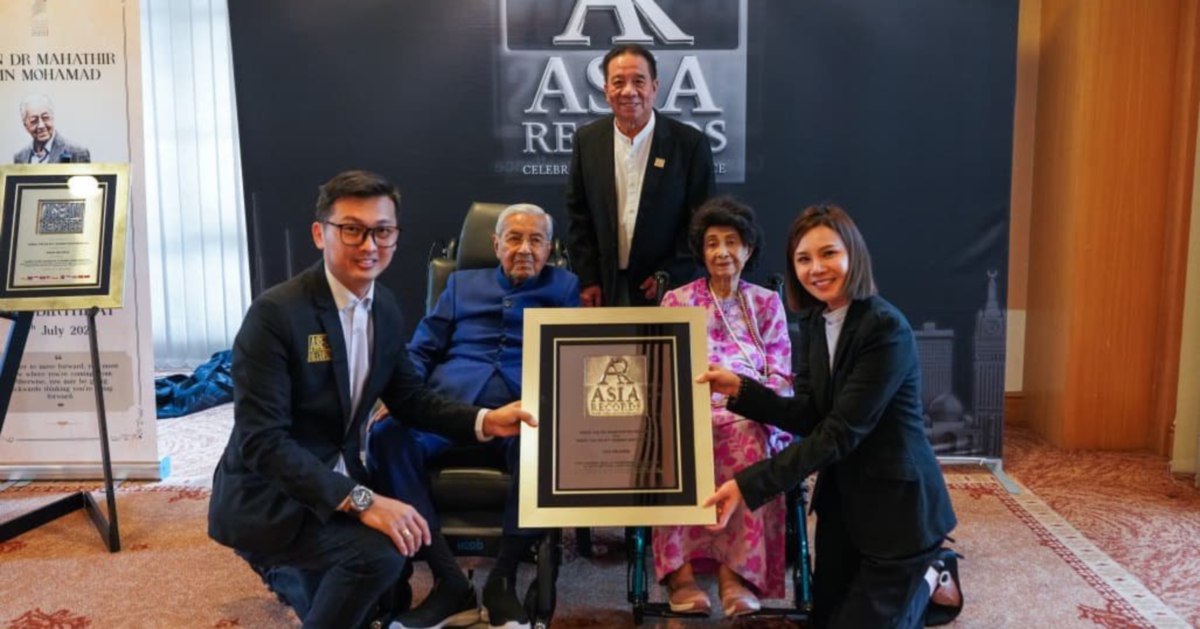
Former Prime Minister Tun Dr Mahathir Mohamad and his wife Tun Dr Siti Hasmah Mohd Ali have etched themselves into the historical record as Malaysia's most celebrated centenarian couple, receiving three official recognitions that underscore their extraordinary longevity and collective contributions to the nation.
The conferral of these formal distinctions marks a significant moment in Malaysian public life, honouring not merely the passage of years but the sustained influence and relevance both have maintained throughout their respective careers and beyond. Tun Dr Mahathir's tenure as Prime Minister spanning two decades fundamentally shaped modern Malaysia's economic trajectory and geopolitical positioning, while Tun Dr Siti Hasmah carved her own distinguished legacy as a medical professional and advocate for social welfare, particularly in championing health initiatives and women's empowerment.
The recognition speaks to a deeper narrative about longevity in public service and the enduring partnership between two individuals who witnessed and shaped pivotal transformations in the nation's development. Their combined experience spans from Malaysia's post-independence period through the subsequent decades of rapid industrialisation, technological advancement, and shifting global dynamics. This continuity of perspective offers invaluable institutional memory at a time when Malaysia faces complex developmental challenges requiring wisdom drawn from historical experience.
Tun Dr Siti Hasmah's own accomplishments deserve particular attention within this recognition. Beyond her role as a supportive partner, she established an independent professional standing as a medical doctor and public health advocate. Her contributions to the welfare sector and her consistent presence at the forefront of social initiatives demonstrated that her significance extended well beyond ceremonial duties, establishing her as an influential figure in her own right within Malaysian society.
For Malaysian readers, this achievement represents something culturally resonant beyond mere statistics. The celebration of a centenarian couple speaks to values of resilience, partnership, and dedication to service that remain central to Malaysian identity. In an era where rapid social change often leaves older generations feeling marginalised, the continued recognition of Tun Dr Mahathir and Tun Dr Siti Hasmah's contributions affirms that experience and longevity carry tangible value within contemporary society.
The regional dimension of this recognition also merits consideration. Within Southeast Asia's broader context, Malaysia's narrative of stable governance and institutional continuity—embodied significantly by Tun Dr Mahathir's extended tenure and his subsequent political involvement—has provided a counterpoint to instability experienced elsewhere in the region. The recognition of this continuity through honouring its most prominent architects carries implications for how the region views governance, succession planning, and the role of elder statesmen in democratic systems.
From a public health perspective, the existence of a centenarian couple in contemporary Malaysia reflects improvements in healthcare delivery, living standards, and lifestyle factors achieved across the nation since independence. Their longevity becomes a statistical marker of collective advancement—that Malaysia has created conditions allowing its citizens to age healthily and actively. This achievement contrasts with earlier periods when such lifespans were considerably rarer, demonstrating measurable progress in public wellbeing.
The symbolic weight of these records extends to questions about succession and institutional knowledge transfer. As Malaysia navigates contemporary challenges ranging from economic restructuring to demographic shifts, the presence of figures who have witnessed and participated in previous transformations provides both grounding and cautionary lessons. Their continued engagement signals that wisdom gained through historical experience remains relevant to current policymaking, even as new voices and approaches reshape the national agenda.
For younger Malaysians, this recognition offers an opportunity to engage with living history. Tun Dr Mahathir and Tun Dr Siti Hasmah represent not abstract historical figures but individuals who continue to participate in public discourse and national reflection. Their accessibility as living exemplars of Malaysia's post-independence journey provides a direct connection to formative periods that might otherwise remain distant or poorly understood.
The celebration of their achievements also prompts reflection on gender dynamics within public life. While Tun Dr Mahathir occupied Malaysia's highest executive office, Tun Dr Siti Hasmah's parallel professional achievements in medicine and social welfare demonstrated that influence and significance need not correlate strictly with formal political position. Her recognition alongside her husband affirms diverse pathways to meaningful contribution and lasting impact on national development.
Looking forward, the establishment of these records creates a framework through which Malaysia positions itself internationally as a nation that values continuity, institutional experience, and the productive role of elder statesmen within democratic systems. At a time when global discourse often emphasises generational replacement, Malaysia's recognition of this centenarian couple suggests a more nuanced approach that balances innovation with accumulated wisdom.
These official recognitions ultimately serve as markers of both individual achievement and national progress. They commemorate two lives lived with purpose and consequence, while simultaneously reflecting Malaysia's journey toward becoming a society where extended, active lifespans are achievable and increasingly common. In honouring Tun Dr Mahathir and Tun Dr Siti Hasmah, Malaysia honours not only their specific contributions but the broader possibilities for human flourishing that economic development and social progress have enabled.

