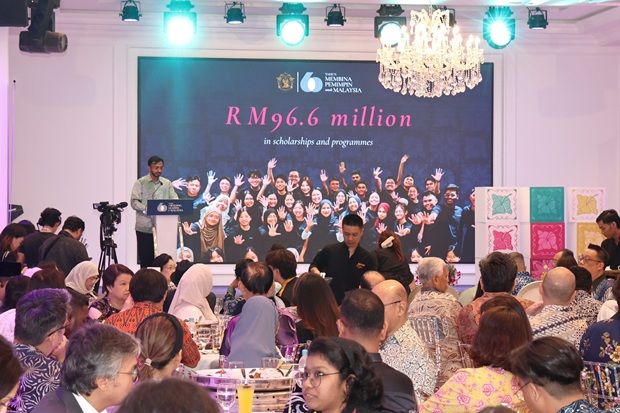
The Tunku Abdul Rahman Foundation (YTAR) commemorated six decades of nation-building through education at a ceremonial gathering on August 13 at Bangunan Sultan Abdul Samad, bringing together generations of stakeholders who have sustained one of Malaysia's most enduring institutional commitments to youth development. The milestone represents not merely the passage of time but a continuous thread of investment in human capital that has woven through the country's post-independence trajectory, shaping leaders across medicine, law, the civil service, and the creative industries.
The foundation's origins reveal a remarkable chapter in Malaysian philanthropic history. In 1964, citizens mobilised through Utusan Melayu to establish an education fund honouring Malaysia's first Prime Minister, Tunku Abdul Rahman Putra al-Haj. This grassroots crowdfunding campaign accumulated more than M$60,170.20—equivalent to approximately RM380,000 in contemporary economic terms—demonstrating genuine public conviction in the transformative potential of education. The following year, the Education Minister at the time, Tan Sri Mohamed Khir Johari, moved to formalise this community initiative by proposing the establishment of Yayasan Tunku Abdul Rahman through the Tunku Abdul Rahman Foundation Fund Act 1966 (Act 43). This legislative transformation elevated what had begun as a spontaneous civic gesture into a sustained institutional mechanism for expanding educational opportunity across the nation.
Throughout its operational life, YTAR has extended support to over 12,000 Malaysian youths across all ethnic and religious backgrounds, functioning as a primary vehicle for enabling pursuit of higher education both domestically and internationally. The foundation has channelled RM96.6 million through scholarships, loans, grants, and employability programmes, each iteration of support reflecting evolving understandings of what youth empowerment entails. Beyond the initial scholarship awards that characterised the institution's early decades, YTAR has progressively developed a more comprehensive framework encompassing talent identification, skills development, and pathways to meaningful employment. This evolution acknowledges that financial assistance, while foundational, represents only one dimension of enabling young people to realise their potential.
At the anniversary ceremony, National Unity Minister Datuk Aaron Ago Dagang emphasised the foundation's expanded remit in contemporary society. He articulated YTAR's transition from a scholarship-dispensing body into a more dynamic institution engaged in identifying talent, creating access pathways, and nurturing existing capabilities among Malaysian youth. This reframing carries particular significance for the corporate sector, which Dagang explicitly called upon to integrate education and talent development into their corporate social responsibility frameworks. Such appeals reflect broader recognition that demographic and economic pressures facing Malaysia necessitate genuine partnership between public institutions, civil society foundations, and commercial enterprises in cultivating the next generation of workers and leaders.
The foundation's continued relevance rests substantially on the testimonies of its early beneficiaries, whose trajectories over sixty years embody the institution's impact. Ch'ng Kim See, among the earliest scholarship recipients in 1967, has emerged as one of Malaysia's most distinguished librarians with regional standing in Southeast Asian history and library science. She described the scholarship's arrival during financial hardship as transformative, enabling her to persist through her university years despite having exhausted other funding sources. Her subsequent commitment to mentoring and supporting others reflects a pay-forward ethos that extends the foundation's legacy beyond individual advancement into broader community stewardship.
Another pioneering recipient, Dr Zakaria Ali, became one of Malaysia's foremost figures in fine arts, establishing himself as painter, writer, and academic leader in the creative disciplines. His pathway to the scholarship was itself instructive, emerging from the advocacy of an American instructor who recognised his potential while Zakaria worked as a processing assistant. This instructor's correspondence to the King, the education minister, and the prime minister—itself a testament to faith in institutional responsiveness—eventually secured Zakaria's interview and award. His reflective gratitude six decades later underscores how individual scholarship awards, when granted to persons of genuine talent and commitment, generate outsized returns to national cultural and intellectual life.
Datin Sri Sharifah Menyalara Syed Hussein, the foundation's chairperson and granddaughter of the late Tunku Abdul Rahman, articulated a philosophical understanding of educational investment that transcends exam results and degree attainment. She emphasised that Tunku's conception of education as the nation's foundation concerned not merely academic achievement but the cultivation of character, purpose, and the capacity for meaningful societal contribution. This framing provides conceptual ballast for YTAR's evolution beyond loan provision into talent identification and values development. The distinction carries weight particularly in an era of rapid technological change, where technical skills alone prove insufficient without the ethical grounding and collaborative sensibility that distinguish leaders capable of addressing complex national challenges.
The foundation's evolution from a post-independence initiative focused on enabling overseas tertiary education to a contemporary institution addressing employability and skills gaps reflects shifting demographic and economic contexts. In 1964, Malaysia's university capacity was negligible and overseas study represented the primary pathway to professional qualification. Contemporary Malaysia possesses substantially expanded local higher education infrastructure yet faces persistent concerns regarding graduate employment readiness and skills alignment with labour market demands. YTAR's expansion into employability programming addresses this gap, partnering with youths to bridge the transition from educational completion to career establishment—a particularly acute challenge in an economy where credential inflation has rendered tertiary qualification increasingly essential yet insufficient for employment security.
The ceremonial recognition of early scholarship recipients served both commemorative and inspirational functions. By honouring individuals like Ch'ng and Zakaria before a contemporary audience, YTAR demonstrated tangibly that foundation investments yield enduring dividends. Both recipients subsequently shaped their respective professional fields and mentored subsequent generations, multiplying the institution's impact across decades. Their presence at the anniversary gathering embodied continuity and legitimacy, reassuring current and prospective beneficiaries that educational investment through YTAR leads not merely to individual advancement but to leadership positions from which beneficiaries subsequently contribute to national development.
National Unity Minister Aaron Ago's announcement regarding the 2026 Pingat Tunku Award reflected institutional commitment to evolving selection mechanisms and broadening access. The introduction of self-nomination alongside institutional recommendations, coupled with explicit inclusion of both public and private university graduates, signals intent to democratise recognition and reduce barriers to participation. This procedural innovation acknowledges that talent and achievement are distributed across Malaysia's diverse educational landscape and that formal gatekeepers sometimes miss exceptional individuals operating outside traditional pathways. Such methodological adjustments, while administrative in appearance, constitute meaningful signals about institutional values regarding inclusivity and meritocratic principle.
The foundation's sixty-year trajectory illuminates broader patterns in Malaysian nation-building. YTAR exemplifies institutions created during the early post-independence period that embedded explicit commitments to equitable opportunity across ethnic and religious lines, operationalising the nation's constitutional pledges regarding education and equality. That the foundation has maintained this commitment across six decades, adapting its mechanisms while preserving its foundational principles, demonstrates both the resilience of well-designed institutions and the sustaining power of widely-held beliefs regarding education's transformative potential. As Malaysia confronts contemporary challenges including income inequality, skills deficits, and regional competition for talent, YTAR's model—combining financial support with mentorship, skills development, and values cultivation—offers instructive lessons regarding sustainable approaches to human capital development.
Looking forward, YTAR's continued evolution will likely respond to Malaysia's positioning within the regional and global knowledge economy. The foundation's expansion of nomination procedures for the Pingat Tunku Award, coupled with its emphasis on employability programming, suggests recognition that educational investment must increasingly address not merely access to qualifications but preparation for careers in rapidly transforming labour markets. Regional competition for talent will intensify, as Singapore, Thailand, and increasingly Indonesia develop their own mechanisms for identifying and retaining high-potential youth. YTAR's role as both a financial institution and a values-bearer—embodying commitment to character development and national purpose alongside technical capability—positions it distinctively within this competitive landscape, offering something beyond mere credential acquisition.

