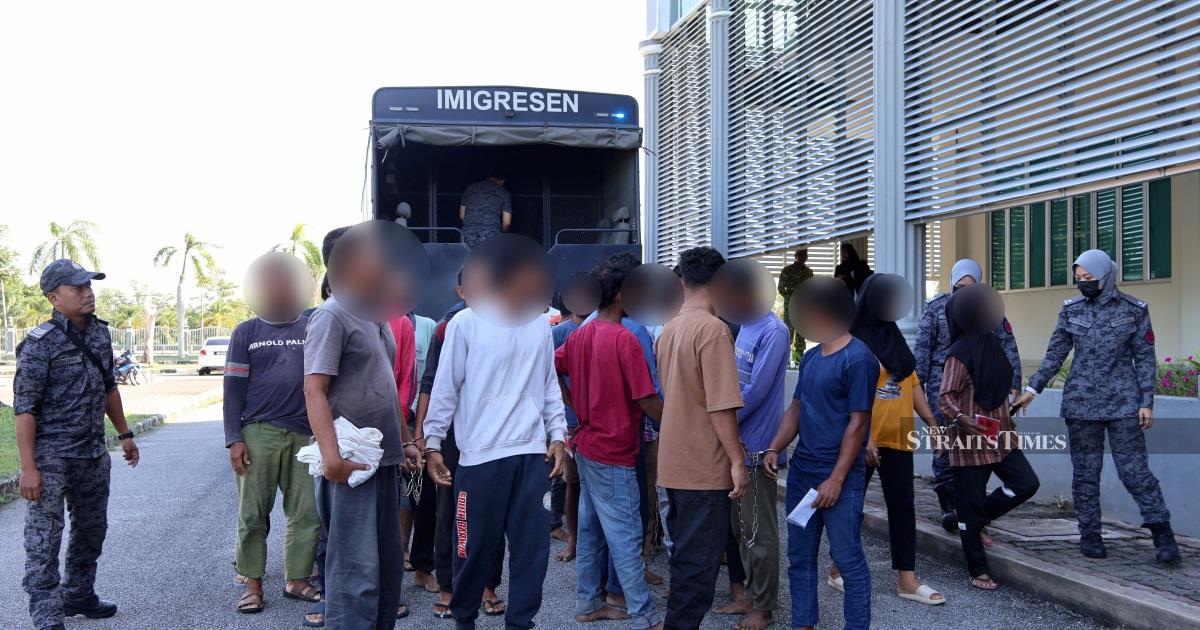
A Sessions Court in the northern Kelantan district of Pasir Mas delivered guilty verdicts and substantial financial penalties against 29 undocumented migrants on charges related to irregular migration. The court imposed fines spanning RM1,000 to RM10,000 on the defendants after they acknowledged committing offences including illegal entry into Malaysian territory, unauthorised residence beyond visa expiry, and misuse of travel documentation.
The case reflects ongoing immigration enforcement efforts in Malaysia, a nation that has long grappled with managing irregular migration across its porous land and maritime borders. Kelantan, situated on Malaysia's northeastern frontier adjacent to Thailand, has historically served as a transit corridor for migrants seeking employment or passage into the country through informal channels. The concentration of illegal entry cases in border regions like Pasir Mas underscores the persistent challenges immigration authorities face in controlling undocumented population movements.
The offences of which these individuals were convicted carry significant legal consequences under Malaysia's immigration framework. Illegal entry represents a breach of the Immigration Act 1959/63, while overstaying constitutes a violation of visitor permit conditions. Misuse of travel documents, a particularly serious charge, involves fraudulent deployment of forged, altered, or illegally obtained identification or visa materials. These violations are treated with increasing severity as Malaysian enforcement agencies prioritise border security and labour market regulation.
The financial penalties imposed demonstrate the court's graduated response to immigration violations, reflecting both the severity of individual cases and the circumstances of each defendant. Fines at the lower end of the spectrum typically apply to first-time offenders or those caught shortly after illegal entry, while maximum penalties target individuals with multiple infractions or evidence of organised smuggling involvement. This tiered approach aims to serve as both punishment and deterrent, signalling to prospective migrants the genuine costs of circumventing legal immigration procedures.
Malaysia's approach to irregular migration enforcement has intensified in recent years amid growing public concerns about unauthorised workers competing for employment, strains on public services, and security vulnerabilities. The country hosts one of Southeast Asia's largest undocumented migrant populations, with estimates suggesting hundreds of thousands of irregular workers across manufacturing, construction, agriculture, and domestic sectors. Enforcement operations like the Pasir Mas prosecutions form part of a broader strategy combining border controls, workplace raids, and judicial action to manage this phenomenon.
The conviction of these 29 individuals also carries implications for broader migration policy discourse within Malaysia and the region. Policymakers and civil society organisations continue debating whether punitive measures alone adequately address root causes of irregular migration, including economic disparities between Malaysia and neighbouring countries, weak employment verification systems, and demand from businesses seeking low-cost labour. Some advocate complementary approaches involving regularisation programmes, improved bilateral agreements with source countries, and labour market reforms.
From a Southeast Asian perspective, migration patterns reflect the region's economic asymmetries and labour mobility pressures. Malaysia, as a relatively wealthier nation with significant sectoral labour shortages, attracts migrants from lower-income neighbours including Bangladesh, Myanmar, Indonesia, and Cambodia. While official channels exist for temporary worker programmes, the complex documentation requirements, costs, and employer recruitment practices often push desperate individuals toward illegal pathways. The Pasir Mas case exemplifies how individuals at the margins of formal labour markets become caught in enforcement actions.
The court proceedings in Pasir Mas also highlight the administrative and judicial burden of processing migration violations. Sessions Courts across Malaysia handle substantial caseloads of immigration-related offences annually, consuming resources that could address other criminal matters. This raises questions about enforcement efficiency and whether the current system effectively balances punishment with rehabilitation and reintegration, particularly for migrants whose primary motivation was economic survival rather than criminal intent.
For Malaysian employers relying on migrant labour, heightened enforcement creates both compliance obligations and operational risks. Businesses utilising undocumented workers face significant penalties and reputational damage, creating incentives to formalise employment relationships. However, structural barriers including bureaucratic complexity and worker availability constraints mean some sectors continue employing irregular labour despite legal jeopardy. The Pasir Mas convictions serve as a reminder of these risks.
Looking forward, Malaysia's immigration authorities will likely maintain enforcement pressure on irregular migrants and smuggling networks. The Pasir Mas case, though seemingly routine in its legal mechanics, represents one data point within a much larger migration management challenge spanning enforcement, policy innovation, and regional cooperation with source and transit countries. The substantial fines imposed signal government commitment to immigration law compliance, though broader solutions addressing why migrants undertake illegal border crossings remain contested among policymakers.

