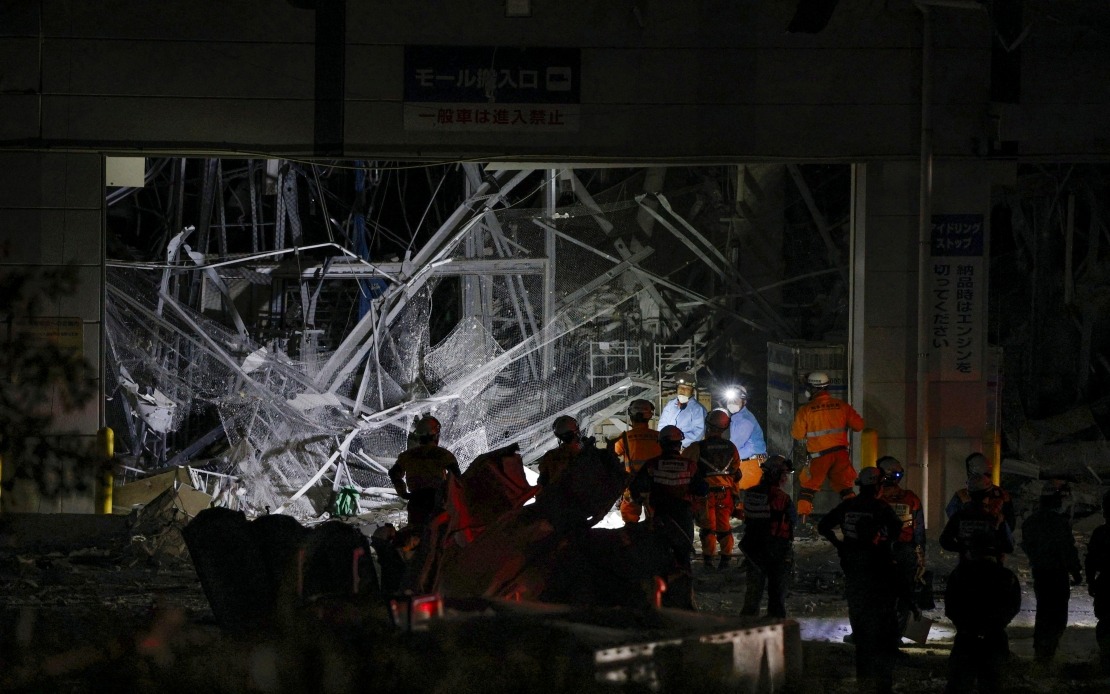
A catastrophic chain of events unfolded in southwestern Japan when a magnitude-7.1 earthquake struck Kumamoto Prefecture on Tuesday afternoon, followed by a devastating explosion at Aeon Mall Kumamoto in Kashima hours later, leaving at least two women dead and raising fears about others still trapped within the damaged structure. The blast, suspected to have resulted from a gas leak triggered by the initial tremor, has mobilised an extensive emergency response involving thousands of personnel across the disaster zone.
The earthquake struck at approximately 4:27 pm local time, prompting immediate evacuation of the shopping complex. Aeon Co., the mall's operator, confirmed that employees and customers were successfully evacuated following the initial quake, with approximately 200 people safely leaving the premises. However, the situation deteriorated dramatically more than 30 minutes after this initial evacuation when the explosion occurred, catching rescue workers and authorities off guard despite the mall's evacuation protocols. The operator's headquarters in Chiba later stated that a person in charge had reported complete evacuation based on visual confirmation, making the subsequent explosion all the more shocking.
The destruction wrought by the blast has proven extensive and troubling. Structural damage to the mall includes collapsed ceilings and walls that have compromised the integrity of the entire second floor, with debris scattered throughout the complex and the building's steel frame now exposed. The Fire and Disaster Management Agency has expressed serious concern that multiple individuals remain trapped within the damaged structure, unable to escape following the collapse. Communications from individuals stranded inside the building to employees indicate that several people are awaiting rescue, though the exact number remains unclear.
Witnesses to the explosion painted a vivid picture of the disaster's immediate aftermath. A local hair salon owner, aged 44, described hearing a loud noise resembling a collision between a large vehicle and an immovable object. Within moments, he observed a prominent plume of white smoke rising from the shopping complex, a visible marker of the magnitude of the blast. The visual and auditory evidence gathered from eyewitnesses has helped authorities piece together the sequence of events and the severity of the incident.
Additionally complicating the rescue effort is a troubling pattern of human behaviour during the evacuation. Some shoppers who initially fled the mall in the immediate aftermath of the earthquake reportedly returned to the building, potentially placing themselves in greater danger when the explosion subsequently occurred. This return to an unstable structure underscores the psychological dynamics of disaster response and the challenges faced by evacuees uncertain about the extent of danger or the permanence of evacuation orders.
The search and rescue operation has become one of the largest mobilisation efforts in the region, with Defence Minister Shinjiro Koizumi announcing that approximately 3,600 Self-Defence Forces personnel have been deployed across the earthquake-affected area. The SDF has been directly engaged in rescue operations at the Aeon Mall site, coordinating with local emergency services and the Fire and Disaster Management Agency to locate and extract survivors from the wreckage. The scale of this military involvement reflects the severity of the situation and the government's determination to locate all missing persons.
Authority investigations have established a probable cause for the explosion. A government source has indicated that a gas leak following the earthquake likely triggered the blast. Such incidents are not uncommon in earthquake scenarios, where ruptures in underground gas pipelines or building-level gas connections create hazardous conditions. The passage of time between the initial earthquake and the explosion—more than 30 minutes—suggests that the gas accumulated to a critical concentration before igniting, whether through residual electrical systems, sparks from structural movement, or other ignition sources.
The location of the mall on the outskirts of Kumamoto city has meant that surrounding businesses and residential areas have also been affected by the explosion and emergency response. The incident has reverberated through the local economy and community, with neighbouring establishments like the mentioned hair salon bearing witness to the disaster and potentially experiencing damage or disruption themselves. This broader impact extends beyond the immediate shopping complex to encompass the wider Kashima commercial district.
For regional observers in Southeast Asia, the Kumamoto incident serves as a sobering reminder of the cascading hazards that earthquakes can trigger. Japan, sitting atop multiple tectonic plates, experiences frequent seismic activity, and the country's building codes and emergency protocols are among the world's most advanced. Yet despite these precautions, the combination of earthquake damage to gas infrastructure and the challenges of evacuating large commercial spaces within narrow timeframes continues to pose significant risks. The incident highlights how secondary disasters—gas explosions, structural collapses, fire hazards—can prove equally lethal to the primary earthquake itself, and how rescue operations must adapt to evolving dangers rather than assuming the crisis ends when the ground stops shaking.

