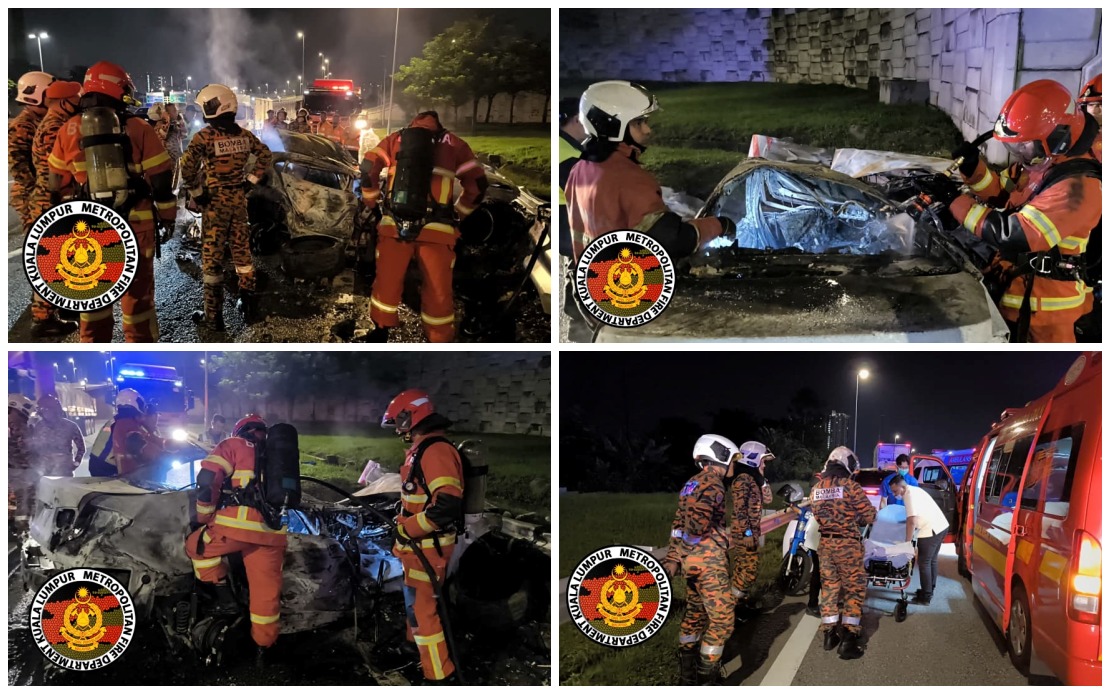
A tragic incident on one of Kuala Lumpur's busiest expressways claimed the lives of two young Malaysian students in the early hours of Wednesday, leaving their families devastated and raising fresh concerns about road safety on the city's arterial routes. The collision occurred at the Jalan Kuching exit ramp on the Duta-Ulu Kelang Expressway, where a BMW 328i Sport veered into the roadside barrier before becoming engulfed in flames that proved fatal for two of its three occupants.
According to Kuala Lumpur Traffic Investigation and Enforcement Department chief ACP Mohd Zamzuri Mohd Isa, the vehicle was traversing from Jalan Duta towards Selayang when the incident unfolded. Preliminary findings suggest that excessive speed was a contributing factor, with the driver losing command of the vehicle before it struck the left divider barrier. The impact triggered a fire that rapidly consumed the car, trapping the two front-seat passengers inside. By the time emergency responders arrived at the scene, both had succumbed to the flames.
The two fatalities were identified as a 22-year-old male driver enrolled at Queensland University of Technology in Australia and a 21-year-old male front passenger studying at Sunway University. Both young men were Malaysian nationals with their lives ahead of them—one pursuing advanced studies abroad, the other engaged in local tertiary education. The sudden loss of students from two different academic institutions has sent shockwaves through university communities and underscores the unpredictable nature of traffic disasters that can strike without warning.
A third occupant, identified as a 20-year-old male student from Singapore, managed to escape the burning wreckage with only minor injuries. He received immediate medical attention at Kuala Lumpur Hospital and is expected to recover. His survival provides crucial eyewitness testimony that authorities are now leveraging to reconstruct the sequence of events leading to the crash. Police have already begun recording comprehensive statements from the survivor, whose account may prove instrumental in understanding exactly what transpired during those final moments before impact.
The investigation has entered its intensive phase with multiple forensic and technical dimensions underway. Because the two victims were severely charred by the intense fire, authorities will rely on DNA analysis to confirm their identities—a time-consuming but necessary procedure in cases involving severe burning. Simultaneously, traffic investigators are scrutinizing closed-circuit television footage from cameras positioned along the expressway corridor, hoping to capture images of the vehicle's trajectory and the moments immediately preceding the collision. This multi-layered investigative approach reflects standard protocol for serious traffic fatalities in Malaysia.
The incident is being pursued as a formal case under Section 41(1) of the Road Transport Act 1987, legislation that governs serious traffic violations resulting in death or injury. This classification suggests investigators are exploring whether criminal culpability exists beyond simple accident designation—a critical distinction that may ultimately shape charges or recommendations brought against any identified responsible parties. For the families of the deceased, such legal proceedings represent both a search for accountability and a mechanism for understanding how their loved ones came to perish.
The DUKE expressway, stretching between Duta and Ulu Kelang, is a critical arterial route serving tens of thousands of commuters daily. The Jalan Kuching exit ramp, where this tragedy unfolded, represents a point where traffic patterns shift and driver attention becomes particularly important. The fact that a high-powered BMW encountered problems at this location suggests that whatever sequence of events led to the crash, the consequences were amplified by the vehicle's speed and the instantaneous nature of the impact and fire.
Speed-related incidents continue to plague Malaysian expressways despite sustained public education campaigns and enforcement initiatives. Young drivers, in particular, sometimes underestimate the risks of traveling at excessive velocities, especially during early morning hours when traffic volumes are lower and the temptation to accelerate increases. The absence of congestion, paradoxically, can breed overconfidence and recklessness—a pattern that may have contributed to this particular tragedy. Whether this crash involved deliberate speeding or a momentary lapse in judgment remains part of ongoing investigations.
Police are actively soliciting public assistance to supplement their investigation. Members of the public who witnessed the incident or possess relevant dashcam footage are being urged to come forward. Such community engagement often proves invaluable in traffic cases, as civilian witnesses and vehicle recordings can provide perspectives and angles that fixed infrastructure cameras might miss. The appeal extends to any nearby police stations, recognizing that information may come from sources across the metropolitan area rather than exclusively from the immediate crash vicinity.
The incident serves as a sobering reminder of the fragility of life on Malaysian roads and the devastating consequences that can unfold in mere seconds when vehicles collide at high velocity. For Queensland University of Technology and Sunway University, the loss represents a tragedy felt across their respective communities. For the survivor, bearing witness to the deaths of his companions will likely leave lasting psychological imprints. For road safety authorities, it represents another data point in their ongoing effort to reduce the carnage that claims thousands of lives annually across Malaysian transportation networks.

