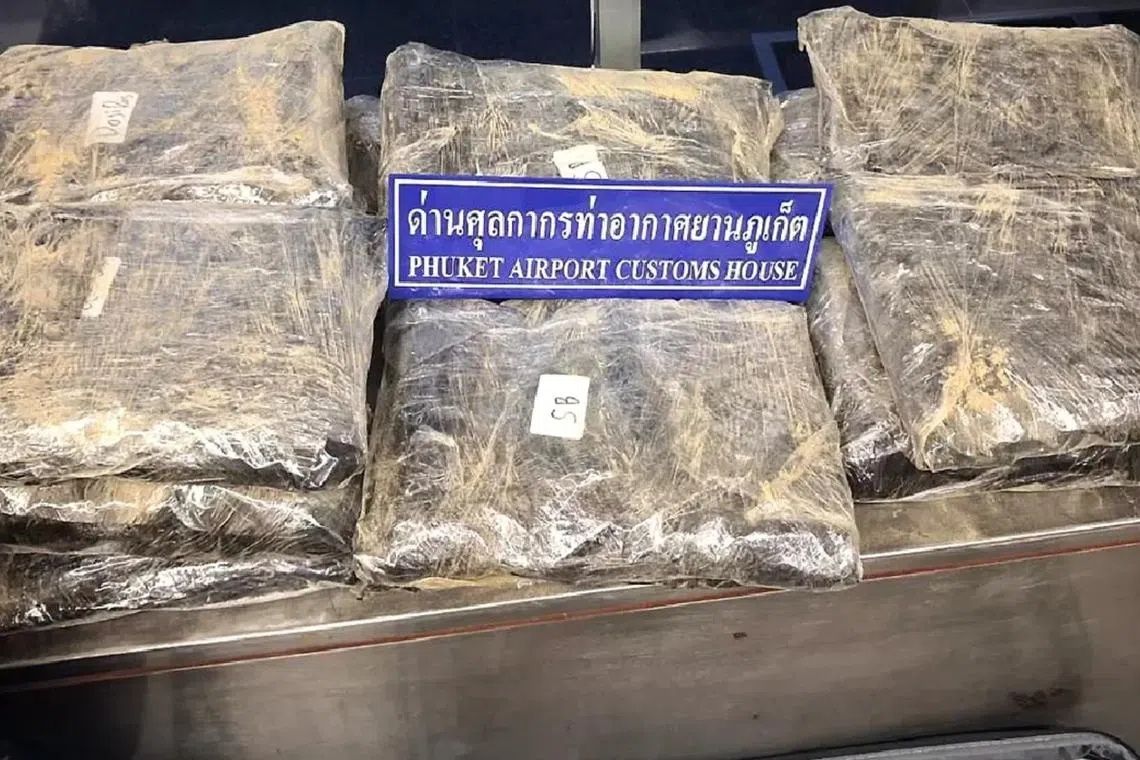
Two women were detained at Phuket International Airport after customs officers uncovered a significant quantity of cannabis concealed within their luggage during separate inspections on Thursday, July 9. Working in coordination, personnel from Phuket Airport Customs House and officers from Sakhu Police Station intercepted the suspects in the international departures terminal. The seizures totalled more than 32 kilograms of cannabis flowers, marking a notable interception in Thailand's ongoing enforcement against drug trafficking through its international gateways.
The first incident unfolded around 11 in the morning when customs officials examined a black Pierre Cardin wheeled suitcase belonging to 18-year-old Levannah Chelsea Guzman, a Filipino national. Inside the bag, inspectors discovered 14 vacuum-sealed packages containing cannabis flowers. When weighed together with their packaging materials, the total haul from this single suitcase reached 14.5 kilograms. Upon questioning, Guzman provided a statement acknowledging her ownership of both the suitcase and all items found within it, according to official records.
The second arrest occurred roughly two hours later, at approximately 1 in the afternoon, when authorities became suspicious of a green Swish Navy wheeled suitcase belonging to Penpitcha Phutsiang, a Thai national. Opening the bag revealed 16 additional vacuum-sealed packages of cannabis flowers totalling 17.6 kilograms in combined weight. Like her counterpart, Phutsiang admitted during interrogation that she was the rightful owner of the suitcase and its contents. Both suspects were subsequently transported to Sakhu Police Station for formal processing and legal disposition.
The charges brought against each woman reflect Thailand's comprehensive legislative framework governing narcotic substances and international trade. Both individuals faced accusations under the Customs Act BE 2560 (2017) for attempting to transport goods—specifically cannabis flowers—across national borders without completing mandatory customs declaration and inspection procedures. These foundational charges establish the administrative violation of attempting to export controlled substances without proper authorisation or documentation. The severity of the situation escalated through additional charges applied under the Narcotics Code, which carries substantially more punitive sanctions than customs violations alone.
Thailand's regulatory approach to cannabis has evolved considerably in recent years, and the enforcement apparatus reflects this shifting landscape. The charges reference the Protection and Promotion of Traditional Thai Medicine Wisdom Act BE 2542 (1999), legislation originally designed to protect and legitimise traditional herbal remedies within Thailand's medical heritage. More recent application includes reference to the Public Health Ministry's notification on controlled herbs concerning cannabis issued in 2025, indicating that Thai authorities have developed specific regulatory guidance addressing the complex status of cannabis in contemporary society. This layered charging approach demonstrates how Thai prosecutors utilise multiple statutory frameworks simultaneously to maximise legal leverage in drug-trafficking prosecutions.
The timing of these arrests reflects broader institutional priorities within Thailand's aviation security apparatus. Airport customs operations have intensified their scrutiny of outbound passengers and baggage in recent months, responding to intelligence suggesting that illegal cannabis trafficking remains a persistent vulnerability at international departure points. These enforcement operations operate under heightened operational awareness, with officers trained to identify suspicious luggage characteristics, unusual packing methods, and passenger behaviour consistent with trafficking attempts. The successful detection of both shipments on the same day suggests that heightened vigilance is yielding tangible results.
For Malaysia and other Southeast Asian nations, the Phuket incident carries important implications regarding regional drug enforcement cooperation. Thailand's position as a regional transportation hub makes its airport security measures relevant to neighbouring countries managing transnational criminal activity. Cannabis trafficking through air routes often involves coordination across multiple jurisdictions, with shipments transiting through regional airports including Kuala Lumpur International Airport. The successful interception at Phuket suggests that enhanced screening at major regional airports can disrupt trafficking networks, providing a baseline for evaluating similar operations elsewhere in Southeast Asia.
The characterisation of Levannah Chelsea Guzman as an 18-year-old Filipino national raises questions about recruitment patterns in international drug smuggling. Trafficking networks frequently engage young individuals, particularly those from economically disadvantaged backgrounds, as couriers because they may appear less suspicious to authorities and carry reduced sentence exposure compared to adult offenders. Penpitcha Phutsiang's status as a Thai national, by contrast, suggests the operation may have involved both foreign and domestic participants, potentially indicating a locally-organised smuggling cell utilising regional travel networks.
The quantities seized—14.5 kilograms and 17.6 kilograms respectively—represent wholesale-level drug quantities rather than personal consumption amounts. These volumes indicate the contraband was intended for distribution markets rather than individual use, establishing the purely commercial nature of the trafficking enterprise. The vacuum-sealing methodology employed for packaging demonstrates operational sophistication in concealment technique, though ultimately unsuccessful against modern customs inspection procedures. The packaging approach suggests organised trafficking operations rather than improvised or amateur attempts.
Cannabis regulation across Southeast Asia remains inconsistent, creating enforcement challenges that trafficking networks exploit. While Thailand has partially decriminalised cannabis under specific medical and traditional medicine circumstances, neighbouring jurisdictions maintain stricter prohibitions. This regulatory inconsistency generates arbitrage opportunities for smugglers, who can exploit differentials in legal status and enforcement intensity between neighbouring territories. Successful trafficking requires knowledge of precisely which substances remain prohibited in destination markets versus transit countries, information that organised smuggling networks maintain through accumulated operational experience.
The investigation by Sakhu Police Station will determine whether either suspect possessed prior trafficking experience or operated within established criminal networks. Intelligence gathered during questioning may reveal upstream suppliers providing the cannabis flowers and downstream distribution networks intended to receive the shipments. Such investigative threads often extend beyond the individual suspects to encompass broader trafficking infrastructure operating across multiple jurisdictions. Cooperation between Thai police and Filipino authorities may be necessary if investigation reveals international coordination in the smuggling operation.
These arrests underscore Thailand's determination to exercise control over drug flows transiting its borders, particularly through commercial aviation infrastructure. Sustained enforcement requires continuous resource allocation, training, and operational prioritisation, demonstrating that Thai authorities view airport security as an essential component of broader narcotics suppression strategy. The success rate of detection operations depends substantially on intelligence quality and random inspection probability, meaning that significant quantities likely escape detection despite enhanced screening protocols. Regional cooperation initiatives that share intelligence and coordinate enforcement operations remain essential for addressing transnational trafficking networks that operate across permeable borders.

