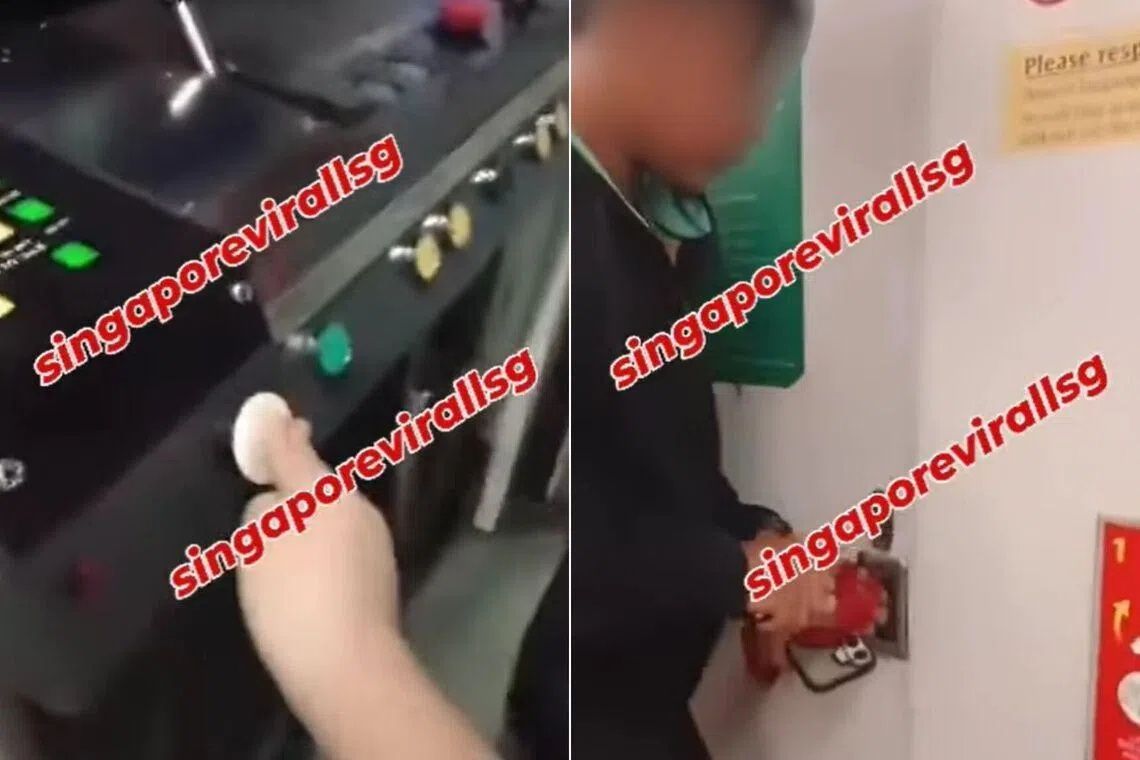
The Singapore police have issued conditional warnings to two young boys—aged 11 and 12—who illegally accessed the restricted driver's cabin of a North-South Line MRT train on February 21, an incident that has only recently captured public attention following viral social media circulation of the breach. The conditional warning is a measured enforcement response that comes after investigations were completed in consultation with the Attorney-General's Chambers, signalling how authorities balance accountability with the ages and circumstances of the minors involved.
The incident itself, captured on multiple mobile phone videos that have since proliferated across social media platforms, shows the two boys using what appears to be a tool to forcibly pry open the partition door separating the passenger cabin from the driver's cabin—a restricted area strictly off-limits to the public. Once inside the unauthorised space, the minors repeatedly pressed a white button mechanism, which activated the train's on-board alarm system and produced an audible horn. The video evidence has become surprisingly influential online; the version posted on the singaporevirallsg Instagram account alone accumulated more than 281,000 views, nearly 140 comments, and over 200 reposts as of late June, demonstrating how quickly such incidents can capture and spread through digital networks in the modern media landscape.
The actual date of the breach—February 21—was not immediately disclosed to the public, creating a gap between the incident's occurrence and its emergence as a viral sensation months later. SMRT Trains president Lam Sheau Kai provided official confirmation on June 30, explaining that the train's captain was on immediate high alert and swiftly contacted the SMRT Operations Control Centre, the central hub responsible for overseeing all daily transit operations across Singapore's rail network. This rapid internal communication protocol ensured that staff stationed at the next station were primed to investigate when the train arrived, underscoring the multi-layered safety systems embedded within transit operations.
The boys' actions were comprehensively documented through the train's closed-circuit television system, providing authorities with clear forensic evidence of the breach and allowing investigators to piece together the full sequence of events. The CCTV footage proved crucial in both the police investigation and the subsequent consultation with the Attorney-General's Chambers, whose input was essential before any final enforcement decision could be reached. The boys disembarked at the following station, making their identification and apprehension relatively straightforward once the breach was reported and investigations commenced.
The police confirmed to The Straits Times that a formal report was lodged on the same day as the incident and that the subsequent investigation culminated in conditional warnings issued under the Rapid Transit System Regulations—a legislative framework designed to protect the operational integrity and safety of Singapore's rapid transit infrastructure. The conditional warning represents a proportionate response that takes into account the age of the offenders while still conveying a formal cautioning from law enforcement. This approach reflects contemporary thinking in juvenile justice systems, where education and deterrence may be prioritised over harsher punitive measures for younger offenders whose judgement and impulse control are still developing.
MRT operations depend fundamentally on the integrity of secure, restricted spaces where highly trained personnel manage complex mechanical and electronic systems that control train movement, braking, and communication. When untrained individuals—particularly children—gain access to these compartments and begin operating unfamiliar controls, they create unpredictable hazards that ripple through an entire system servicing hundreds of thousands of daily commuters. The activation of the alarm system itself, while designed to alert authorities to anomalies, also represents a potential disruption to the carefully orchestrated scheduling that keeps Singapore's transport network functioning with legendary efficiency.
SMRT president Lam's statement underscores the organisation's institutional position on such breaches, emphasising that unauthorised intrusions into restricted train areas constitute serious threats to both passenger and operational safety. The company's formal response highlights the cascading consequences of such actions: they endanger the young people involved by exposing them to electrified equipment, moving mechanical parts, and other hazards; they pose risks to crew members and passengers by introducing unpredictable variables into controlled operational procedures; and they fundamentally disrupt service delivery by forcing emergency protocols that delay trains and inconvenience the broader commuting public. The message implicit in SMRT's stance is that transit security cannot be treated casually, as even seemingly minor infractions can have system-wide ramifications.
For regional observers, this incident offers perspective on how developed transit systems in Southeast Asia integrate enforcement, technological oversight, and public communication to maintain security and operational standards. Singapore's response—combining swift internal alerts, CCTV documentation, police investigation, and legal consultation—represents a comprehensive approach that Malaysian, Thai, and Indonesian transport authorities increasingly aspire to replicate as their own networks expand. The fact that the police chose a measured response rather than prosecution demonstrates how mature regulatory frameworks can distinguish between genuine malice and youthful mischief, maintaining deterrent effect without scarring young lives with permanent criminal records.
The viral circulation of the video itself raises interesting questions about how digital media amplifies incidents that might otherwise remain largely contained within official channels and local news coverage. The four-month gap between the incident and its emergence as a viral phenomenon suggests that the original video was recorded opportunistically by other passengers and subsequently uploaded to social media platforms where algorithmic distribution and public curiosity drove exponential engagement. This dynamic means that what was primarily an internal security and law enforcement matter became, through internet culture, a subject of public discourse and speculation—a pattern increasingly common in transit systems worldwide where many passengers carry video equipment.
Going forward, transit authorities across the region may need to calibrate their responses to account not merely for the immediate operational and safety implications of breaches but also for the secondary effects of viral documentation, where the reputational impact of widespread video circulation can overshadow the underlying incident. Educational campaigns emphasising the genuine dangers present in restricted areas—electrical hazards, mechanical systems, and the legal consequences of unauthorised entry—might prove more effective than enforcement alone in discouraging similar behaviour among younger passengers curious about restricted spaces.

