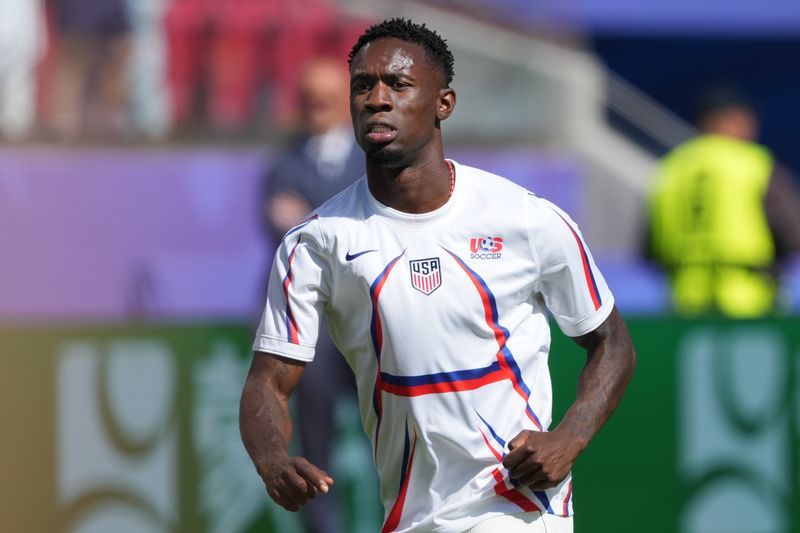
European football's governing body UEFA has delivered a scathing rebuke of FIFA's decision to suspend the implementation of a red-card ban against United States striker Folarin Balogun, following intervention by U.S. President Donald Trump. In a strongly worded statement released on Monday, UEFA expressed its "disbelief" at what it characterised as an "unprecedented, incomprehensible and unjustifiable" move by world soccer's governing body, signalling a significant rupture between the continental federation and FIFA's leadership over the handling of the disciplinary matter.
The controversy centres on Balogun's dismissal during the United States' round of 32 victory over Bosnia, which occurred after a VAR review determined that the striker had deliberately dragged his cleats down the back of defender Tarik Muharemovic's leg and onto his foot. This infraction would normally have resulted in an automatic suspension from the subsequent round of 16 fixture against Belgium. However, FIFA's decision to suspend rather than rescind the ban—essentially allowing Balogun to play while maintaining the formal sanction—has created an unprecedented situation that challenges the fundamental principle of consistent rule application in international sport.
The timing of FIFA's intervention is particularly controversial given that Trump had personally contacted FIFA President Gianni Infantino to request a review of Balogun's disciplinary case. This direct political engagement in a sporting matter raises substantial questions about the separation between governmental authority and the autonomous governance of professional athletics, a principle that has long been considered fundamental to the credibility of international sports bodies. UEFA's statement articulates precisely this concern, emphasising that when "the certainty of rules is no longer guaranteed by its guardians, the integrity of the game is at stake and the credibility of a competition is undermined."
Balogun has emerged as a key performer for the United States in the tournament, having already contributed three goals to his country's campaign. His availability for the Belgium match would provide a significant tactical advantage to the American team, which may partially explain why the U.S. administration pursued the matter at the highest diplomatic levels. However, this consideration has proven largely irrelevant to the substantive criticism now being directed at FIFA, with observers focusing instead on the troubling precedent being established regarding external political influence over sporting decisions.
The Royal Belgian Football Association (RBFA) has also registered its formal objection to the ruling, expressing astonishment at FIFA's course of action. The RBFA has reportedly submitted an appeal to FIFA, seeking to challenge the suspension of Balogun's ban and restore the original disciplinary sanction. This intervention from Belgium's football authorities underscores the competitive disadvantage created by FIFA's decision, as the European nation now faces the American striker despite a legitimate disciplinary process having reached its conclusion through established protocols.
FIFA's decision to suspend the ban for a probationary period of one year without completely rescinding the red card itself represents an unusual compromise position that has satisfied neither those who believe the original dismissal should stand nor those who sought its complete reversal. This middle-ground approach has instead created confusion about the precedential value of the decision and raises questions about whether other players or national federations might now seek similar exceptional treatment through alternative channels, potentially including political pressure.
The incident has thrust FIFA's disciplinary procedures into sharp focus at a critical moment in the tournament, exposing what many observers see as structural vulnerabilities in the organisation's ability to maintain impartiality when faced with external political or economic pressure. For Malaysian and broader Southeast Asian football communities, this controversy carries particular significance, as it demonstrates how decisions made in distant boardrooms can reshape expectations about what constitutes fair competition and whether sporting rules retain their intended meaning when applied inconsistently.
The regulatory framework governing professional football relies fundamentally on the notion that disciplinary decisions, once rendered through established review processes, are binding and consistent. When that framework is circumvented through direct governmental intervention, it creates cascading implications for the entire competitive structure. Players from less wealthy or politically influential nations might justifiably question whether they would receive similar consideration if their national governments applied equivalent pressure on FIFA.
This situation also reflects broader tensions within FIFA regarding its autonomy and legitimacy as a governing body. The organisation has faced sustained criticism in recent years over various governance matters, corruption allegations, and accusations of favouring wealthier football nations in tournament administration. The Balogun decision, coming against this backdrop, serves to reinforce concerns among football authorities and observers that FIFA may lack either the institutional independence or the will to resist external pressure when applied by sufficiently powerful actors on the global stage.
As the tournament progresses, the implications of FIFA's decision will likely continue to reverberate through both immediate competition scheduling and longer-term discussions about governance reform. UEFA's pointed criticism suggests that European federations are prepared to challenge FIFA's authority more openly when they perceive decisions to lack principled justification. This fracture in consensus among football's governing institutions could have substantial consequences for how the sport regulates itself at the international level in coming years.

