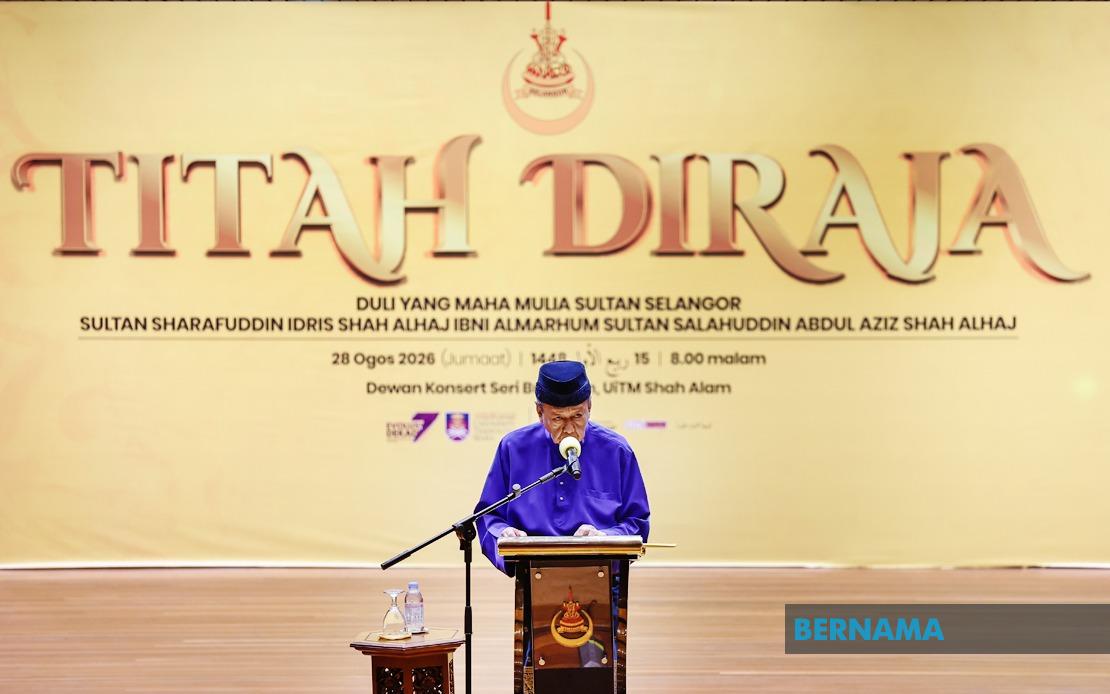
At the UiTM 2026 Royal Address held at Dewan Konsert Seri Budiman in Shah Alam, Sultan Sharafuddin Idris Shah delivered a measured yet pointed message about the university's foundational purpose. The Selangor Sultan stressed that as Malaysia's largest tertiary institution continues to expand and modernize, it must not abandon its original constituency—the children of working-class and rural families whose access to quality education was previously limited. This intervention comes at a critical juncture as the institution evaluates its enrolment policies and admission standards, reflecting broader national conversations about equity in higher education.
The Sultan's address underscores a persistent tension within UiTM's evolution. Since its modest establishment in 1965 with merely 219 students and 11 lecturers, the institution has transformed into an educational powerhouse. Within a single decade, enrolment had multiplied to nearly 7,000 learners supported by approximately 1,000 academic staff offering around 60 distinct programmes across multiple states. This expansion narrative, while demonstrating institutional success, also raises questions about whether rapid growth inadvertently shifts the university toward an increasingly selective intake that privileges students from more affluent backgrounds.
Today, UiTM's scale is remarkable by any standard. The university produces over 40,000 graduates annually, and its alumni network has exceeded one million individuals spread across virtually every profession and industry. Engineers, accountants, medical practitioners, legal professionals, architects, entrepreneurs, and government officials bearing UiTM credentials operate throughout Malaysia's public and private sectors. Many occupy leadership positions in major corporations and government agencies, directly shaping national economic and administrative priorities. This pervasive presence demonstrates the university's instrumental role in creating Malaysia's middle class and professional workforce.
Yet the Sultan's intervention suggests concern that UiTM's expansion has created distance between the institution's current reality and its foundational mission. When the university was smaller and less prestigious, it necessarily served as a transformative engine for brilliant students whose family circumstances would otherwise have precluded university attendance. The implicit challenge posed by Sultan Sharafuddin is whether UiTM has begun to replicate the selective patterns of older, more established universities, thereby becoming just another credential-granting institution rather than a genuine mobility escalator for the disadvantaged.
Crucially, the Sultan framed this concern not as criticism but as a call to recommit to core values. His rhetorical strategy emphasized continuity rather than change, suggesting that honoring UiTM's original spirit actually serves the institution's contemporary interests. In this framing, accessibility to underprivileged Bumiputera youth is not a constraint on excellence but rather the defining measure of UiTM's genuine achievement. The Sultan explicitly rejected quantitative measures—raw student numbers or graduation statistics—as authentic indicators of success, instead proposing that lives genuinely transformed through education constitute the true metric of institutional impact.
The Sultan's most concrete proposal involved establishing a sustainable funding mechanism through alumni contributions. He proposed a system whereby each of UiTM's estimated million-plus alumni contribute a modest RM10 monthly or RM100 annually to their alma mater. This suggestion deliberately pitched the commitment as minimal and universal—affordable across income levels and positioned as token gratitude rather than burdensome obligation. The mathematics are striking: such a scheme could potentially generate RM100 million annually, a figure substantial enough to materially support both institutional development and direct financial assistance for struggling current students.
This financing proposal carries particular significance for the Malaysian context. UiTM operates within a public higher education ecosystem where budgetary constraints have intensified in recent years, limiting the institution's ability to expand scholarship support or waive fees for economically disadvantaged students. An alumni contribution scheme creates an alternative revenue stream anchored in the expressed gratitude of those whose lives were transformed by UiTM, thereby establishing a circle of mutual obligation. Former students who achieved professional success and middle-class stability directly enable their less fortunate successors to access the same transformative opportunity they themselves received.
The attending dignitaries underscored the political weight of the Sultan's message. Tengku Permaisuri Norashikin's presence represented the Selangor royal household's formal endorsement of these principles, while Higher Education Minister Datuk Seri Dr Zambry Abd Kadir's attendance signaled governmental receptiveness to the Sultan's proposals. The event's organization under the Malay Rulers Institution demonstrated that this was not an isolated commentary but rather a coordinated statement reflecting consensus among traditional authority structures about national priorities regarding Bumiputera access to quality higher education.
For Malaysian readers and Southeast Asian observers, the Sultan's intervention illustrates how monarchy can function as institutional guardian protecting foundational missions against gradual drift. Unlike parliamentary or ministerial pronouncements that might be dismissed as partisan, a royal address carries cultural and constitutional weight that demands serious consideration from educational administrators and policymakers. The Sultan essentially positioned the Selangor sultanate as guarantor of UiTM's fidelity to its original purposes, a role reflecting the historical relationship between Malaysia's Malay Rulers and Bumiputera protection mechanisms embedded in the Federal Constitution.
The Sultan's invocation of the 'UiTM Dihatiku' slogan—which translates as 'UiTM in My Heart'—was particularly significant. This internally circulated motto represents how the university community conceptualizes institutional identity. By calling for this sentiment to be demonstrated through concrete alumni contributions and renewed commitment to accessibility, the Sultan transformed the slogan from mere sentiment into operational principle. This linguistic move reframes generosity toward disadvantaged students not as charity but as authentic expression of institutional love and continuity.
Looking forward, the Sultan's address creates pressure on UiTM's leadership to demonstrate renewed commitment to accessibility. While the university cannot reverse broader market pressures toward selectivity and prestige maximization, the Sultan has provided both intellectual justification and practical mechanism for maintaining a robust pipeline of opportunities for underprivileged Bumiputera youth. The alumni contribution scheme, if implemented, would institutionalize the responsibility of successful graduates toward their institution and its accessibility mission, creating sustained funding independent of government budgetary cycles.
The address also implicitly warns against allowing UiTM to evolve into a mere feeder institution for Malaysia's elite professional class. Such trajectory would represent not merely institutional change but betrayal of the contract implied when the Merdeka generation established the university as an instrument of post-independence social engineering. The Sultan's intervention thus defends both historical memory and future justice, insisting that institutional progress must not compound existing inequalities but rather provide genuine pathways of ascent for those beginning from disadvantage.

