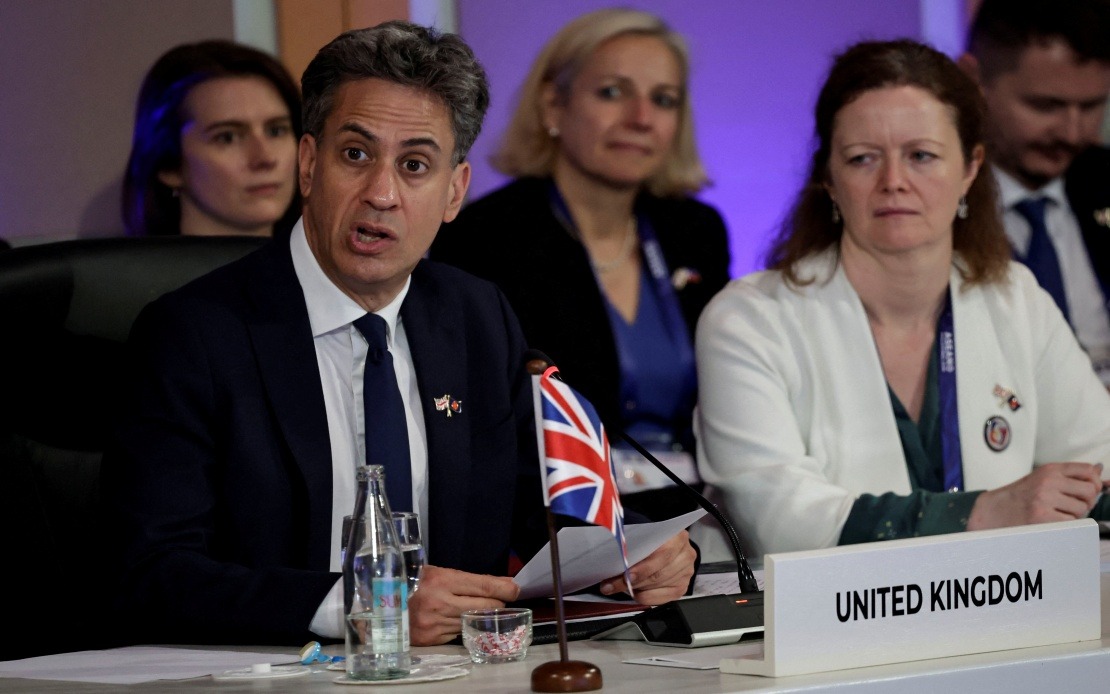
Britain's newly appointed Foreign Secretary Ed Miliband is embarking on his first official visit to continental Europe this week, signalling the government's intent to rebuild and reinvigorate relationships with key EU partners following years of post-Brexit tensions. The tour, which takes him to both France and Spain on Wednesday, represents a symbolic gesture of renewed engagement at a time when transatlantic and intra-European security concerns are intensifying.
The timing of Miliband's inaugural trip carries considerable symbolic weight, arriving as both France and Spain grapple with unprecedented wildfire disasters that have forced the evacuation of approximately 330,000 people across the two countries. Rather than viewing this as merely an unfortunate backdrop, Miliband intends to leverage the crisis as a platform for demonstrating British solidarity whilst simultaneously anchoring these conversations within the broader context of the climate emergency. This approach underscores a diplomatic strategy that seeks to connect immediate humanitarian concerns with longer-term strategic partnerships centred on shared environmental and security challenges.
In Paris, Miliband will hold discussions with French Foreign Minister Jean-Noël Barrot, where the agenda extends well beyond pleasantries. The conversation is expected to encompass critical matters of European security architecture, reflecting ongoing concerns about regional stability in an increasingly uncertain geopolitical environment. A significant portion of their discussion will likely focus on sustained British support for Ukraine, a commitment that has defined post-invasion European diplomacy and remains central to demonstrating unified Western resolve against Russian aggression.
The French leg of the visit will also address Middle Eastern dynamics, with both nations expected to explore pathways toward de-escalation and sustainable peace in West Asia. This conversation assumes particular importance given the historically significant roles both Britain and France play in Middle Eastern affairs, and their respective interests in preventing further regional conflagration. Additionally, migration—a perennially contentious issue across the English Channel—is anticipated to feature prominently, as both governments seek practical mechanisms for managing population flows whilst respecting humanitarian obligations.
Following his Paris engagement, Miliband will travel to Madrid to meet Spanish Foreign Minister José Manuel Albares, where discussions will centre on aspects of the UK-EU relationship that have proven especially complex during recent years. The UK-EU Gibraltar treaty represents one such flashpoint, embodying the intricate territorial and jurisdictional questions that Brexit has thrown into sharper relief. Beyond Gibraltar, security collaboration will feature prominently, reflecting Spain's strategic importance to British interests in Mediterranean and Atlantic security frameworks.
The emphasis on climate action across both meetings reflects a genuine policy priority rather than mere rhetorical flourish. The devastating wildfires consuming vast swathes of southern Europe serve as a visceral reminder of climate vulnerability affecting developed nations, lending urgency to discussions that might otherwise remain abstract or long-term in character. For Miliband, this moment presents an opportunity to argue that climate crisis mitigation demands not merely national responses but coordinated international action—a message that resonates particularly strongly in Southeast Asia, where many nations face compounded climate risks arising from tropical geography and development pressures.
From a Malaysian perspective, Miliband's tour carries indirect but meaningful implications. The strengthening of British-European partnerships, particularly around security and climate frameworks, influences the broader international order within which ASEAN nations operate. A more cohesive and engaged Europe, working in concert with Britain, could translate into more robust commitments to climate action and regional stability mechanisms that ultimately affect Southeast Asian interests. Furthermore, the UK's explicit prioritisation of EU relationships signals a recalibration of British foreign policy toward emphasising multilateral partnerships and alliance-building rather than pursuing isolated national advantage.
The visit also reflects the Labour government's broader foreign policy orientation since its recent electoral victory. By positioning the Foreign Secretary's maiden international trip as a deliberate engagement with European partners, the new administration signals that repairing relationships strained during the previous government's tenure constitutes a genuine priority. This approach contrasts with previous rhetoric around British independence and suggests a recognition that Britain's influence is substantially amplified through sustained partnerships rather than unilateral posturing.
Climate and security concerns will form the thematic backbone throughout both meetings, presenting interlocking challenges that no single nation can adequately address alone. The simultaneous occurrence of the wildfire crisis lends practical urgency to these discussions, moving conversations beyond theoretical frameworks into immediate policy terrain. For countries across Southeast Asia watching European responses to such crises, the British approach to integrating climate discussion within security dialogue offers a potential model for how regional organisations might similarly position environmental challenges within broader strategic frameworks.
Miliband's outreach also implicitly acknowledges that Britain's future prosperity and security remain substantially intertwined with continental European dynamics, a recognition that carries both economic and strategic dimensions. Enhanced cooperation on migration, security intelligence, and climate adaptation serves British interests whilst simultaneously strengthening the broader European security architecture. This mutuality of interest, if successfully translated into concrete policy commitments, could establish foundations for more productive UK-EU relations throughout the decade ahead.

