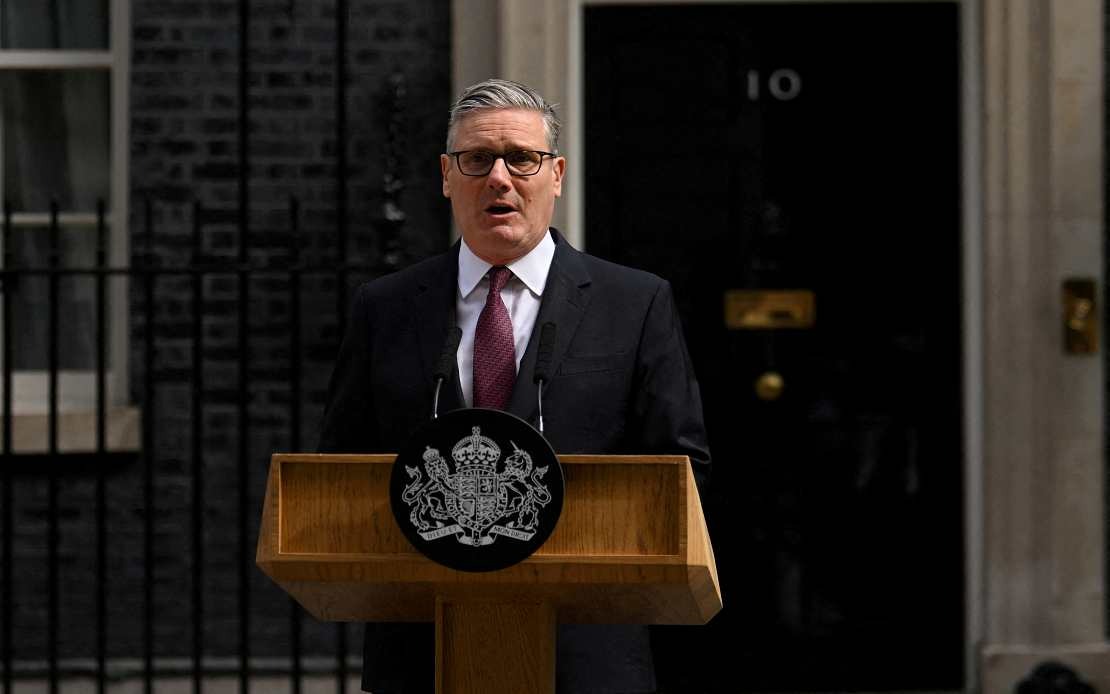
British Prime Minister Keir Starmer has demanded an urgent resumption of ceasefire negotiations between the United States and Iran following escalating military tensions that have jeopardised one of the world's most critical shipping channels. Speaking at a joint press conference in Paris alongside French, German, and Ukrainian leaders after a "coalition of the willing" meeting, Starmer made clear that the international community views the breakdown in diplomatic efforts as a serious threat to regional and global security.
The tensions centre on the Strait of Hormuz, a vital waterway through which roughly one-fifth of global oil trade passes annually. Iran's recent military strikes on commercial shipping operations and regional partners have drawn sharp condemnation from Western capitals, with Starmer describing the attacks as unacceptable and demanding their immediate cessation. The British leader's intervention reflects growing alarm among established powers that the dispute could spiral beyond the current military posturing into sustained disruption of international commerce.
Starmer articulated a three-part framework for de-escalation that encompasses renewed ceasefire negotiations, resolution of outstanding political issues, and crucially, the restoration of unrestricted freedom of navigation through the strait. His emphasis on the latter point underscores Western concern that Iranian actions are effectively imposing an informal blockade that threatens the livelihoods of shipping companies and the energy security of dependent nations worldwide. The British government has signalled readiness to commit naval assets and other resources to facilitate the safe passage of vessels through contested waters.
The immediate trigger for intensified diplomacy was a rapid exchange of military strikes between Washington and Tehran over the weekend. President Donald Trump announced that the United States was "reinstating" a blockade targeting Iran's economy and, more provocatively, suggested that American forces would charge commercial shipping fees in exchange for safe passage through the strait. Such a proposal represents a dramatic escalation from standard international maritime practice and appears designed to increase economic pressure on the Iranian government.
This latest confrontation must be understood against the backdrop of an earlier, more comprehensive conflict. The US-Israeli military campaign against Iranian targets began in late February and had led to significant regional destabilisation. In June, however, both sides had negotiated a memorandum of understanding that was expected to end active hostilities and restore normal maritime operations through the strait. The apparent collapse of that agreement within weeks suggests deep mutual distrust and disagreement over the terms needed for sustained peace.
For Malaysia and Southeast Asia, the implications are substantial. The region depends heavily on energy imports and maintains significant shipping interests passing through the Strait of Hormuz. Any sustained closure or taxation of the waterway would inflate energy costs for Malaysian businesses and households, potentially dampening economic growth across the region. Malaysian shipping companies operating in the Gulf would face elevated insurance premiums and operational risks, directly affecting the competitiveness of regional maritime industries.
The British position reflects a broader Western strategy of preventing unilateral action by either the US or Iran from determining the strait's status. By assembling a diplomatic coalition and emphasising the primacy of negotiated settlement, London seeks to constrain Trump's apparent willingness to use economic and military leverage unilaterally. The inclusion of French and German leaders in the announcement signals European determination to maintain influence over Middle Eastern affairs despite reduced military capabilities.
Iran's perspective, though not directly represented in Starmer's statement, likely stems from perceptions that the June memorandum was insufficient to guarantee its security interests. The Islamic Republic may view renewed American threats as evidence that diplomatic agreements offer limited protection against external pressure, justifying military demonstrations of resolve. This dynamic creates a dangerous cycle wherein each side interprets the other's actions as confirmation of hostile intent.
The reference to "Gulf partners" in Starmer's remarks points to Saudi Arabia, the United Arab Emirates, and other regional states that depend on stable maritime trade. These nations have quietly encouraged Western powers to balance American and Iranian influence, recognising that either power gaining exclusive control over the strait would disadvantage their own interests. Their strategic position as swing voters in this dispute gives them leverage, though their public positioning remains cautious.
Starmer's deployment language—offering to position British naval assets—reflects the practical challenge that international law provides limited grounds for intervention without a clear mandate from affected states or international organisations. The British approach attempts to frame force deployment as a neutral measure supporting freedom of navigation rather than taking sides in the underlying conflict. This subtle distinction matters because explicit alignment with American blockade policies could provoke Iranian counter-moves.
The timing of this diplomatic push remains uncertain regarding prospects for success. Trump's apparent comfort with economic pressure tactics suggests Washington may not regard a ceasefire as its preferred outcome if escalating costs on Iran produce political change. Conversely, Iran may feel cornered and more likely to resort to asymmetric responses if it perceives the international community as siding with American policies. The window for de-escalation appears narrower than it was when the June memorandum was signed.
For regional powers including Malaysia, the coming weeks will determine whether the Strait of Hormuz remains a contested zone or returns to relative normalcy. The stakes extend beyond insurance and fuel costs to encompass the broader principle of whether international law and peaceful dispute resolution can prevail over unilateral economic coercion and military threats. Starmer's call for urgent diplomatic action represents an attempt to restore that principle, but success ultimately depends on whether both Washington and Tehran view negotiation as preferable to continued confrontation.

