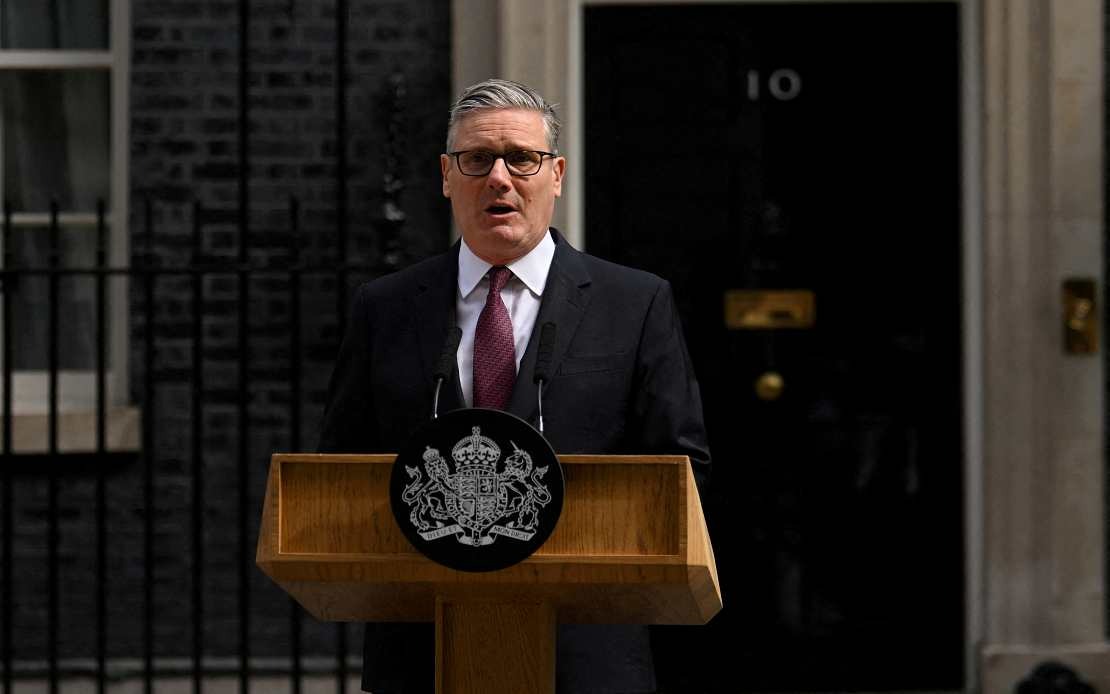
British Prime Minister Keir Starmer has announced he will step down from his position, with a new leader set to take office by the time Parliament returns in September. The decision marks a dramatic reversal for a leader who swept to power less than two years ago on a platform promising to restore stability to British governance after years of political turbulence.
Starmer's announcement comes amid a sharp deterioration in his political standing. Once regarded as a stabilizing force following the chaotic tenures of his predecessors, his popularity has plummeted to levels unseen by any recent British premier. The cascade of resignations and dissent within his own Labour Party reflected a broader erosion of public confidence, suggesting that even a decisive election mandate cannot insulate a government from the grinding consequences of economic stagnation and unmet public expectations.
The tipping point arrived on Friday when Andy Burnham, the Mayor of Greater Manchester, secured a commanding victory in a parliamentary by-election. Burnham's triumph over a Reform UK candidate was particularly significant given that Nigel Farage's party has dominated national opinion polling for over a year, capturing the anger of voters disenchanted with the political establishment. That Labour could hold the seat with such a strong performance suggested that a fresh face might reverse the party's hemorrhaging support among its traditional base.
Burnham, a seasoned political operator with a reputation for effective communication, now emerges as the frontrunner to succeed Starmer. His parliamentary comeback promises the Labour Party a leader untainted by association with the unpopular decisions of the past two years. Yet the incoming prime minister will inherit precisely the same structural constraints that have crippled Starmer's tenure. The British economy remains mired in sluggish growth, household incomes stagnate under the pressure of elevated living costs, and public services strain under chronic underfunding.
The economic landscape presents a formidable challenge for any incoming administration. Britain currently carries the highest borrowing costs among the Group of Seven wealthy nations, a consequence of elevated national debt, substantial interest payments, persistently weak economic growth, and the structural difficulty of reducing public expenditure whilst simultaneously investing in critical areas such as defence. Burnham cannot wish away these constraints through rhetorical flourish alone. The bond markets that finance British government spending care little for political messaging; they respond to mathematics and risk assessment.
Burnham has articulated that the country requires fundamental structural reform and must tackle the cost-of-living crisis, yet he has remained largely silent on how his administration would approach foreign policy, economic management, and defence strategy. His previous comments suggesting Britain must transcend its dependence on the bond markets have raised questions among investors about whether he fully grasps the severity of the fiscal situation. Analysis from Citibank economists concludes that a Burnham administration would confront "a precarious fiscal situation with few tools to deliver meaningful change," highlighting the perilous inheritance awaiting the next prime minister.
The instability of British political leadership has reached remarkable proportions. Starmer will become merely the latest in a succession of seven prime ministers since the 2016 Brexit referendum, a turnover unprecedented in nearly two centuries of British parliamentary history. This extraordinary churn reflects not temporary partisan disagreement but a deeper crisis of confidence in the capacity of Westminster to address the fundamental concerns of ordinary citizens. Successive governments have failed to deliver palpable improvements in living standards, to restore the functionality of public services, or to establish effective immigration controls—areas where public frustration has reached critical levels.
The transition timeline proposed by political observers suggests that Starmer should remain in office through a European Union reset summit scheduled for July, providing the incoming leader time to prepare for the transition to power. This staggered handover would preserve some institutional continuity whilst allowing Burnham, or whoever succeeds Starmer, to avoid the immediate crisis atmosphere that surrounds a precipitous change of government. The September date coinciding with Parliament's return offers a natural moment for the new administration to present itself to the electorate and outline its legislative agenda.
For Malaysian observers and Southeast Asian policymakers, the British situation carries instructive lessons about the limits of electoral mandates in the face of structural economic dysfunction. Democracy alone cannot resolve problems rooted in fiscal imbalance, weak productivity growth, and the erosion of institutional trust. Starmer's downfall, despite commanding electoral numbers, demonstrates that voters punish governments perceived as unable to improve their material circumstances, regardless of the scale of the mandate received. Southeast Asian economies, whilst generally experiencing stronger growth trajectories than Britain, nonetheless face similar pressures regarding public expectations for improved living standards and responsive governance. The British experience underscores that complacency regarding electoral security can rapidly give way to political vulnerability when economic performance disappoints public expectations.