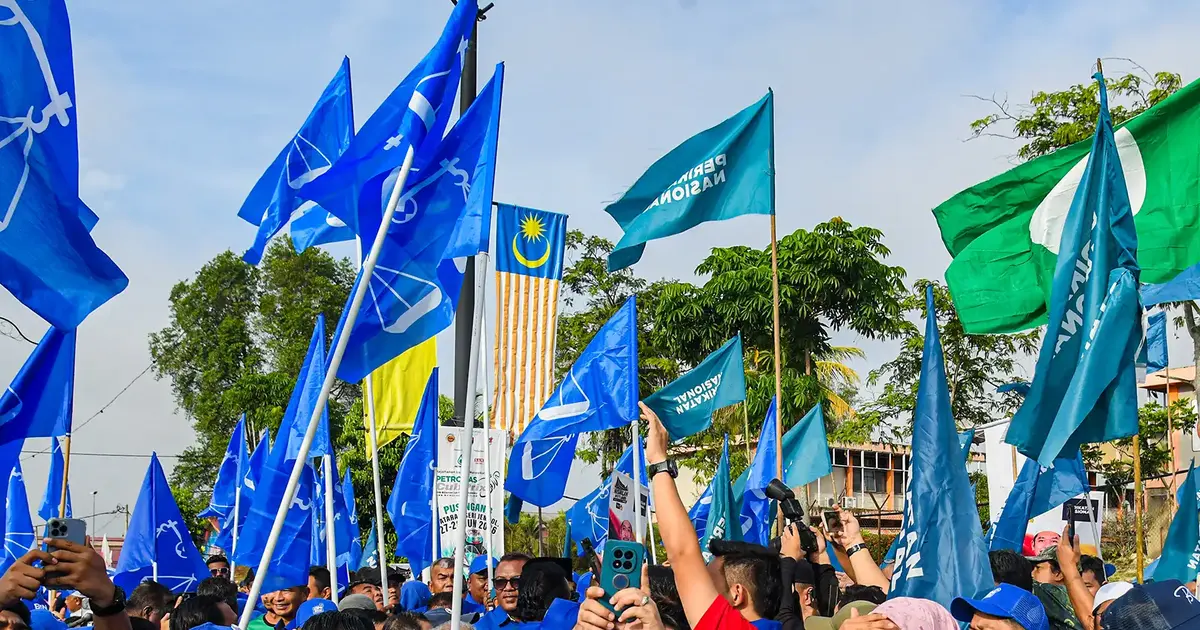
The fragile alliance between Barisan Nasional and Perikatan Nasional faces a mounting test as Umno moves to reclaim its historical position as Malaysia's dominant Malay-Muslim political force, with observers warning that the coalition's survival depends on how competing territorial claims are resolved in the coming state elections.
The tension centres on three peninsular states where Perikatan Nasional has consolidated control but Umno harbours ambitions for revival. In Terengganu, Kedah, and Perlis, the two coalitions represent fundamentally different power bases. Perikatan Nasional, anchored by Pas and its grassroots Islamic credentials, has become entrenched in these strongholds through electoral success and on-the-ground organisational work. Umno, historically Malaysia's governing party and still commanding significant resources and institutional machinery, views these losses as anomalies rather than permanent defeats.
The mathematics of Malaysian politics suggest little room for compromise. Perikatan Nasional is unlikely to voluntarily cede contested seats to Umno, particularly in states where it currently holds parliamentary representation. The party's leadership faces internal pressure from its base, which would interpret any surrender of seats as weakness. For Umno to reassert supremacy—its stated objective—it would need to dislodge Perikatan from these territories through electoral competition, a scenario that could pit allies directly against each other and undermine the nominal unity of the broader Barisan-Perikatan framework.
Kelantan presents a more complex scenario. Umno won only two seats in the last state election, a dramatic collapse from its historical dominance in one of Malaysia's east-coast heartlands. The state remains a Pas fortress, with Perikatan control seemingly stable. Yet Umno's diminished presence there may actually make a negotiated settlement more feasible than in states where both coalitions command comparable strength. However, Umno's recovery in Kelantan represents a matter of pride for the party's leadership, making any acceptance of permanent marginalisation politically difficult at the national level.
Analysts point to the fundamental contradiction embedded in the current Malaysian coalition architecture. Barisan Nasional, traditionally a coalition of ethnically-anchored parties with defined territorial bases, struggles to function within an alliance that includes Perikatan Nasional—itself composed of parties with overlapping support bases and competing territorial ambitions. The arrangement was born from necessity following the 2022 general election, when no single coalition secured an absolute majority. It was always presented as a temporary mechanism for stability rather than a durable political settlement.
Umno's push for dominance reflects the party's struggle with electoral relevance in the post-2018 era. The party suffered catastrophic losses when federal power shifted away from its traditional coalition partners, and its recent revival—including its strong showing in the 2023 general election—has reinvigorated internal factions arguing for more aggressive expansion. The party's leadership cannot indefinitely suppress these voices without risking internal schisms that could prove even more destabilising than coalition tensions.
For Malaysian and Southeast Asian observers, the unfolding situation illustrates broader challenges facing established political parties navigating electoral volatility. Umno's position mirrors that of traditional parties elsewhere in the region that have seen their support bases eroded by more focused religious or populist movements. The question is whether institutional seniority and organisational capacity can recover lost ground, or whether the political landscape has fundamentally shifted.
The coalition's trajectory will likely depend on how national-level negotiations between Umno and Perikatan leadership resolve these territorial disputes before state-level campaigns formally commence. Early signals suggest entrenched positions rather than flexibility. If both coalitions proceed to general elections without clear seat allocations, the result could be a fragmented campaign where Barisan Nasional and Perikatan Nasional effectively campaign against each other in critical states, undermining their joint messaging and allowing opposition parties to exploit the divisions.
For international observers watching Malaysian politics, the instability also reflects the broader challenge of coalition governance in plural democracies. Coalition partners inevitably compete even while formally aligned, and the costs of that competition escalate when elections approach and internal party dynamics pressure leaders to prove they can deliver tangible benefits to their base. The Barisan-Perikatan arrangement, lacking deep ideological integration or historical precedent for sustained cooperation, remains peculiarly vulnerable to these pressures.
The coming weeks and months will test whether pragmatism can override ambition. If Umno's pursuit of supremacy comes at the expense of the coalition's cohesion, the political settlement that Malaysia has inhabited since 2022 could unravel more quickly than many analysts anticipated. Conversely, if both coalitions can negotiate a modus vivendi that allows Umno modest territorial recovery while preserving Perikatan's existing strongholds, the alliance might yet prove durable. The resolution will carry implications not just for Malaysian domestic politics but for how established parties throughout Southeast Asia navigate the challenges of electoral competition within formal coalition structures.

