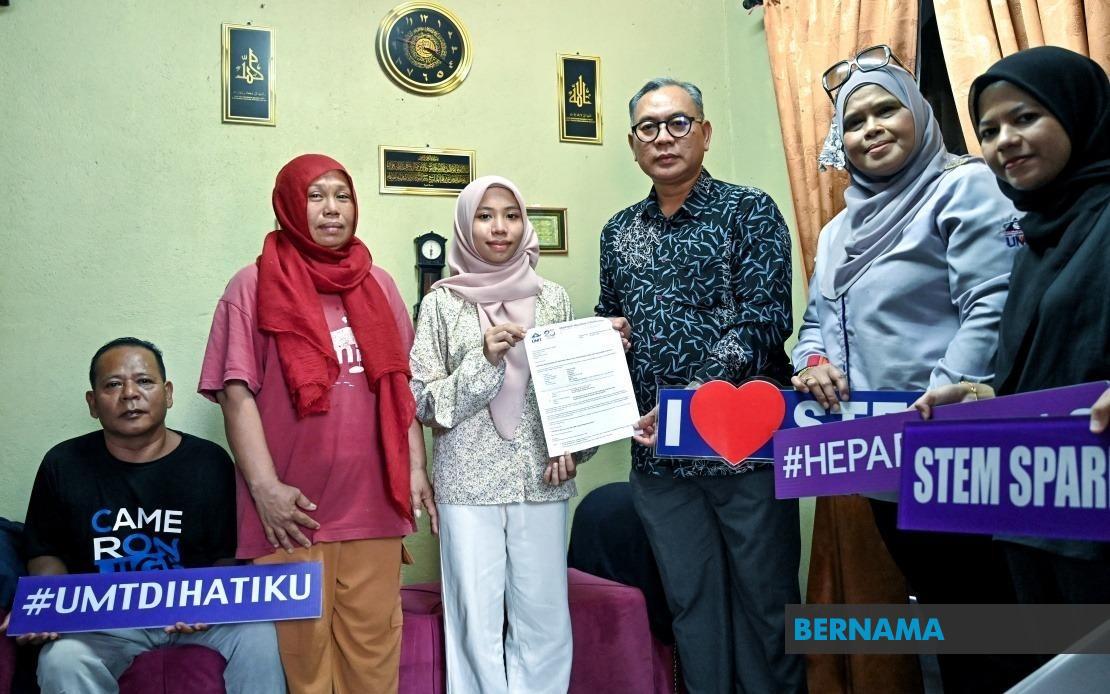
When Nurul Amira Abdul Hamid received her university acceptance letter, the moment of triumph quickly gave way to anxiety. The 18-year-old from Parit Jawa in Bagan Serai faced an obstacle that many Malaysian students encounter: the inability to afford registration and tuition fees. Her family's precarious financial situation, compounded by her father's health problems and her mother's role as a homemaker, made continuing to tertiary education seem like an impossible dream. Yet this story took a different turn when Universiti Malaysia Terengganu (UMT) recognised her potential and chose to intervene.
After completing her Sijil Pelajaran Malaysia with three A grades, Nurul Amira made the difficult decision to take up work rather than pursue further education. The former Sekolah Menengah Kebangsaan Sri Kurau student secured employment at a goods store, earning RM1,300 monthly to contribute to her household expenses. This sacrifice reflected a common reality in Malaysia: talented young people from disadvantaged backgrounds often delay or abandon their educational aspirations to help support their families. Her situation embodied the structural barriers that persist despite the country's emphasis on accessible education.
When Nurul Amira received her university offer letter, her initial instinct was to decline. Rather than accept and risk burdening her family, she took the proactive step of contacting UMT to explain her circumstances in detail. This direct communication proved transformative. The university responded not with sympathy but with concrete support, demonstrating an institutional commitment to ensuring that financial hardship should not determine educational outcomes. This approach reflects broader discussions in Malaysia about equitable access to higher education and the role universities should play in social mobility.
The university arranged the Al-Ikhlas Scholarship worth RM500 for Nurul Amira, supplementing this with additional financial assistance to cover her registration and tuition expenses. Beyond the initial scholarship, UMT committed to providing living allowances throughout her entire academic journey. This holistic support structure recognises a critical gap in many scholarship programmes: that fees alone do not capture the full cost of university attendance. Students from lower-income families face ongoing expenses for accommodation, transportation, meals, and materials that can prove as prohibitive as tuition itself.
Nurul Amira enrolled in UMT's one-year Science, Technology, Engineering and Mathematics (STEM) Foundation programme, preparing her for entry into the Bachelor's degree in Science (Nautical Science and Maritime Transportation). The choice of maritime studies is particularly significant for Malaysia, a nation with extensive coastlines and a strategic position in global shipping lanes. Developing local talent in nautical science and maritime transportation addresses both current skills shortages and future economic needs in these critical sectors. The decision to support her pursuit of this field represents investment in both individual capability and national capacity-building.
UMT Vice-Chancellor Prof Dr Mohd Zamri Ibrahim emphasised that the university has adopted a deliberately hands-on approach to identifying and assisting struggling students. Rather than maintaining a passive stance where students must navigate bureaucratic processes independently, the institution actively reaches out to families experiencing hardship. This philosophy represents a significant departure from traditional models where universities primarily respond to applications rather than engage in proactive outreach. The vice-chancellor's statement that the university will meet with both students and parents underscores a recognition that educational barriers are often family-level challenges requiring family-level solutions.
The scale of UMT's commitment becomes apparent in Prof Zamri's disclosure that more than ten students from underprivileged families received assistance during the current academic year alone. This figure suggests a sustained institutional programme rather than occasional charitable acts. For a university of UMT's size, directing resources toward multiple disadvantaged students annually demonstrates genuine prioritisation of access and equity. Such commitments carry broader implications for Malaysian higher education, signalling that universities can serve as engines of social mobility when they allocate resources strategically toward this goal.
The vice-chancellor's invitation for struggling students to approach the university before accepting defeat carries powerful messaging. By explicitly stating "if any student cannot afford to pay the fees, come to the university first and we will help via various forms of assistance," UMT is attempting to shift the narrative around educational access. This approach acknowledges that financial difficulties often remain hidden, with students withdrawing silently rather than seeking support. Creating low-barrier pathways for disclosure and assistance potentially unlocks opportunities for many more students who might otherwise remain invisible to institutional support systems.
Nurul Amira's case illuminates the intersection of personal determination and institutional support. Her decision to pursue higher education despite financial obstacles, combined with her willingness to communicate directly with the university about her constraints, created the conditions for intervention. However, the university's receptiveness and rapid provision of comprehensive support proved equally crucial. This symbiosis suggests that expanding access to higher education requires both individual agency and institutional flexibility. Universities cannot simply wait passively for applications; they must actively create conditions where talented students from all backgrounds feel empowered to pursue advanced studies.
The broader context of this story involves ongoing debates within Malaysian education about whether universities should prioritise inclusion of disadvantaged students. Some argue that institutions should focus on academic excellence without regard to socioeconomic background, while others contend that universities have a social responsibility to counteract systemic inequalities. UMT's approach suggests a middle path: maintaining rigorous admission standards while simultaneously removing financial barriers for admitted students. Nurul Amira was selected because she demonstrated academic capability; the university then ensured that her capability could translate into actual educational opportunity.
Looking forward, the implications extend beyond Nurul Amira's individual trajectory. Each student supported through such programmes returns value to society through their future contributions. A graduate in nautical science and maritime transportation from a disadvantaged background brings not only technical expertise but also lived experience of economic challenge, potentially making her more attuned to workplace diversity and inclusion issues. Moreover, her success story becomes visible to other students facing similar circumstances, potentially encouraging them to pursue higher education rather than accepting limited economic opportunities as inevitable.
The case also highlights gaps in existing support structures. Nurul Amira should not have faced the dilemma of declining her university offer in the first place. Government funding, loan schemes, and other institutional scholarship programmes should theoretically address such situations. That a university must step in with discretionary assistance suggests either that national-level support mechanisms are insufficient or that they are not reaching all eligible students effectively. UMT's proactive approach, while commendable, represents a workaround rather than a permanent solution to deeper funding challenges in Malaysia's higher education system.
As Malaysia navigates its economic transformation and increasing competition for skilled workers, ensuring that talent develops regardless of family background becomes strategically important. Universities positioned as social institutions committed to broad-based access will increasingly attract the brightest students from all communities. For Nurul Amira, UMT's intervention means she can now focus entirely on her studies rather than wrestling with financial anxiety. For Malaysia, her successful completion of a degree in maritime science represents human capital development that would have been lost without institutional intervention. The university's modest investment in her future may yield significant returns, both for her personal trajectory and for the nation's maritime expertise.

