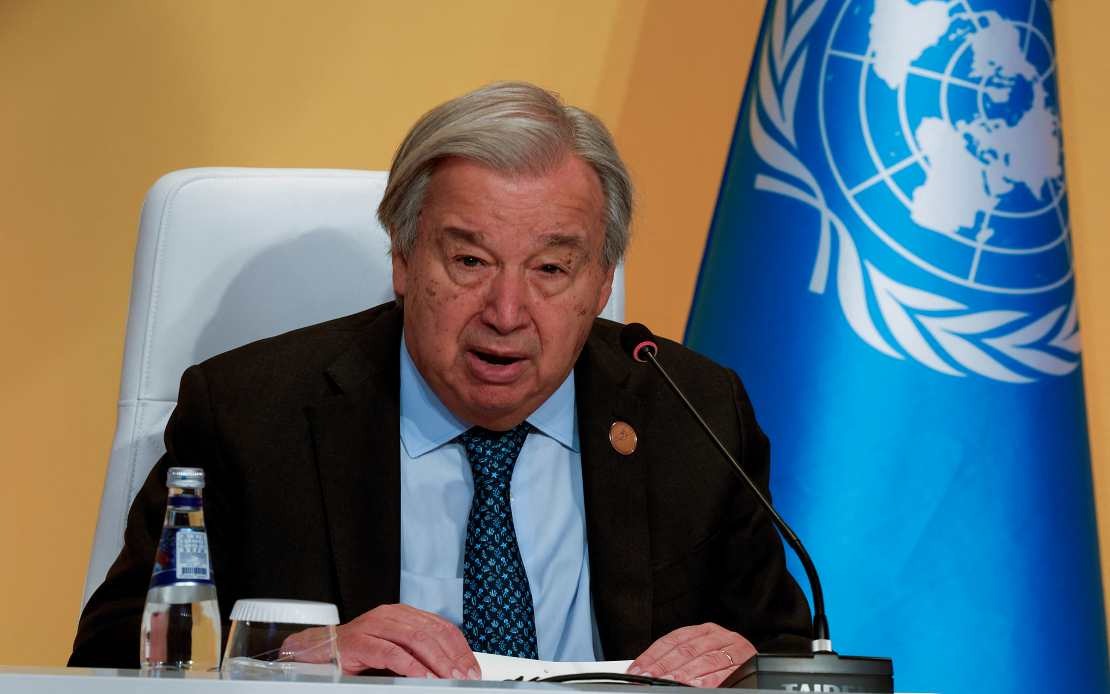
The United Nations has sounded an urgent warning about the deteriorating security situation in the Persian Gulf, with Secretary-General Antonio Guterres expressing profound concern over a pattern of escalating military incidents that threaten to destabilise one of the world's most strategically important regions. Speaking through his spokesperson on Sunday, Guterres highlighted the gravity of recent events, including Iranian attacks on commercial shipping transiting the Strait of Hormuz, retaliatory American strikes against Iranian targets, and Iranian military operations directed at neighbouring countries. The accumulating tensions represent a concerning shift from diplomatic posturing to direct military action, raising the prospect of an uncontrolled spiral that could engulf the entire region.
The UN chief's intervention reflects deepening international anxiety about the direction of Gulf affairs at a moment when diplomatic channels appear strained. Guterres has called upon all involved parties to demonstrate maximum restraint and immediately cease actions that add fuel to an already volatile situation. The message carries particular weight given the UN's responsibility for maintaining global peace and security, and the organisation's concerns extend beyond the immediate military dimension to encompass broader implications for international stability. The secretary-general's emphasis on restraint serves as a direct plea to decision-makers in Tehran and Washington to reconsider the trajectory of their confrontation before unintended consequences spiral beyond their control.
Critical to the UN's concerns is the threat posed to freedom of navigation through the Strait of Hormuz, one of the world's most essential maritime corridors through which roughly one-third of global seaborne traded oil passes daily. Any prolonged disruption to shipping in this waterway would reverberate across the global economy, affecting energy prices and supply chains that Malaysian businesses and consumers ultimately depend upon. The UN has specifically reaffirmed the imperative of maintaining full and unimpeded freedom of navigation, recognising that the current pattern of attacks on vessels threatens this fundamental principle of international maritime law. For Southeast Asian nations including Malaysia with significant energy import requirements, any sustained interference with Gulf shipping represents a direct economic vulnerability that extends the regional consequences of distant conflicts.
Guterres has warned starkly that a return to full-scale hostilities would produce catastrophic consequences across multiple dimensions. The assessment considers not only the immediate humanitarian toll that would afflict Gulf populations caught in the crossfire, but also the wider repercussions for international peace and security architecture. A major conflict in the Gulf would inevitably draw in external powers with global interests, potentially fragmenting international consensus and undermining the multilateral frameworks that have underpinned relative stability since the Cold War. The economic dimension adds another layer of concern, given the region's outsized influence on global energy markets and the vulnerability of the world economy to sudden supply shocks. These interconnected risks explain the UN chief's particular anxiety about the current trajectory.
The diplomatic opening that Guterres has advocated centres on urgent resumption of negotiations between Iran and the United States, the two principal antagonists in the current escalation cycle. Direct dialogue between Tehran and Washington represents the most credible pathway toward de-escalation, as their mutual concerns and legitimate grievances cannot be addressed through military exchanges. The secretary-general's explicit call for a return to diplomacy carries an implicit acknowledgment that military pressure alone has failed to resolve the underlying disputes driving the confrontation. Whether either party possesses sufficient political will to suspend military operations in favour of negotiation remains an open question, particularly given the rhetorical positions both have adopted regarding their respective red lines and non-negotiable demands.
The escalation pattern identified by the UN reflects broader tensions that have accumulated over years of fractious relations between Iran and the United States, exacerbated by the withdrawal of Washington from the 2015 Joint Comprehensive Plan of Action and the reimposition of comprehensive economic sanctions on Tehran. These sanctions have constrained Iran's economy and created powerful incentives for confrontational behaviour, while American military posture in the region has convinced Iranian leadership that Washington pursues regime change rather than negotiated settlement. The resulting security dilemma has produced tit-for-tat military operations that each side views as defensive responses while the other perceives as provocative escalation. Breaking this cycle requires acknowledgment of mutual concerns and commitment to addressing underlying grievances through structured dialogue.
For Malaysia and other Southeast Asian nations, the deterioration in Gulf security carries particular significance given the region's economic interdependence with Middle Eastern oil and gas producers. Malaysian companies have substantial commercial interests throughout the Gulf, and Malaysian workers remain present in significant numbers across the region. Any wider conflict would immediately threaten these economic and human assets while disrupting the global supply chains upon which Malaysian manufacturing and trade depend. The risk of accidental escalation between Iranian and American forces, or miscalculation regarding the intentions of third parties, adds an element of unpredictability that complicates contingency planning for regional governments.
The UN's intervention highlights the limitations of military solutions to fundamentally political disputes between major powers. Despite decades of American military presence in the Gulf and substantial military capabilities, force projection has not resolved Washington's strategic competition with Tehran or produced the desired outcomes in neighbouring conflicts. Similarly, Iran's acquisition of sophisticated missile capabilities and willingness to employ them has not deterred American pressure or reversed sanctions regimes. This mutual military stalemate suggests that sustainable resolution requires movement beyond the current cycle of tit-for-tat strikes toward structured negotiation addressing core security concerns.
Guterres's statement serves notice that the international community expects responsible behaviour from all parties and will not accept further deterioration toward generalised conflict. The UN chief's intervention, while lacking enforcement mechanisms, establishes a normative framework emphasising restraint and diplomacy as the appropriate path forward. Whether this appeal carries sufficient weight to influence decision-making in Tehran and Washington will become apparent in the coming weeks, as the international community watches closely for signals regarding whether both parties can step back from the brink of wider confrontation or whether the current trajectory continues toward full-scale hostilities.

