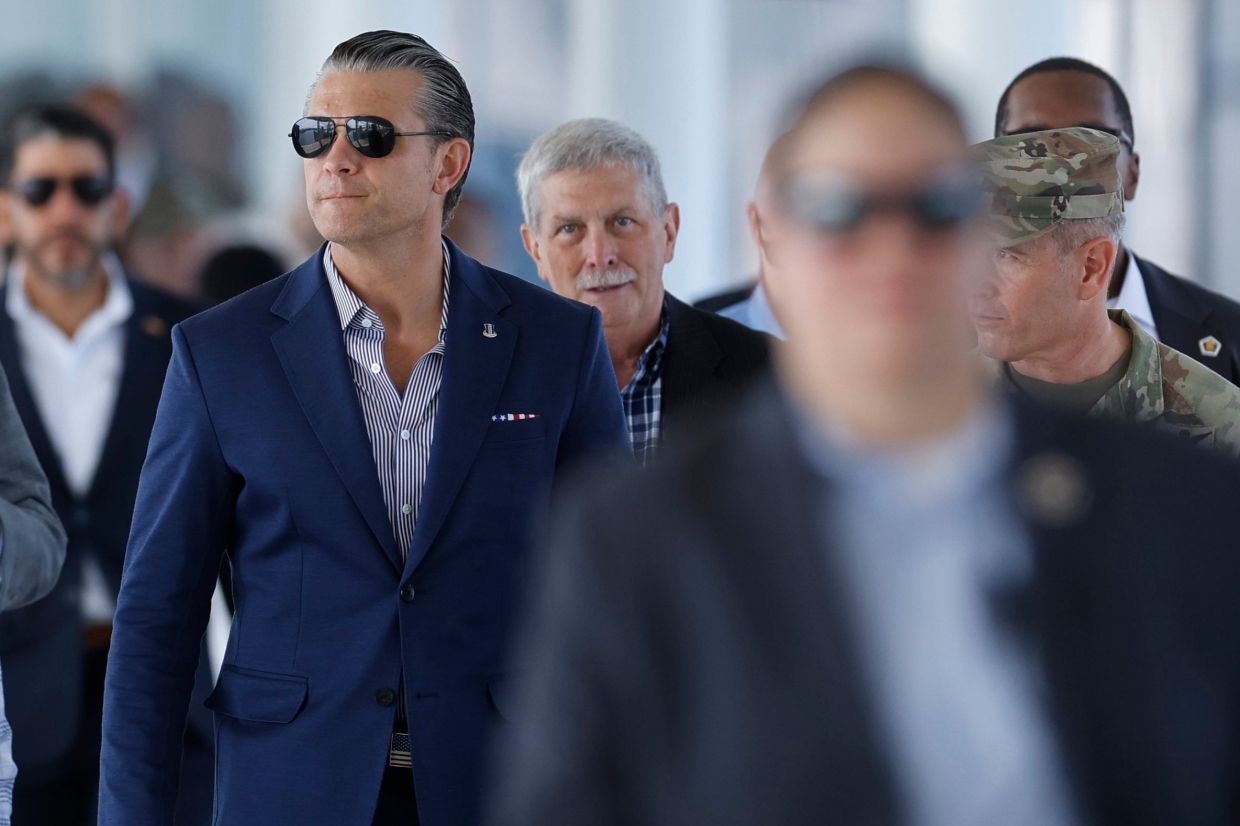
Pentagon insiders are quietly warning that US Defence Secretary Pete Hegseth faces possible removal from office, raising fresh concerns about the stability of military-to-military relations between Washington and Beijing at a moment when ties have shown unexpected improvement. Multiple anonymous sources point to an unresolved deadlock over Iran policy and accumulating negative media coverage as factors that could precipitate Hegseth's departure, creating uncertainty about the Pentagon's leadership precisely when defence engagement across the Pacific has gained momentum.
The timing is particularly delicate. Sino-American military relations have warmed notably since President Donald Trump and Chinese leader Xi Jinping met in Beijing in May, marking a significant shift from years of escalating tensions. Defence officials familiar with interactions between the two armed forces report contact occurring at nearly every organisational level during Trump's second term, with engagement quality reaching heights unseen for over a decade. This represents a tactical opportunity for both capitals to reduce miscalculation risks in one of the world's most consequential bilateral relationships.
Hegseth himself has publicly embraced this warming trajectory. Addressing defence officials several weeks after the Beijing summit, he characterised the military relationship as having improved substantially, framing the cooperation as a natural extension of Trump and Xi's commitment to building a constructive partnership. When senior American defence and diplomatic officials hosted China's Vice-Minister for Foreign Affairs Ma Zhaoxu in Washington last month, Pentagon deputy Alvaro Smith explicitly credited Hegseth's leadership for actively rebuilding what he described as a previously fractured military channel, describing the progress as steady and measurable.
Yet uncertainty surrounding Hegseth's tenure introduces a complication that Beijing must weigh carefully. Zhao Minghao, who studies international relations at Fudan University's Institute of International Studies in Shanghai, suggests that Trump may seek a scapegoat to absorb responsibility for ongoing military complications, particularly regarding Iran. He also notes that cabinet reshuffles conventionally occur as American administrations prepare for midterm elections, a pattern that could affect Hegseth's position. Should Hegseth depart, Zhao warns, the hard work of reestablishing personal relationships and institutional trust between defence establishments would require restarting from a weakened position with a new American counterpart.
Zhao points to Hegseth's direct engagement with Chinese Defence Minister Dong Jun as evidence of the relationship's personalised dimension. Their meetings in Malaysia and during Trump's Beijing visit created channels that extend beyond formal diplomacy into working-level military cooperation. A leadership change at the Pentagon would disrupt these established connections and force Chinese officials to undergo lengthy relationship-building processes with an unfamiliar American counterpart, potentially slowing the consolidation of gains achieved over recent months.
However, American officials and China specialists caution against assuming Hegseth's possible exit would fundamentally derail the developing defence relationship. The depth of current military engagement suggests that institutional momentum may prove resilient to personnel changes. Colby, a senior Pentagon official involved in recent high-level talks with Chinese counterparts, appears to have impressed Beijing through substantive discussions. Chinese officials have noted Colby's willingness to reframe Taiwan policy discussions in pragmatic rather than ideological terms, an approach suggesting flexibility in how future administrations might manage contentious issues.
One knowledgeable source describes current military contacts as functioning very smoothly, with another suggesting that Hegseth's replacement would likely have minimal impact on operational military engagement unless the successor proved to be a hardline China hawk committed to confrontation. This assessment implies that the institutional architecture supporting military communication—working-group meetings, officer exchanges, crisis communication protocols—possesses sufficient autonomy to function independent of top leadership personalities.
Zhao argues that if Colby remains in his current Pentagon position, the military relationship would benefit from policy continuity despite Hegseth's potential departure. The restoration of military-to-military contacts at working levels has already resumed, partly because Trump and Xi's stated commitment to building a relationship centred on strategic stability creates political cover for defence officials to engage pragmatically. This shared language about stability, rather than confrontation, provides a foundation that transcends individual cabinet officers.
The backdrop for this relationship involves Xi's planned state visit to Washington next month, his first such visit since 2015. Chinese and American officials view strengthening military exchanges as a crucial agenda item for that summit, reflecting mutual interest in preventing miscalculation amid broader strategic competition. Trump's apparent investment in maintaining productive defence relations—evidenced by his personal engagement with Xi and subsequent institutional follow-through—suggests that military cooperation serves his strategic interests, making it resilient to internal Pentagon turbulence.
For Malaysia and other Southeast Asian nations, the stability of Sino-American military communication carries significant implications. A functioning military dialogue reduces the risk of accidental escalation in the South China Sea and other regional flashpoints where Chinese and American forces operate in proximity. Military-to-military channels provide off-ramps during crises that diplomatic channels sometimes cannot offer, making their preservation essential to regional security. Uncertainty about Pentagon leadership thus ripples beyond Washington and Beijing, affecting the stability calculations that shape defence behaviour across Southeast Asia.
Experts observing this dynamic suggest that while Hegseth's departure would create short-term disruption requiring new relationship-building, the underlying policy framework appears sufficiently institutionalised to survive top-level personnel changes. The question centres not on whether military engagement will continue but rather on how seamlessly new leadership can sustain the momentum that has accumulated over recent months. For a region already navigating great-power competition, the answer carries weight extending far beyond Pentagon corridors.

