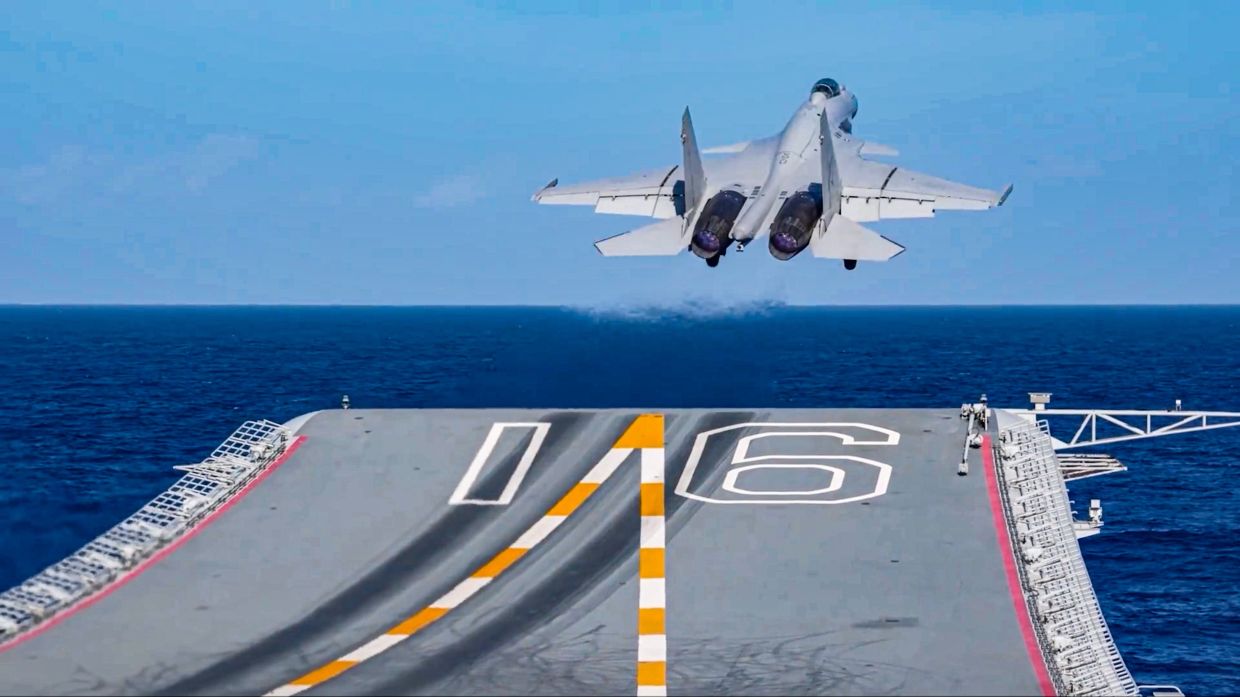
China's rapidly modernising aircraft carrier programme represents one of the most visible symbols of Beijing's naval expansion, yet defence strategists increasingly contend that the fleet's greatest vulnerability lies not in the skies above but in the waters below. Research from Washington's Centre for Strategic and International Studies has illuminated how submarine ambushes could prove catastrophic for Chinese naval operations, particularly as carrier groups venture further from protected coastal waters into the Indo-Pacific theatre where they would face coordinated opposition from advanced underwater platforms.
The strategic concept underpinning this vulnerability centres on what analysts term a "cost-imposition" strategy—a multifaceted approach designed to make Chinese carrier operations prohibitively expensive and risky. This framework encompasses diverse threat vectors including land-based strike networks, satellite-guided long-range air operations, cyber and electromagnetic warfare capabilities, and coordinated drone swarms. Yet among these various military dimensions, submarine operations emerge as the most consequential and least remediable challenge. American attack submarines prowling the western Pacific represent perhaps the single most potent threat to Chinese carrier formations, a distinction that stems directly from critical gaps in Beijing's undersea sensing infrastructure and detection architecture.
Geographical realities substantially amplify this vulnerability. The maritime chokepoints through which any Chinese carrier group must transit—whether traversing the Taiwan Strait, navigating past Japan, or moving through Southeast Asian waters—create predictable passages where ambush tactics become devastatingly effective. Intelligence agencies and military planners can position assets along these critical waterways with reasonable confidence about timing and routing, transforming chokepoint geography into a defensive advantage. Beyond these confined channels, the open ocean presents additional difficulties, where satellite-supported reconnaissance can track carrier movements and enable long-range strike aircraft to coordinate devastating attacks while disrupting communications systems that bind naval formations together.
Christopher Sharman, who directs the China Maritime Studies Institute at the US Naval War College, characterises the undersea challenge as both immediate and structural. While acknowledging that Chinese naval planners have invested substantially in recent years to enhance underwater awareness and predictive modelling capabilities, Sharman notes that significant impediments remain unresolved. Crucially, the People's Liberation Army Navy still lags the American military in meteorological and oceanographic knowledge—intelligence essential for understanding the submarine operating environment. This comparative disadvantage proves particularly acute beyond the first island chain, where Chinese forces cannot leverage their home-water advantages and must operate in unfamiliar oceanic conditions where advanced Western submarines already possess superior situational awareness.
Recognising this strategic liability, Chinese authorities have embarked on ambitious programmes to close the undersea intelligence gap. The Transparent Ocean initiative, conceptualised over a decade ago and now actively deployed, represents China's attempt to construct a comprehensive maritime surveillance architecture spanning strategically vital regions from the South China Sea through the western Pacific to the Indian Ocean. This system integrates satellites, research vessels, autonomous underwater gliders, deep-sea buoys, and seafloor sensor networks into a unified oceanographic monitoring regime. Officials have explicitly linked this programme to national security imperatives, while institutions including the Ocean University of China report deploying hundreds of deep-sea observation systems and expanding monitoring networks across priority maritime zones. Despite these investments, analysts contend that substantial gaps persist between Chinese capabilities and those possessed by American and allied forces.
Beijing has simultaneously pursued more direct military improvements to counter submarine threats. The People's Liberation Army Navy has expanded its fleet of fixed-wing maritime patrol aircraft and introduced Type 927 ocean-surveillance vessels equipped with sophisticated towed-array sonar systems. Related upgrades have modernised sensor packages on anti-submarine helicopters and patrol aircraft, enhancing their capacity to detect and track submerged adversaries. Nonetheless, these incremental improvements have not fundamentally resolved the underlying technological disparities that allow American submarines—among the world's quietest and most advanced platforms—to operate with near impunity in waters where Chinese detection systems struggle to maintain effective oversight.
The implications of this undersea vulnerability extend well beyond protecting carrier formations. Naval strategists emphasise that undersea warfare constitutes a cornerstone of Chinese military doctrine, particularly regarding potential confrontation over Taiwan. Within the first island chain, effective submarine operations represent essential components of any Beijing strategy seeking to establish sea control during wartime. Beyond that perimeter, into the Indian Ocean and beyond, Chinese military planners view undersea dominance as critical for countering American naval superiority and complicating potential third-party intervention in Taiwan scenarios. This expansive strategic vision means that submarine gaps threaten not merely individual capital ships but the entire operational logic underlying Chinese naval ambitions across the Indo-Pacific.
Timothy Heath, head of defence research firm Perceptum, amplifies these concerns by emphasising the particular lethality that American submarine platforms pose to any Chinese naval configuration. The combination of extreme acoustic quietness, advanced targeting systems, and substantial weapons loadouts creates an asymmetry strongly favouring underwater attackers. Additionally, should Japan intervene in any Taiwan conflict—a scenario that defence planners cannot dismiss—the introduction of Japanese maritime forces would substantially raise operational risks for Chinese warships operating proximate to Japanese territorial waters. In such circumstances, carriers might theoretically provide air cover for naval forces attempting to manage third-party intervention, yet this deployment option remains fraught with danger.
Indeed, Heath argues that deploying Chinese carriers at such distances would prove strategically irrational given the multiple targeting options available to American and allied forces. Land-based intermediate-range ballistic missiles remain far more survivable platforms for threatening distant maritime targets, whereas carrier deployment at extended ranges exposes extraordinarily expensive and irreplaceable assets to unacceptable risk levels. This mathematical calculation suggests fundamental constraints on where China can safely operate its carrier fleets, potentially undermining strategic objectives that presume confident power projection across vast oceanic distances. The very vulnerability that characterises undersea warfare may thus impose strategic boundaries on China's naval ambitions that technological improvements alone cannot overcome.
American defence planners have drawn explicit lessons from this analysis, arguing that procurement priorities should reflect the revealed advantages of submarine-centric naval strategies. Investment recommendations include expanded torpedo production, advanced undersea drone development, and coordinated defence industrial collaboration with allied nations including Japan and Australia. This allied approach recognises that effective counter-carrier strategies require geographically distributed capabilities and interoperable platforms extending across multiple nations and service branches. The identification of submarine warfare as the most consequential asymmetric advantage available to China's potential adversaries thus carries profound implications for how regional powers structure their defence investments and military partnerships throughout the coming decade.

