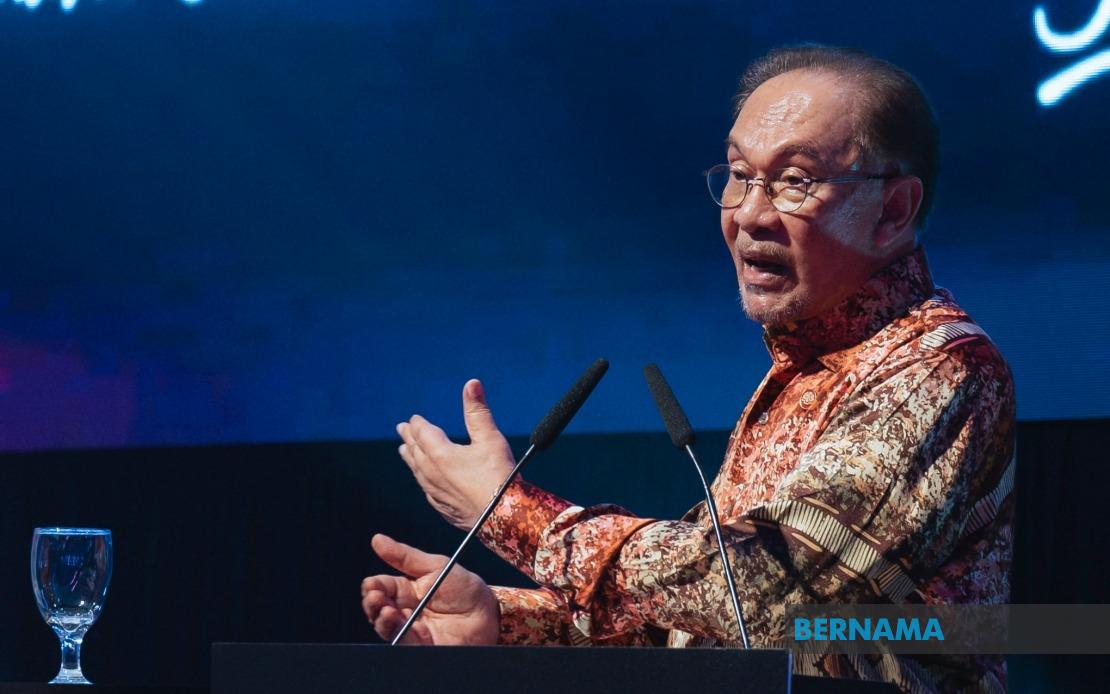
Prime Minister Datuk Seri Anwar Ibrahim's recent comments regarding Taiwan have drawn scrutiny, particularly his acknowledgement that China reserves the option of military action if peaceful reunification becomes impossible. Yet a closer examination reveals the remarks were mischaracterised by some observers. The substance of Anwar's position addresses fundamental questions of state sovereignty, deterrence doctrine, and Malaysia's own strategic posture in a region increasingly defined by great power tensions. His words warrant careful interpretation within the context of both Malaysian foreign policy and broader principles of international relations.
The crux of Anwar's argument rests upon a straightforward principle: maintaining the credible capacity to defend territorial integrity does not constitute advocacy for war, but rather a necessary component of statecraft. He employed Malaysia itself as an illustrative example, positing that no legitimate government would passively accept the disintegration of its federation without mounting some form of resistance. This observation moves beyond theoretical abstraction and touches directly on how modern states behave when faced with existential territorial challenges. The logic underpinning deterrence theory suggests that a state's refusal to renounce force entirely serves as a check against adversaries who might otherwise gamble on challenging the status quo, calculating that the costs of resistance would be prohibitively low.
Crucially, Anwar's framing preserves a hierarchy of preferred responses to international disputes. Negotiation, legal mechanisms, and political settlement occupy the primary position in this framework, with force envisioned only as a last resort should all peaceful avenues be exhausted. This distinction between reserving the right to use force and actively pursuing military confrontation represents a foundational element of deterrence thinking. A state that formally renounces military options entirely may inadvertently invite provocations from those convinced that no serious consequences await their actions. By contrast, maintaining ambiguity about willingness and capacity to respond militarily can paradoxically reduce the likelihood that force will ever be deployed, as potential adversaries refrain from testing resolve they cannot be certain of overcoming.
The application of this logic to Malaysia's established One China policy reveals the internal coherence of Anwar's position. Malaysia officially recognises the People's Republic of China as the legitimate Chinese government and has consistently declined to extend diplomatic recognition to Taiwan as an independent state. Simultaneously, Malaysia maintains substantial economic relationships with Taiwan and nurtures extensive people-to-people connections across the Taiwan Strait. Within this diplomatic framework, Anwar's observation gains particular weight: if Malaysia accepts the One China principle, it follows logically that Beijing's concerns regarding territorial integrity and reunification carry legitimacy from the perspective of that very policy. The analogy between Malaysia's hypothetical resistance to federation breakup and China's position on Taiwan illuminates this point without requiring endorsement of any particular means of achieving reunification.
The Taiwanese perspective naturally diverges sharply from this characterisation. Taiwan views itself as a thriving, autonomous democracy fully entitled to self-determination, and consequently rejects framing that treats the island as merely a wayward province awaiting return to the fold. From Taipei's vantage point, any Malaysian or international reference to force as a viable option in the Taiwan dispute risks legitimising coercion and undermining the principle that political outcomes should reflect the genuine consent of affected populations. This fundamental disagreement over Taiwan's status and the legitimacy of force in resolving it persists regardless of how carefully one articulates the philosophical distinction between maintaining deterrent capacity and endorsing military action.
Malaysia's regional position demands exceptional sensitivity to these competing claims. A military conflict across the Taiwan Strait would inflict severe consequences upon the entire Southeast Asian region, disrupting critical maritime supply chains, fragmenting global trade networks, and destabilising the carefully maintained balance upon which ASEAN's consensus-based diplomacy depends. The waters surrounding Taiwan represent some of the world's most economically vital corridors, and any sustained military confrontation would reverberate through Malaysian ports, manufacturing sectors, and export markets. Malaysia therefore maintains a compelling interest in supporting sustained dialogue, restraint from all parties, and the peaceful resolution of disputed issues through mechanisms that respect the concerns and perspectives of all stakeholders involved.
An essential clarification must be underscored: Anwar's remarks should not be interpreted as advocacy for military conflict or endorsement of coercive approaches to the Taiwan question. Rather, they reflect a realist perspective rooted in classical international relations thinking about how sovereign states approach questions of territorial integrity and existential security. Realism as an analytical framework does not celebrate violence; rather, it acknowledges that states operating within an anarchic international system where no supreme authority can guarantee their survival must maintain the material and psychological capacity to defend their core interests. This orientation does not preclude preference for peaceful settlement, diplomacy, and negotiation, but it does reject the notion that states should voluntarily strip themselves of all defensive options.
The conceptual foundation underlying deterrence doctrine reveals why Anwar's distinction matters operationally. The entire mechanism depends upon potential adversaries harbouring uncertainty about the costs of challenging the status quo. A state that explicitly renounces force removes this uncertainty and effectively invites testing of its resolve. Conversely, a state that maintains ambiguity about its willingness and capacity to respond may never need to demonstrate that willingness through actual combat. In this framework, the mere existence of credible defensive capability serves the cause of peace by rendering conflict unnecessarily costly to any rational actor contemplating provocative action. Whether observers find this logic persuasive remains contested, but its relevance to state behaviour across centuries of international history cannot be dismissed.
Malaysia's own foreign policy reflects this balanced approach, though sometimes imperfectly articulated. The country upholds the One China principle in its official diplomatic recognition and international statements. Simultaneously, Malaysia deliberately avoids language or policies that would actively support military pressure upon Taiwan, instead encouraging restraint and dialogue among all parties. This position accommodates Malaysia's strategic interests, its relationships with multiple great powers, and its commitment to regional stability. Anwar's remarks, properly understood, fit comfortably within this framework rather than representing a departure from established Malaysian practice or principle.
The deeper implication of this entire discussion concerns how middle powers like Malaysia navigate the treacherous terrain between competing great power interests while maintaining their own strategic autonomy. Anwar's comments reflect an effort to explain, rather than endorse, how major powers calculate their security interests and defend their territorial integrity. By articulating this logic, Anwar neither embraces military confrontation nor abandons Malaysia's long-standing commitment to peaceful settlement of disputes. Instead, he demonstrates awareness that managing great power tensions requires understanding, not dismissing, the strategic reasoning that informs their positions. This intellectual honesty serves Malaysia better than rhetorical posturing that ignores the underlying realities of international competition.
Moving forward, Malaysia should sustain its commitment to restraint, dialogue, and peaceful resolution mechanisms while recognising that other actors may operate from different strategic premises. The core Malaysian interest centres not on the means by which China and Taiwan eventually resolve their differences, but on ensuring that whatever eventual settlement emerges does not disrupt regional stability or harm Malaysian prosperity. By maintaining this focus, Malaysia can support international efforts to reduce tensions without naively suggesting that all parties will simultaneously abandon the capacity to defend interests they deem vital to their survival and national purpose.

