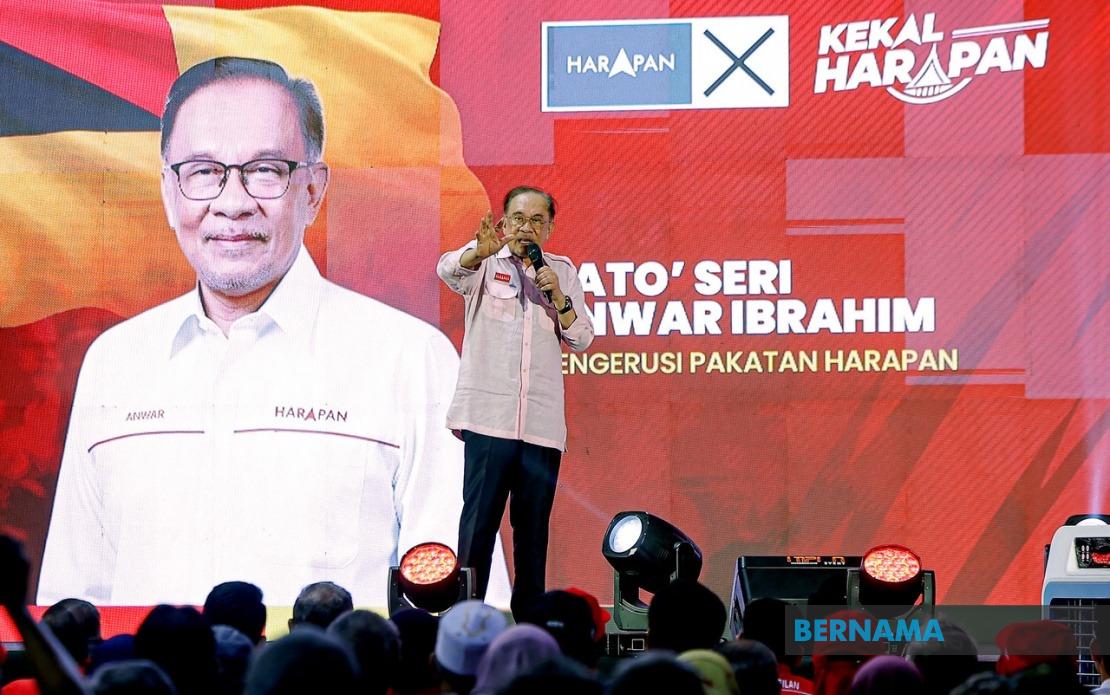
Prime Minister Datuk Seri Anwar Ibrahim has provided reassurance about the resilience of the federal Unity Government, emphasising its continued stability and capacity to support Malaysia's economic trajectory. Speaking in Seremban on July 22, Anwar stressed that the coalition arrangement at the federal level remains intact and functioning effectively, a development he views as critical to maintaining investor confidence and sustaining the country's growth momentum during an otherwise challenging period.
The Prime Minister's remarks come against a backdrop of periodic tensions within the broader coalition, which comprises multiple political parties with distinct electoral interests. Anwar acknowledged this reality directly, noting that while state-level competition between coalition partners creates occasional friction, such rivalries have not undermined the federal government's operational coherence. This distinction between state and federal dynamics is significant, as it reflects the pragmatic compartmentalisation that has allowed the Unity Government to persist since its formation following the 2022 general election.
Anwar highlighted the consistent execution of Cabinet meetings as tangible evidence of functional partnership among coalition partners. He referenced recent sessions chaired by himself, attended by key ministers including Agriculture and Food Security Minister Datuk Seri Mohamad Sabu, Transport Minister Anthony Loke, and Deputy Prime Minister Datuk Seri Dr Ahmad Zahid Hamidi, among other cabinet members. The regularity and apparent harmony of these gatherings underscores the working arrangements that enable day-to-day governance despite the coalition's inherent structural complexities.
The Prime Minister's emphasis on preserving federal-level stability reflects genuine concern about the economic consequences of political instability. For Malaysia, investor sentiment remains sensitive to perceptions of political chaos or governmental dysfunction. Any suggestion of imminent coalition collapse or ministerial discord could trigger currency volatility, reduce foreign direct investment inflows, and complicate efforts to implement the government's economic agenda. Anwar's public reaffirmation of stability serves therefore not merely as political posturing but as a reassurance mechanism directed toward domestic and international economic stakeholders.
The timing of Anwar's statement is noteworthy, arriving as various state-level electoral contests create natural flashpoints for coalition friction. In several states where coalition partners compete directly, tensions over nominations and campaign support have surfaced, raising legitimate questions about whether such rivalry could metastasise into federal-level dysfunction. Anwar's remarks suggest the federal leadership has successfully insulated national governance structures from these lower-level controversies, at least thus far.
The Unity Government represents a distinctive political arrangement within Malaysia's context, assembled from diverse ideological traditions and electoral bases. Unlike single-party governments that maintain unified command structures, the coalition requires continuous negotiation and compromise among constituent parties holding distinct policy preferences and organisational interests. That this arrangement has produced functional Cabinet operations and measurable policy outputs demonstrates either genuine commitment to shared governance or, alternatively, a sophisticated capacity to manage competing agendas for mutual benefit.
Anwar's invocation of Islamic faith through "Insha'Allah" in hoping the stability persists post-election adds a spiritual dimension to his political assessment, suggesting he recognises the arrangement's fragility despite his confident public pronouncements. Elections naturally create uncertainties in coalition politics, as electoral outcomes can shift the balance of power between partners or introduce new actors requiring accommodation. His conditional hopefulness thus reflects realistic acknowledgment that current arrangements, however functional, depend on continued political calculations by coalition members that cooperation serves their respective interests.
The stakes of maintaining federal cohesion extend beyond immediate governance. Malaysia's development agenda, including infrastructure projects, financial reforms, and international trade negotiations, requires continuity of executive authority and policy direction. Economic actors, both domestic and foreign, require predictability about the government's intentions and capacity to execute commitments. Periodic coalition tensions, while perhaps inevitable in plural governments, risk creating the perception of drift precisely when decisive action matters most for addressing challenges like inflation, infrastructure deficits, and regional economic positioning.
From a Southeast Asian perspective, Malaysia's political stability influences regional dynamics and ASEAN's collective capacity to respond to challenges. Prolonged internal governmental dysfunction could diminish Malaysia's regional profile at a time when the country seeks to maintain influence within ASEAN and vis-à-vis major powers. Anwar's affirmation of federal stability thus carries implications beyond domestic borders, signalling to regional partners and external powers that Malaysia's government retains coherence and capacity.
The fundamental question underlying Anwar's statement concerns the sustainability of the current coalition arrangement. While he expresses confidence in its continuation, structural tensions remain inherent to any arrangement requiring multiple parties to subordinate autonomous interests to collective governance. The success of the Unity Government ultimately depends on whether coalition partners conclude that continued cooperation serves their long-term political fortunes better than alternatives including realignment or renewed electoral competition.
Moving forward, the federal government faces a complex balancing act. Coalition partners must simultaneously compete credibly at state level to maintain their respective electoral bases while demonstrating sufficient discipline to preserve federal governance functionality. This dual imperative becomes increasingly challenging as elections approach and parties position themselves for post-election negotiations. Anwar's leadership challenge consists substantially in maintaining this balance, using his position as Prime Minister to anchor coalition cohesion while allowing sufficient competitive space for partners to establish distinct identities.

