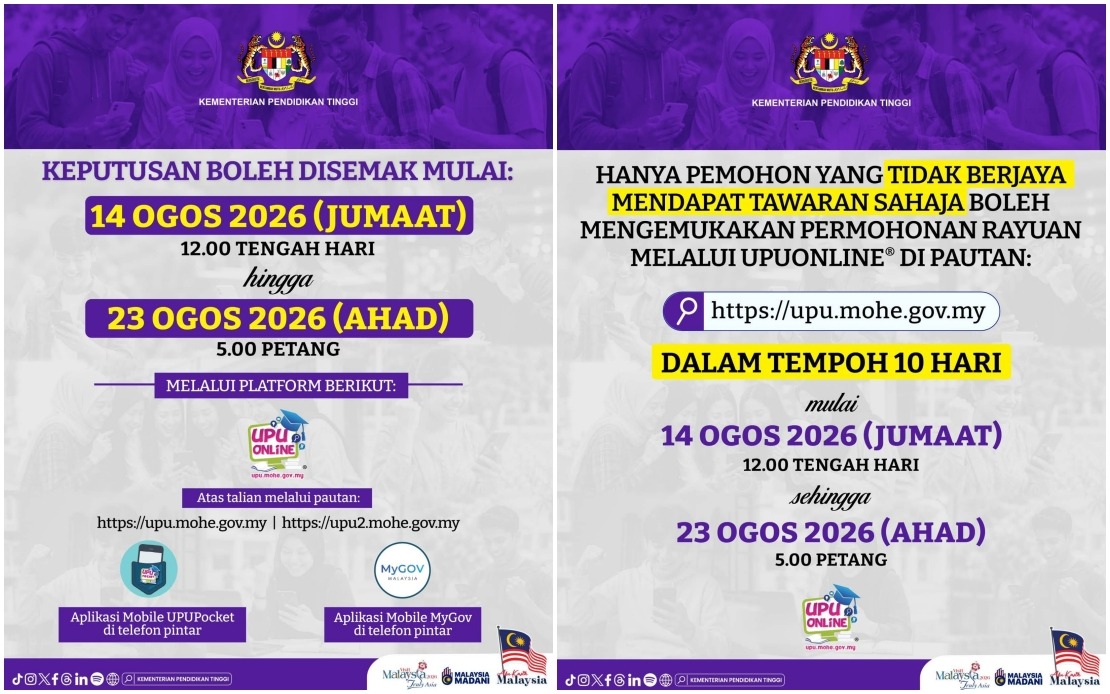
Prospective undergraduates holding STPM and equivalent qualifications will receive their public university admission decisions on August 14, marking a crucial milestone in Malaysia's university placement cycle for the 2026/2027 academic session. The Ministry of Higher Education has confirmed that results will become accessible through multiple digital channels beginning at noon, extending through August 23, ensuring candidates have sufficient time to review their outcomes across several platforms.
Applicants seeking their results can access them via three primary routes: the main UPU portal at https://upu.mohe.gov.my, the secondary UPU system at https://upu2.mohe.gov.my, or through mobile applications including Mobile UPUPocket and Mobile MyGov, which have become increasingly popular among younger cohorts preferring smartphone-based access. This multi-channel approach reflects efforts to accommodate diverse technological preferences and address potential system congestion during peak usage periods when thousands of candidates log in simultaneously.
The admission confirmation process follows immediately after result publication, with universities opening their portals from August 15 onwards to allow successful applicants to formally accept or decline their offers. This nine-day confirmation window provides candidates adequate time to review multiple offers if they have applied to several institutions and programmes, enabling informed decision-making before finalising their academic trajectories. The staggered timeline reduces pressure on individual students while allowing universities to manage their intake systematically.
Formal offer letters will be dispatched by individual universities starting August 15, but only to candidates who have confirmed their acceptance during the specified period. This conditional documentation approach ensures that paperwork reflects genuine commitment to enrolment rather than provisional allocations, streamlining institutional planning for dormitory assignments, course scheduling, and resource allocation across faculties and departments. Universities typically utilise this data to finalise their intake numbers and identify any unfilled positions requiring additional recruitment efforts.
Candidates who do not receive offers face a structured appeal mechanism permitting them to submit formal objections and request reconsideration for alternative programmes or institutions where vacancies arise. The appeal submission window runs from August 14 through August 23, providing unsuccessful applicants with a ten-day period to lodge applications through the UPUOnline portal. This appeals process has become an important safety valve in Malaysia's higher education system, allowing qualified candidates to access university places that become available when higher-ranked applicants decline offers.
However, appeal prospects depend directly on available vacancies emerging after initial candidates complete registration in late August and early September. Universities only allocate appeal positions from genuine surplus places within specific programmes, meaning appeal success rates vary considerably depending on programme popularity and initial acceptance rates. This vacancy-dependent approach occasionally frustrates appeals applicants who may remain uncertain whether positions will materialise for their preferred fields of study.
The Ministry of Higher Education has explicitly stated that offer allocations for the 2026/2027 session are final, prohibiting any subsequent programme or institution changes once candidates formally accept their places. This policy aims to enhance institutional planning certainty and prevent the cascading complications that arise when large numbers of enrolled students subsequently request transfers. While this firmness provides universities with reliable intake projections, it also places considerable pressure on initial applicants to select carefully, knowing they cannot easily switch programmes or transfer between universities after acceptance.
For Malaysian students and families, this admission cycle represents a pivotal transition point determining educational pathways and career trajectories. STPM qualifications remain the primary gateway to public university places, with the highly competitive process reflecting limited domestic undergraduate spaces relative to demand. Understanding the timeline and submission procedures is critical, as late applications or missed deadlines can result in permanent exclusion from the initial round, leaving candidates dependent on the more precarious appeal process.
The August 14 results announcement also has broader implications for Malaysia's higher education ecosystem and regional competitiveness. Public universities shoulder responsibility for developing human capital across diverse fields, from engineering and medicine to arts and social sciences. The admission outcomes will reveal whether institutions successfully attract academically accomplished STPM holders or whether increasing numbers pursue diplomas, technical qualifications, or international university pathways instead. Such trends inform policy discussions about university funding, programme competitiveness, and whether domestic institutions adequately meet student aspirations and labour market demands.
Regional context matters considerably here, as Southeast Asian countries increasingly compete for talented students through scholarship programmes, international campuses, and innovative curricula. Malaysia's admission process and university reputation directly influence whether top STPM performers choose domestic institutions or migrate to universities in Singapore, Australia, the United Kingdom, or other destinations. The August results season thus functions as a barometer of confidence in Malaysian higher education quality and value proposition among the nation's most academically advanced school leavers.

