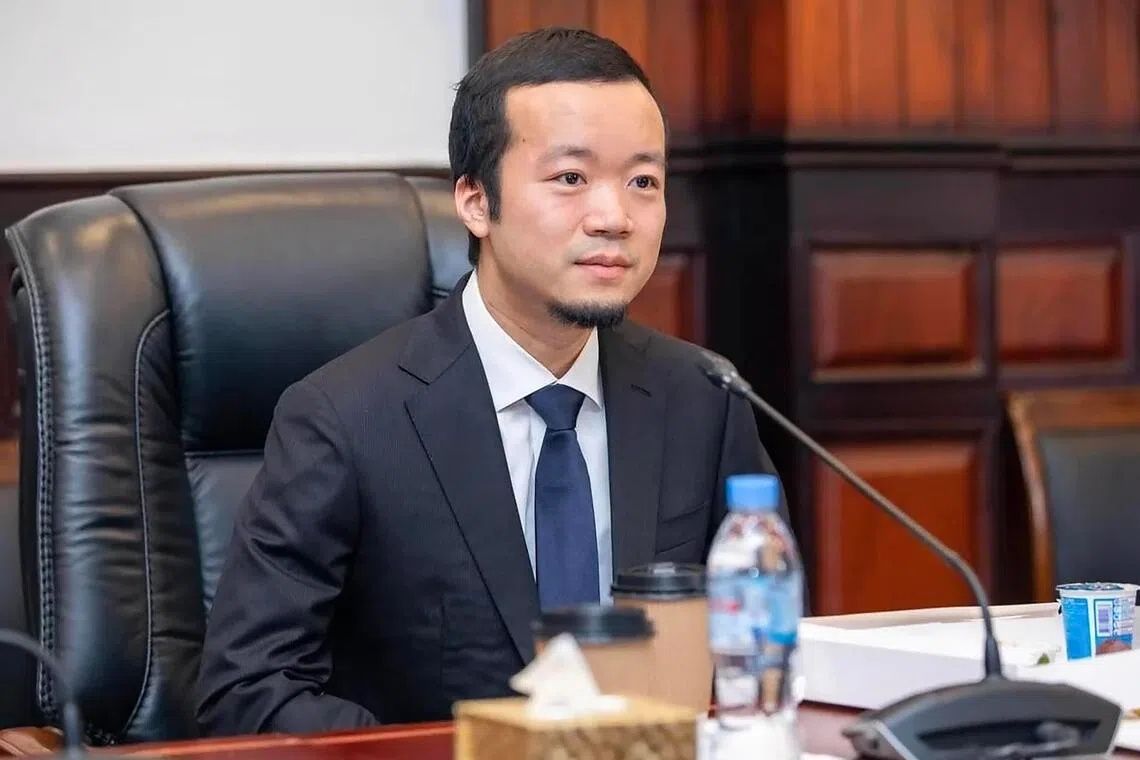
Law enforcement agencies in the United States have charged Chen Xing, a key figure in an international fraud and money laundering operation, alongside his superior Chen Zhi. Identified in a New York indictment filed on October 8, 2025, Chen Xing operated under multiple identities across different jurisdictions, a sophisticated approach that allowed him to shield his involvement in one of the largest criminal enterprises uncovered in recent years. The Straits Times and the Organised Crime and Corruption Reporting Project spent six months piecing together fragments of official records to establish his real identity and trace his global operations, revealing how his network of shell companies facilitated the laundering of billions obtained from scam compounds in Cambodia where foreign workers were held against their will.
Born in Shanghai in 1986, Chen Xing reinvented himself as Chen Sokly after acquiring Cambodian citizenship near the end of 2017, according to records in the Cambodian government gazette. His ability to obtain multiple nationalities—adding Cypriot citizenship to his portfolio—formed part of a deliberate strategy to compartmentalise his activities and evade detection. In Singapore, where he maintained a substantial profile as a businessman, he cultivated yet another persona, using the anglicised name Martin Chen to move through elite social circles. This layering of identities across jurisdictions typified the operational security methods employed by Chen Zhi's organisation, which maintained networks spanning Asia, Europe, and North America.
Within the Prince Holding Group structure, Chen Sokly held the critical position of risk control officer, tasked with anticipating threats to the operation and neutralising them before they could escalate. This role extended far beyond routine business management; it encompassed surveillance of law enforcement investigations and the cultivation of corrupt relationships with government officials in multiple countries. His authority to engage in bribery and influence peddling placed him at the inner circle of the syndicate, reporting directly to Chen Zhi on matters of strategic importance to the organisation's survival and expansion.
The indictment alleges that in May 2023, Sokly engaged in a conversation with a Chinese government official who offered to protect Prince Group members from legal consequences in exchange for financial favours. The arrangement exemplified the syndicate's approach to risk mitigation: rather than abandon illegal activities, the organisation sought to place key officials within law enforcement and government on its payroll. Sokly's confidence in these relationships bordered on reckless; when Cambodian authorities launched crackdowns on scam compounds in late 2023, he dismissed concerns among associates, boasting that nothing would happen to his organisation due to the protections he had secured. This arrogance would prove premature, but documents seized by US authorities revealed the depth of his corruption network and the scale of resources allocated to maintaining it.
Bribery appears systematically embedded in the syndicate's operations. A ledger recovered during the investigation documented Sokly's purchase of a yacht valued at more than three million US dollars as a gift to a foreign government official in 2019, a transaction that would have required substantial financial flows through the money laundering apparatus. In internal communications with Chen Zhi, the two men discussed their contacts with government figures with the casualness of businessmen reviewing partnership portfolios, suggesting that corruption operated as a core business function rather than an occasional expedience. Sokly's boasts to associates that the global operation generated thirty million US dollars daily through illicit activities reflected genuine scale; the US government's seizure of 127,271 bitcoins valued at approximately fifteen billion dollars represented only a fraction of the organisation's accumulated wealth.
Beyond corruption, Sokly also served as the organisation's enforcer, maintaining discipline through intimidation and violence. When internal theft occurred within the syndicate—a member absconding with organisation funds in July 2024—Sokly was called upon to restore order through direct action. This dual role as both the corruption manager and internal security chief highlighted his indispensability to Chen Zhi's operations and the trust placed in him despite the risks such concentration of power typically posed.
Sokly's property acquisitions across the United States and Singapore reveal the visibility of his ill-gotten wealth during the period when the organisation operated with relative impunity. In California, he purchased a residential property in 2019 from Fang Zhizhen, a member of the Knight Attack Group, a cybercriminal syndicate that preceded Prince Group in the regional ecosystem. The transaction itself suggests interconnections between separate criminal enterprises, with personnel and assets flowing between organisations. He later sold this property in 2024 for approximately four and a half million US dollars, timing that transaction before the full weight of sanctions. More telling was his transfer of a separate four million dollar property to his wife on November 4, 2025, just weeks after the indictment, followed by placement of the assets into a trust controlled by his spouse in December—a textbook manoeuvre in asset protection that acknowledged the vulnerability of his position.
In Singapore, where Sokly established himself as a wealthy foreign businessman, his arrival was announced through an acquisition of an apartment at 10 Leedon Heights for 11 million Singapore dollars in 2017. The luxury property, comprising nearly 5,700 square feet, served as his residential base and social hub. Shortly thereafter, he incorporated M Capital Global Holdings and invested over five million Singapore dollars jointly with his wife, a partnership structure that would prove useful in subsequent asset shielding activities. Between 2017 and 2019, Sokly registered himself as a director across at least sixteen Singapore companies, many operating from an office at Shenton Way where investigators found no legitimate business activities corresponding to the directorships. His name was systematically removed from corporate records between 2020 and 2023, suggesting a deliberate retreat from visible business operations as scrutiny intensified.
Former employees who worked with Sokly characterised him as a part-time presence in Singapore, typically visiting for two to three month periods annually. During these stays, he cultivated social relationships with Chen Zhi and other associates through evening entertainment, projecting the image of a successful international businessman. His vehicle collection—including a Bentley and luxury seven-seater—was stored at his Leedon Heights residence, a visible display of wealth that communicated status within his network. This pattern of intermittent presence, selective visibility, and compartmentalised business activities allowed him to maintain a position of influence while minimising his exposure to local law enforcement scrutiny.
The unravelling of Sokly's operations began with the US Treasury Department's Office of Foreign Assets Control imposing sanctions on the Prince Group and its associated individuals and entities on October 14, 2025—six days after the criminal indictment. The sanctions action identified not only Sokly but also nine other individuals and twenty-six entities connected to the organisation, indicating the sprawling nature of the conspiracy. The seizure of cryptocurrencies and the freezing of international assets triggered a cascade of asset protection measures, including the transfer of properties to family members and placement into trusts, actions that confirmed the timing of authorities' investigation and Sokly's awareness of impending enforcement action.
For Malaysia and Southeast Asia more broadly, the Sokly case illuminates the operational methods used by transnational organised crime groups to embed themselves within legitimate business communities and leverage corrupted officials to sustain large-scale criminal enterprises. The region's growing appeal as a regional headquarters for such operations—evident in the Prince Group's use of Cambodia for scam compounds and Singapore for financial infrastructure—presents ongoing challenges for national authorities. The sophistication demonstrated in identity management, money laundering through property acquisition, and systematic corruption of government officials suggests that many such operations may continue undetected despite increased international cooperation. The exposure of Sokly's network demonstrates the necessity of enhanced cross-border information sharing and financial transparency mechanisms to identify and disrupt these schemes before they accumulate the massive resource bases that make them resilient to enforcement action.

