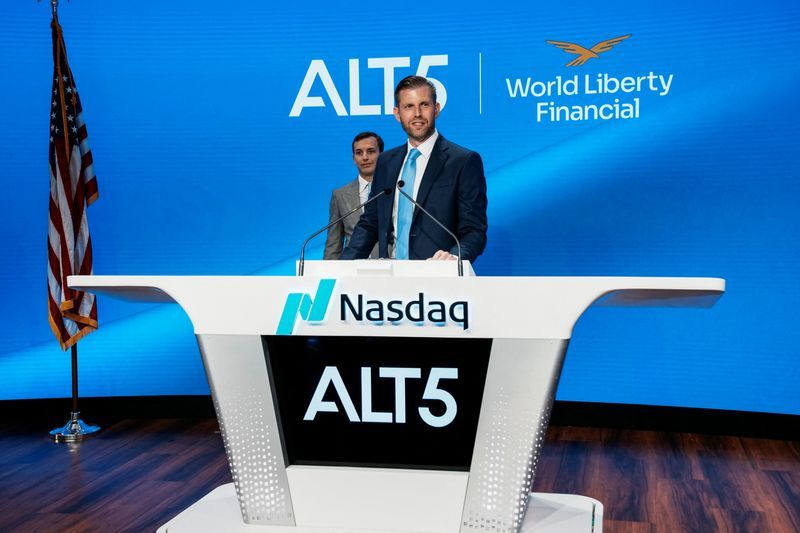
American banking authorities have cleared the way for World Liberty Financial, a cryptocurrency platform closely associated with President Donald Trump and his family, to operate as a federally chartered trust bank. The Office of the Comptroller of the Currency announced the conditional preliminary approval on Friday, a development that represents a significant step forward for one of the Trump family's most prominent financial ventures in the digital assets sector.
The approval grants World Liberty Trust Company a conditional national trust charter following its application submitted in January. While final approval remains contingent on meeting various regulatory conditions, the green light from the OCC signals recognition that the company meets baseline standards for operating within the heavily regulated banking infrastructure. The charter would permit the firm to manage and custody assets on behalf of clients across the United States under a single federal framework, while also enabling faster settlement of payments through blockchain infrastructure.
Crucially, the charter does not extend traditional banking powers such as deposit-taking or consumer lending. Instead, it focuses on asset custody, management, and settlement functions—precisely the capabilities that crypto companies have sought from federal regulators. This distinction matters for institutional adoption, as it allows World Liberty to offer services to major clients seeking to enter cryptocurrency markets without exposing themselves to unregulated entities. The regulatory blessing carries significant weight in an industry long viewed with scepticism by traditional finance.
The Trump administration's embrace of cryptocurrency has created unprecedented opportunity for digital asset firms seeking federal recognition. Comptroller Jonathan Gould, appointed by Trump last year, has already approved preliminary charters for other major crypto companies including Ripple and Circle. World Liberty's approval reflects a broader shift in regulatory posture, though it also raises questions about the speed and consistency of vetting processes. The company's most tangible benefit from the charter lies in direct issuance and custody of its USD1 stablecoin, operations currently outsourced to BitGo, a third-party custodian.
World Liberty Financial itself heralded the decision as transformational. Zach Witkoff, the company's president and chairman, described the conditional approval as a milestone that would consolidate stablecoin issuance, custody, and reserve management under unified OCC supervision. His language deliberately invoked traditional banking standards, framing the company as subject to the same oversight principles governing conventional financial institutions. This rhetorical move addresses persistent public and political scepticism about whether crypto ventures deserve equal regulatory status.
However, the charter carries substantial conditions that World Liberty must satisfy. The company must maintain minimum capital of USD20 million, notify regulators of any major business plan changes, and appoint a qualified internal audit manager. These requirements, while standard for trust banks, establish clear accountability mechanisms. The OCC's approval letter also specifically addressed concerns about foreign ownership, noting that non-United States investors are not considered principal shareholders and have signed agreements pledging not to influence the bank's operations. Among those who signed such passivity agreements is Eric Trump, the president's son, acting on behalf of Trump-family investment vehicles.
The foreign ownership issue carries particular political weight. Democratic senators previously raised national security questions about World Liberty's funding structure, specifically a reported USD500 million investment stake linked to the United Arab Emirates' national security adviser. The OCC's handling of these concerns through investor passivity agreements represents a pragmatic solution, though it also reflects the administrative challenge of scrutinising complex cross-border financial arrangements. The regulatory letter emphasises that OCC staff reviewed the application consistently with statutory and ethical obligations, with career staff conducting review rather than political appointees, an assertion that directly addresses Democratic claims of partisan bias.
World Liberty Financial's leadership is deeply entangled with Trump's personal network and longtime allies. Zach Witkoff serves as the company's chief executive while also functioning as president of the trust bank; he is the son of Steve Witkoff, Trump's special diplomatic envoy. The Witkoff family itself co-founded World Liberty alongside Trump and his three adult sons in late 2024. Steve Witkoff's brother Robert will serve as a director of the trust bank, while Scott Alper, president of the Witkoff family real estate business, is proposed as another director. This interlocking structure means that approval of the charter essentially validates an enterprise whose decision-making authority flows directly from Trump's innermost circle.
The USD1 stablecoin has demonstrated remarkable market momentum since its public launch in March 2025. The token has climbed to become the fourth-largest stablecoin by market capitalisation, with approximately USD4 billion in circulation. Reuters calculations suggest the Trump family has earned roughly USD50 million from USD1 issuance through June 2026, with World Liberty Financial channelling more than USD1.6 billion to the president and his family as of April. These figures underscore why the OCC approval matters so intensely: it unlocks the company's ability to expand stablecoin issuance dramatically while directly managing reserves, a combination that could significantly increase revenues flowing to Trump and his associates.
The approval also reflects the structural asymmetries within American financial regulation. Unlike most other financial regulators, the OCC operates without a bipartisan board, placing considerable discretion in the hands of the comptroller. Democrats have characterised the World Liberty charter as presenting a profound conflict of interest, given Trump's direct financial stake in the company's success. During congressional testimony, Democratic senators demanded that Comptroller Gould disclose the company's unredacted application, arguing that the public version omitted essential information about capital structure and business strategy. The OCC's response—releasing a redacted version and asserting that career staff rather than political appointees made the decision—has done little to assuage these concerns.
World Liberty Financial and its parent ecosystem position themselves as democratising finance by circumventing what the Trump family characterises as a restrictive and inequitable traditional banking system. The company frames USD1 as a gateway enabling ordinary people to access diverse financial products operating on blockchain infrastructure, a narrative that resonates with crypto advocates seeking to reduce dependence on institutional intermediaries. However, the intense corporate structure tying the venture to Trump's family and inner circle complicates this populist messaging, raising questions about whether decentralisation rhetoric can credibly apply to a platform where decision-making power concentrates among a small group of Trump-aligned executives.
For Southeast Asian observers and investors, the implications extend beyond Washington politics. The OCC approval legitimises the broader regulatory framework within which crypto companies operate, potentially influencing how Asian authorities approach similar applications. Malaysia, Singapore, and other regional jurisdictions monitoring American regulatory developments may interpret federal approval of such ventures as implicit validation of stablecoin models, regardless of whether regional standards actually match American oversight. Additionally, the rapid growth of USD1 and World Liberty's billion-dollar revenues demonstrate the commercial potential of blockchain-based financial platforms, dynamics that regional policymakers must account for as they formulate crypto strategies.
The conditional approval remains subject to final ratification at an unspecified future date, meaning regulatory review continues. Yet the OCC's preliminary blessing has effectively removed the most substantial barrier to World Liberty's expansion, allowing the company to market itself as a federally regulated financial institution. This milestone illustrates how regulatory structure shapes cryptocurrency's trajectory: approval by a single regulator in a single jurisdiction can transform a venture from speculative digital asset platform into legitimised financial service provider.

