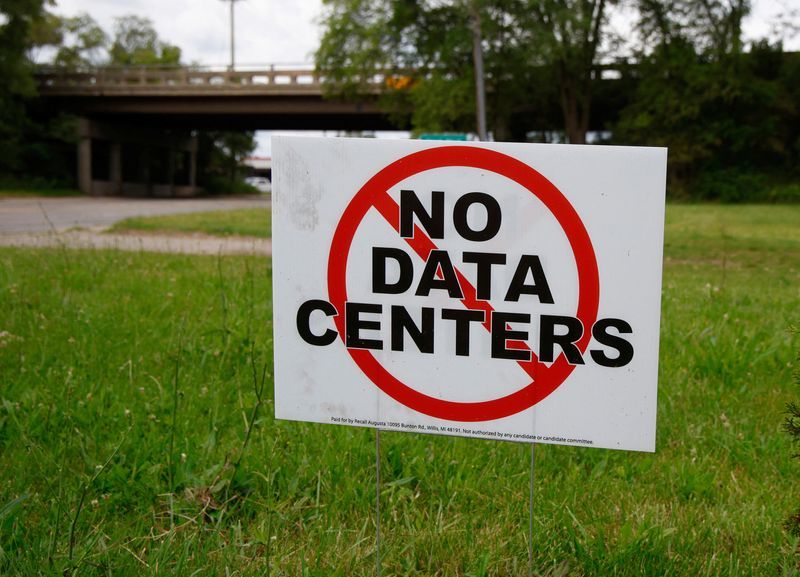
The backlash against America's accelerating data center construction is reaching a crescendo. On Saturday, opponents of the artificial intelligence infrastructure boom plan to stage coordinated protests spanning at least 125 locations across the United States—marking the first nationwide effort to consolidate local grievances into a unified political message. This mobilization represents a significant shift in how communities are responding to what many perceive as an uncontrolled expansion of Big Tech's physical footprint across American soil.
The protests are being orchestrated by HumansFirst, a grassroots organization founded by Amy Kremer, a prominent figure in the Tea Party movement of the late 2000s. Kremer's involvement signals how the data center issue has transcended traditional partisan boundaries. She has deliberately framed the anti-data-center movement as a nonpartisan phenomenon, comparing its grassroots character to the populist energy that characterized early Tea Party activism. The coalition explicitly opposes what it characterizes as the "unaccountable" expansion of data infrastructure and what it calls an "unacceptable infringement on our liberty." This framing suggests the movement views corporate deployment of data centers not merely as a local planning issue but as a fundamental question about who controls America's future and whether communities retain agency over their own development.
Until recently, opposition to data centers remained largely fragmented at the municipal level, with individual towns and counties pushing back against developer proposals with limited coordination. What has changed the landscape is the sheer scale and pace of deployment. Technology giants including Meta, Alphabet, Amazon, and Microsoft are racing to build data center infrastructure to support their artificial intelligence ambitions, and many projects have been approved through processes that critics argue lacked transparency or rigorous public consultation. In numerous cases, local officials have signed non-disclosure agreements with developers, effectively silencing public debate even as residents raised serious concerns about environmental and infrastructure impacts.
Public opinion data suggests the grievances are widely shared. A Reuters-Ipsos poll conducted in June revealed that only one-third of Americans approve of the current pace of data center construction in the country. Even more striking, just 14 percent of respondents said they would support building a data center in their own community to service artificial intelligence projects by major technology firms. This dramatic gap between national acceptance and local opposition reflects a classic "not in my backyard" phenomenon but also suggests deeper anxieties about whether communities are being consulted meaningfully or are instead being presented with faits accomplis by corporate entities with superior resources and political connections.
The geographic distribution of Saturday's protests reveals which states have become particular hotspots for data center development. Texas, a Republican-controlled state with abundant energy infrastructure and favorable regulatory conditions, leads with 16 planned protests. Georgia, a closely watched battleground state in national elections, follows with 11. California, Florida, and Pennsylvania each have seven scheduled demonstrations, reflecting how data center expansion has become a coast-to-coast phenomenon rather than concentrated in any particular region. This geographic spread underscores how the issue cuts across America's familiar political geography and voter coalitions.
Among the protesters are individuals from across the political spectrum. Eva Cardona, a 31-year-old first-time activist she describes as a "political nomad," is organizing a Texas protest, motivated by alarm at unregulated artificial intelligence deployment and rapid infrastructure growth. On the other side, Ivan DelSol, a 54-year-old left-leaning organizer, is leading a demonstration in Imperial County, California, where a proposed data center project could consume 260 million gallons of water annually from the Colorado River. DelSol characterized such water consumption as "dystopian," highlighting how the environmental dimension of data center opposition resonates across ideological divides.
Water scarcity has emerged as a central concern, particularly in water-stressed regions of the West and Southwest. The contrast between the human consumption needs of entire communities and the industrial water demands of data centers creates powerful symbolic and practical arguments for opponents. However, the data center industry disputes the significance of these water concerns, arguing that their consumption pales in comparison to other industrial users. This disagreement reflects a fundamental divergence in how the industry and its critics assess environmental sustainability and the appropriate balance between technological progress and resource preservation.
Beyond water and energy, protesters are articulating broader demands about the development process itself. Organizers want greater transparency in project approval procedures, protection of community resources and environmental health, concrete community benefits such as well-paid union employment, and enforceable accountability mechanisms to ensure developers follow through on promised commitments. These demands suggest that opposition is not merely reflexive resistance to change but rather a reasoned critique of how corporate development projects are being implemented without adequate community input or long-term responsibility.
Notably, the political establishment across party lines is beginning to respond to constituent pressure. State and national politicians are attempting to develop policy responses to mounting voter anger over projected increases in electricity bills, diversion of water resources, and pollution concerns. Even within the grassroots opposition, there is disagreement about remedies. While some organizers reject moratorium approaches like those adopted in New York, a Democratic-controlled state, the existence of such debate indicates that data center policy is becoming a serious matter of electoral consequence and not merely a footnote in technology policy discussions.
Amy Kremer's prediction that data centers will become a defining issue in the November midterm elections and the 2028 presidential race suggests she believes this movement has staying power beyond Saturday's demonstrations. Her willingness to criticize Republicans for extending a "free pass" to Big Tech indicates that opposition to data center expansion may become a vehicle for challenging technology companies' political influence across the ideological spectrum. If Kremer's forecast proves accurate, candidates at all levels will need to develop substantive positions on data center policy, moving the issue from local planning boards into mainstream political discourse.
For Southeast Asian observers, the American data center protests warrant attention as a potential template for how communities might respond to similar infrastructure expansion pressures. As technology companies seek to build data center capacity across multiple regions globally, the organizational tactics and political arguments being developed in the United States may influence how opposition mobilizes elsewhere. Additionally, the regulatory vacuum that has characterized American data center approvals contrasts with more centralized planning systems in some Asian nations, suggesting different pathways for managing the tension between technological investment and community protection. Whether Malaysian and other Southeast Asian policymakers will learn from the American experience to implement preventive governance structures remains an open question as the region becomes an increasingly attractive location for technology infrastructure investment.

