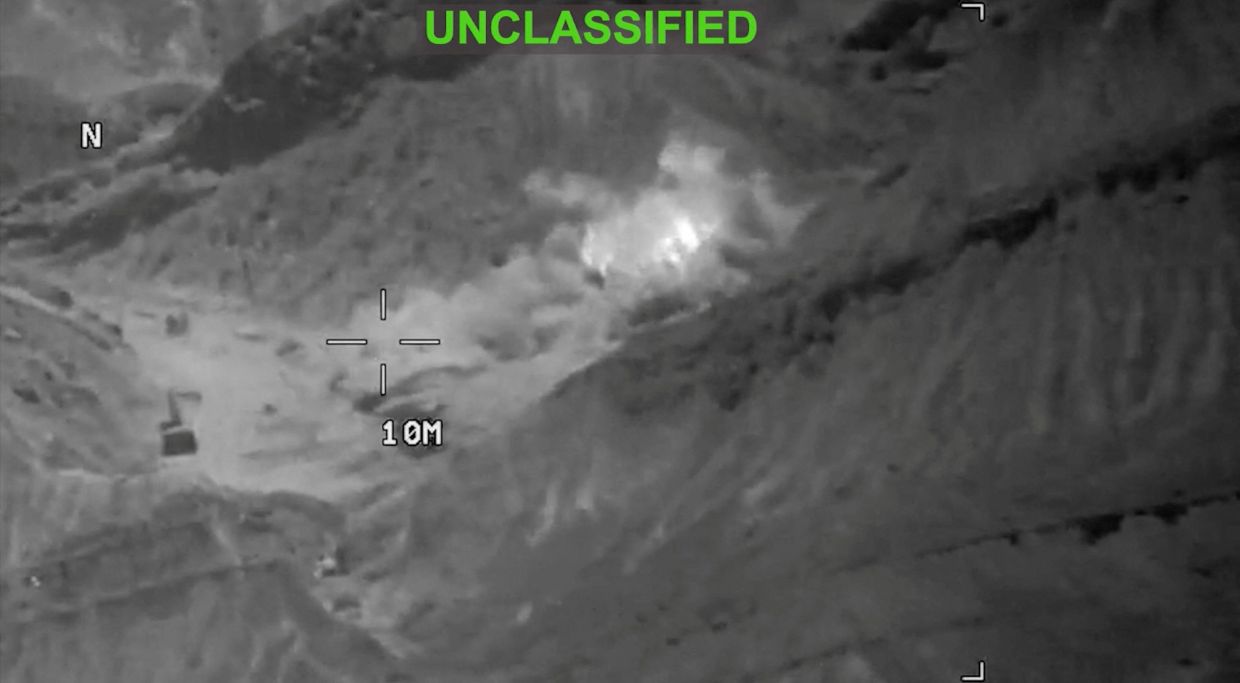
Tensions between the United States and Iran have reached a critical juncture as Washington launched fresh military strikes against Iranian targets on Saturday evening, marking the eighth consecutive night of aerial bombardment. The latest offensive came in response to what American officials characterize as an Iranian attack in Jordan that resulted in the deaths of two military personnel and left a third missing in action. These casualties represent a sharp escalation in direct combat losses for US forces operating in the region, bringing the total death toll to 16 service members since hostilities commenced nearly three weeks ago.
The collapse of a ceasefire arrangement brokered just one month earlier has fundamentally altered the strategic calculus in the Middle East, transforming what had been a period of contained tensions into a rapidly spiralling conflict. US Central Command stated that President Trump ordered the latest strikes to commence at 6 p.m. ET on Saturday, targeting what military officials described as Iranian capabilities that pose threats to maritime commerce and regional stability. The strikes specifically focused on degrading Iran's coastal surveillance infrastructure and air defence systems, according to official American statements, with particular emphasis on eliminating capabilities of the Islamic Revolutionary Guard Corps.
Iranian state media provided limited acknowledgment of the damage, with the Mehr news agency reporting strikes near Sirik in southern Iran while claiming no significant casualties or infrastructure damage. However, more concerning for Iran's leadership was a reported US strike on a nuclear power plant facility under construction at Darkhovin, which drew sharp condemnation from Iran's Atomic Energy Organization. This dimension of the conflict introduces an additional layer of complexity and risk, as attacks on nuclear installations can quickly escalate tensions beyond conventional military exchange and raise international concerns about nuclear safety and proliferation.
The tit-for-tat nature of the escalation became apparent as Iran responded to these strikes with its own drone and missile attacks targeting American military assets throughout the Gulf region. Early Sunday morning, Iranian state television reported that the army had launched a coordinated drone assault against US military installations, specifically naming Kuwait's Al-Adiri camp and Ali Al Salem Air Base as targets. These responses underscore Iran's determination to maintain what it perceives as proportionate escalation, though neither side has reported significant casualties from the retaliatory strikes. Kuwait's air defence systems intercepted multiple Iranian missiles and drones in consecutive days, while Bahrain also successfully defended against Iranian attacks, indicating that regional air defence networks have become increasingly effective at interdicting Iranian projectiles.
The conflict's impact extends beyond direct military confrontation to encompass control of crucial maritime corridors vital to global energy security. The Strait of Hormuz, through which approximately one-fifth of the world's oil supply typically transits, has become a flashpoint for both military operations and economic competition. The US claims it is enforcing a naval blockade against Iran to restrict its capabilities, while Tehran contends it is defending its territorial waters and enforcing navigation rules within the strait. Iran's Islamic Revolutionary Guard Corps reported that four vessels attempted to transit the waterway via routes it deems unsafe, with two vessels abandoning their attempts and two others reportedly experiencing accidents, though details remain vague.
For Malaysian and Southeast Asian readers, these developments carry significant implications for regional energy security and broader geopolitical stability. Malaysia, as a major energy importer and a nation with substantial shipping interests, faces potential disruptions to oil supplies and increased maritime insurance costs should the conflict further escalate. The broader principle of freedom of navigation in international waters, a cornerstone of regional prosperity, becomes increasingly compromised as military operations intensify around the Strait of Hormuz. Additional pressures on global oil supplies risk translating into inflation across the region, affecting everything from transportation costs to manufacturing input prices.
The human toll of the conflict has proven substantial for all parties involved. While the US has sustained 16 military deaths and over 420 wounded personnel, Iran's Health Ministry reported that US strikes over the preceding three weeks alone had killed 50 people and wounded more than 500 within Iranian territory. These figures underscore the genuine costs of the escalating confrontation, extending beyond military personnel to encompass civilian populations in affected areas. The announcement by the US embassy in Jordan that Aqaba's international airport and seaport required evacuation due to a credible security threat further demonstrates how the conflict's reverberations affect civilian infrastructure and normal economic activity across the region.
The rhetorical dimension of the conflict has become increasingly pointed, reflecting the deep mistrust between Washington and Tehran. Iran's Supreme Leader Ayatollah Mojtaba Khamenei issued a statement through state media characterizing previous US agreements as possessing no credibility or worth, while warning of escalating costs and further humiliation for the United States should the conflict continue. Notably, Khamenei's public absence since the conflict's inception on February 28—when a predecessor with the same name was killed in an airstrike—has fueled speculation about the leadership's security situation and decision-making capacity. The US Defense Secretary's assertion that American service members' sacrifice would only strengthen resolve indicates that Washington shows no signs of modifying its strategic approach or seeking diplomatic off-ramps.
The original conflict's genesis lay in coordinated US and Israeli strikes launched on February 28, purportedly aimed at disabling Iran's nuclear and missile programmes while degrading its network of regional proxies and allies. However, the intervention has produced consequences extending far beyond the stated military objectives. Global energy markets face uncertainty, inflation pressures mount across developed and developing economies alike, and the risk of further escalation remains acute as both sides appear committed to military solutions rather than negotiated settlements. The breakdown of the ceasefire arrangement suggests that diplomatic channels, if they ever functioned effectively, have now closed substantially.
Regional powers have become increasingly drawn into the conflict through targeted attacks, most notably Kuwait and Bahrain, which have experienced repeated Iranian drone and missile strikes. This pattern of expanding involvement threatens to transform what began as a bilateral US-Iran confrontation into a broader regional conflict drawing in multiple Gulf states. For merchants and shipping companies operating in the region, the environment has become progressively more hazardous, with insurance premiums rising and some operators avoiding the Strait of Hormuz entirely in favour of longer, more expensive routes around the African continent. This economic displacement, while less visible than military casualties, ultimately affects consumers and businesses across Southeast Asia and beyond through higher energy and transportation costs.

