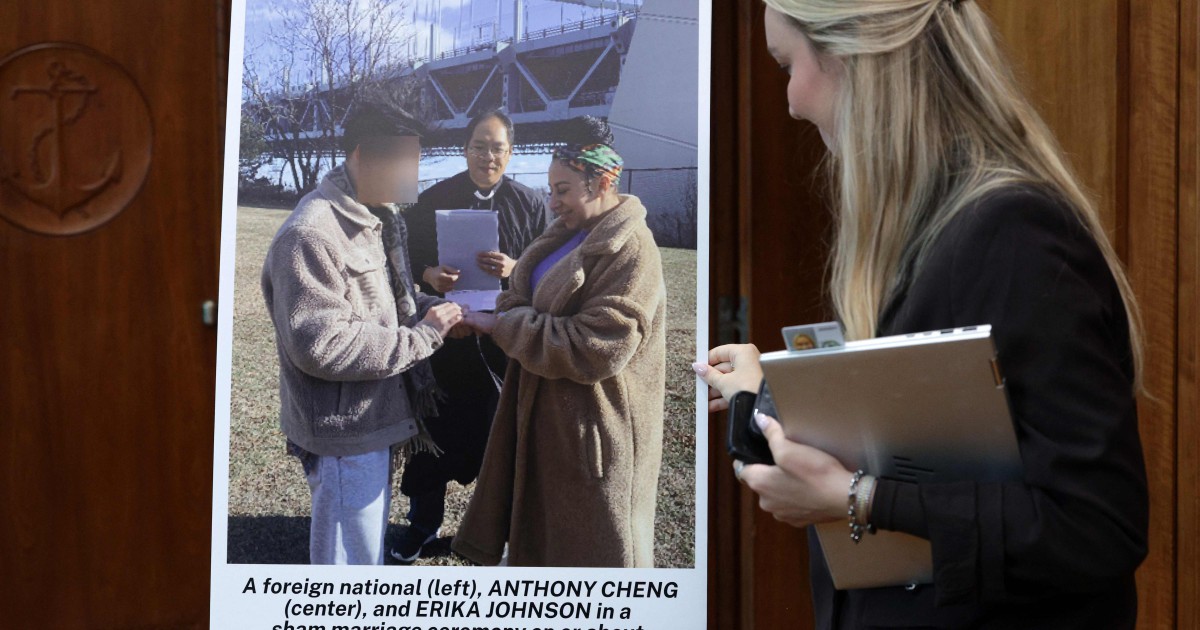
The United States Justice Department has filed criminal charges against 11 individuals for their roles in orchestrating what prosecutors describe as an elaborate matrimonial fraud scheme that persisted for roughly ten years. According to filings submitted in federal court, the ring facilitated some 1,000 fraudulent marriage arrangements, predominantly involving Chinese nationals seeking to circumvent standard immigration pathways and establish legal residency in the United States.
This prosecution arrives at a moment when immigration enforcement has intensified under renewed political pressure. The timing underscores the Trump administration's stated priorities around tightening immigration controls and eliminating what officials characterise as loopholes in the system. The operation highlights vulnerabilities in the US immigration bureaucracy that unscrupulous networks have exploited to help foreign nationals gain entry and permanent status through fraudulent spousal claims.
The indictment represents one of the largest coordinated crackdowns on marriage-fraud networks in recent years. Prosecutors allege that the defendants operated a sophisticated operation involving multiple participants across different jurisdictions, coordinating the pairing of foreign nationals with American citizens or green-card holders willing to participate in fake marriages for financial compensation. The scheme apparently generated substantial revenue for organisers while providing a faster, less scrutinised pathway to legal status compared to traditional family-based immigration channels.
Marriage fraud has long been recognised as a significant immigration violation, though enforcement efforts have varied considerably. When individuals enter into marriages primarily to circumvent immigration law rather than establish genuine domestic partnerships, they expose themselves to prosecution, deportation, and permanent immigration bars. Similarly, American citizens or lawful permanent residents who knowingly facilitate such arrangements face federal criminal liability. The charges in this case suggest prosecutors have substantial evidence demonstrating knowledge and intent among all defendants.
For Malaysia and other Southeast Asian nations, this development carries particular relevance. Immigration enforcement trends in major Western destinations directly influence migration pathways and popular fraud schemes regionally. Successful prosecutions and heightened scrutiny of marriage-based immigration may redirect would-be migrants toward alternative routes, potentially increasing competition for legitimate family reunification sponsorships or employment-based visas. Malaysian migration brokers and consultancy services, which often advise nationals on US immigration options, will likely need to adjust their guidance in light of intensified enforcement.
The scheme's apparent scale—spanning a decade and encompassing roughly 1,000 arrangements—suggests sophisticated operations with multiple operational nodes. Prosecutors likely uncovered financial records, communications, and testimony establishing how the ring recruited Chinese nationals, identified willing American citizens, negotiated payments, coached participants on cohabitation narratives, and facilitated fraudulent documents. The existence of such an extensive network for an extended period indicates significant lapses in verification procedures at various points within immigration processing.
Chinese nationals have historically represented a substantial portion of marriage-fraud cases within US immigration statistics. The prevalence reflects both the large numbers of Chinese citizens pursuing US residency and established networks facilitating fraudulent arrangements. Economic factors driving migration, combined with perceived delays and challenges in obtaining employment-based or family sponsorship visas, create conditions where fraudulent marriage schemes appear attractive despite their legal risks.
The enforcement action also reflects broader policy shifts regarding immigrant vetting and status verification. Federal agencies have increasingly deployed data analytics and pattern-recognition tools to identify suspicious marriage petitions. Cross-referencing financial transactions, communications patterns, and cohabitation records now routinely supports marriage-fraud investigations. Defendants in such cases increasingly face conviction on conspiracy charges as well as substantive marriage fraud counts, resulting in prolonged prison sentences.
For individuals involved in genuine spousal sponsorships, heightened scrutiny poses both challenges and protections. Immigration officers will likely intensify questioning and evidence requirements for married couples seeking status adjustments or permanence. Legitimate applicants may experience longer processing delays and more invasive interviews, though these measures theoretically improve verification accuracy. The balance between efficient processing and thorough fraud detection remains perpetually contentious within immigration administration.
The indictment signals that federal prosecutors will pursue comprehensive enforcement strategies targeting not merely individual perpetrators but entire organisational structures. Conspiracy charges typically carry sentences comparable to substantive offences, effectively multiplying penalties for participants at different operational levels. This approach aims to dismantle networks rather than prosecute isolated incidents, potentially deterring would-be operators of similar schemes through visible prosecution of established rings.
Looking forward, this case will likely influence both enforcement priorities and policy discussions around family-based immigration pathways. Some lawmakers advocate for enhanced marriage verification procedures, while others emphasise potential negative impacts on legitimate family reunification. The Justice Department's evident capacity to pursue complex, multi-defendant immigration fraud investigations suggests comparable scrutiny may extend to other circumvention schemes, whether involving employment credentials, humanitarian claims, or other status categories.
The prosecution serves as a cautionary reminder that immigration fraud carries substantial criminal consequences beyond deportation. Participants face federal convictions, imprisonments, financial penalties, and permanent bars to future legal status. For Southeast Asian nationals considering irregular pathways to Western residency, the visible enforcement and conviction of major fraud networks reinforces the substantial risks associated with fraudulent applications, potentially channelling migration decisions toward lawful if more protracted immigration processes.

