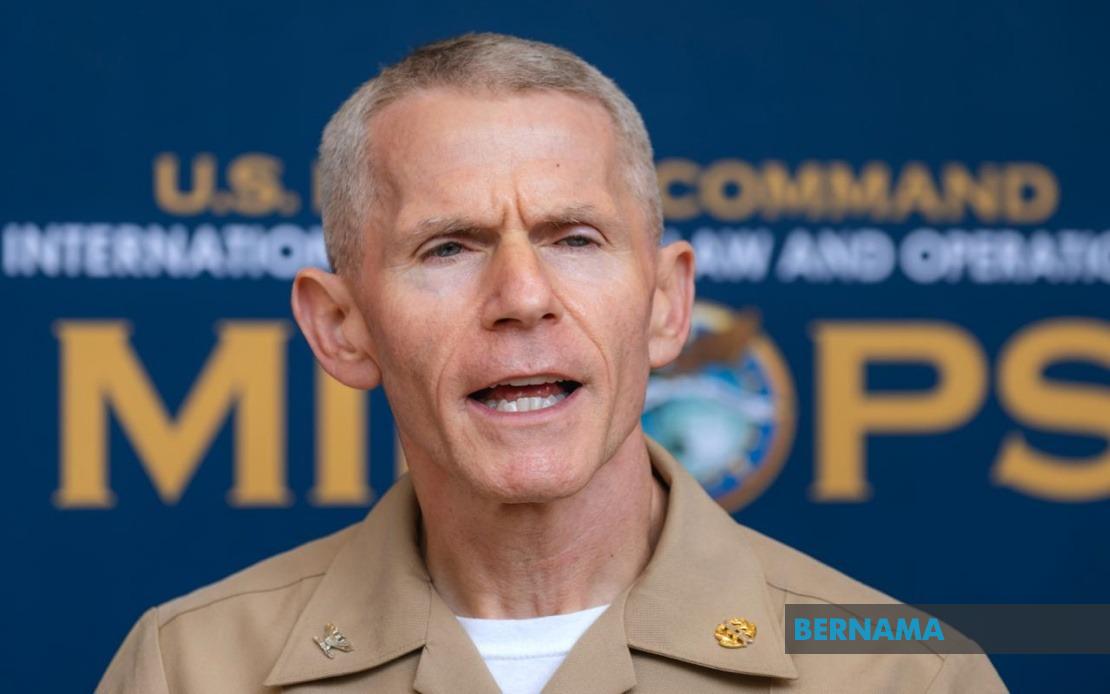
The United States Pacific Command has restated its dedication to maintaining a security presence across the South China Sea, framing the waterway as essential to broader Indo-Pacific stability and prosperity. Speaking at an international military law conference in Kuala Lumpur, USPACOM officials outlined their strategic priorities for the region, emphasizing that deterrence and the prevention of destabilizing actions remain central to the command's operational mandate in one of the world's most contested maritime zones.
Navy Captain Dustin Wallace, serving as USPACOM's Staff Judge Advocate, articulated the command's dual focus on active deterrence and constructive partnerships. He stressed that preventing aggression and destabilizing activities across the South China Sea forms the core of USPACOM's broader mission architecture for the Indo-Pacific, a region where competing claims, rising maritime traffic, and great-power competition create complex security dynamics. The framing reflects Washington's long-standing position that freedom of navigation and unobstructed commerce remain non-negotiable principles that underpin regional peace.
A cornerstone of USPACOM's approach centers on respect for international maritime law and the protection of sovereign rights. Wallace emphasized that these principles—freedom of navigation and freedom of commerce—represent shared commitments between the United States and its regional allies, designed to safeguard the equality and independence of all nations in the region. This messaging targets ongoing concerns among Southeast Asian nations about coercive behavior and the militarization of disputed maritime areas, issues that have gained prominence as China continues to assert expansive territorial claims in waters where other countries have competing interests.
Wallace's remarks about ASEAN's role signal a deliberate effort by Washington to position itself as a supporter of the regional bloc's centrality in managing regional affairs. USPACOM has made clear that it views ASEAN as indispensable to maintaining peace and security frameworks, even as the organization grapples with internal divisions on South China Sea disputes and varying levels of alignment with major powers. By explicitly endorsing ASEAN centrality, the US aims to reinforce the bloc's authority to shape regional norms while subtly countering efforts by other powers to bypass established multilateral mechanisms.
The command's stated approach of tailoring engagement with individual ASEAN member states according to their specific interests represents a calibrated strategy that acknowledges Southeast Asia's diplomatic diversity. Rather than imposing a uniform policy across the region, USPACOM proposes to work with each country to identify and address its own priorities and concerns. This flexibility reflects the reality that ASEAN members have divergent relationships with major powers, varying economic dependencies, and different threat perceptions—factors that make one-size-fits-all policies ineffective. Malaysia, Vietnam, the Philippines, and other claimant states each face distinct geopolitical calculations that USPACOM recognizes must inform bilateral and multilateral engagement patterns.
The broader context for these commitments emerges from the 37th International Military Law and Operations Conference (MILOPS 26), hosted jointly by USPACOM, Malaysia's Defence Ministry, and the Malaysian Armed Forces from August 3 to 6. The conference's participation—drawing more than 300 military leaders, security lawyers, policymakers, and scholars from over 30 countries—underscores the international dimensions of maritime security governance. The gathering represents an effort to build consensus around rule-of-law principles and sovereign equality, legal frameworks that the US and regional allies view as essential counterweights to unilateral assertions of control over disputed territories.
The conference theme, "From the Seabed to Space: Advancing Security, Freedom, and Prosperity for All Across the Indo-Pacific," reflects an expansive interpretation of security that encompasses conventional naval operations, underwater infrastructure, satellite communications, and economic connectivity. This holistic framing acknowledges that regional stability depends on multiple overlapping domains and that legal frameworks must evolve to address emerging challenges like cyber threats, space-based surveillance, and critical maritime infrastructure protection. For Malaysian readers and policymakers, this suggests that Indo-Pacific security increasingly involves technical and legal expertise beyond traditional military spheres.
The emphasis on legal and operational cooperation through forums like MILOPS 26 reflects a strategic preference among the US and allied nations for managing disputes through institutional mechanisms rather than military confrontation. By convening diverse security practitioners to discuss shared challenges and legal principles, the conference aims to establish common understandings that can constrain aggressive behavior and provide dispute-resolution pathways. Malaysia's role as host nation positions it as a bridge-builder in regional security architecture, reinforcing its status as a respected voice within ASEAN on maritime governance issues.
For Southeast Asian nations navigating great-power competition, USPACOM's reaffirmed commitment carries both reassurance and complexity. The stated determination to maintain presence and deter aggression offers security guarantees that smaller states value, particularly given China's military modernization and expanded capabilities. Simultaneously, the emphasis on working with individual countries according to their interests acknowledges that regional states must balance relationships with multiple powers without submitting to any single external security framework. This recognition of sovereign choice remains critical to maintaining ASEAN unity and avoiding deepening strategic divisions within the bloc.
The broader implications of USPACOM's positioning extend to economic and institutional dimensions beyond military security. The focus on freedom of commerce and stable maritime conditions directly affects Southeast Asia's trade routes, supply chain vulnerabilities, and integration into global economic systems. Malaysia and other regional economies depend substantially on unobstructed access to international waters and predictable maritime commerce, making the legal and operational frameworks discussed at MILOPS 26 economically consequential for development trajectories and regional prosperity.
Looking forward, USPACOM's stated commitment to sustained presence, respect for international law, and differentiated partnership with ASEAN members will likely shape regional security dynamics for years to come. Whether this approach succeeds in preventing escalation while maintaining the fragile balance of power in the South China Sea depends partly on consistent implementation and partly on how other regional actors—particularly China—respond to these positioning statements and operational activities. For Malaysia and Southeast Asia more broadly, the challenge remains advancing national interests while preserving regional stability and international legal principles that protect smaller nations' rights and autonomy in an increasingly multipolar environment.

