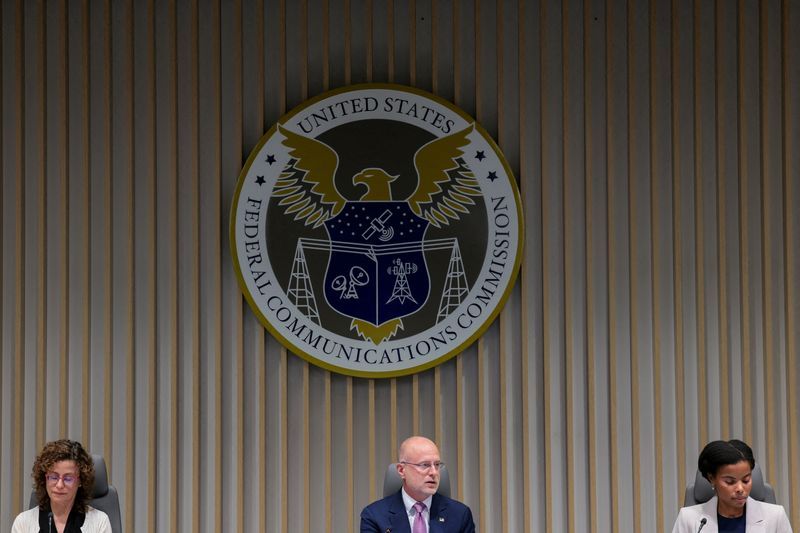
The US Federal Communications Commission has moved to strengthen barriers against Chinese technology entering American markets by voting to prohibit the sale of devices containing critical hardware components manufactured by companies deemed national security threats. The decision, announced on Wednesday, marks a significant escalation in technology restrictions that extends beyond previous bans targeting finished products to now encompassing component-level restrictions.
The FCC maintains a roster of Chinese firms—most prominently Huawei and ZTE—whose equipment has been barred from US distribution due to national security considerations. These designations reflect longstanding American concerns about potential vulnerabilities embedded in foreign-made telecommunications and networking equipment. The regulatory action represents the latest effort by Washington to manage technological dependencies that could expose critical infrastructure to foreign interference or espionage.
FCC Chair Brendan Carr characterised the move as a comprehensive effort to "fully close the component part loophole," signalling frustration with regulatory gaps that had persisted despite previous prohibitions. Since 2022, finished devices manufactured by blacklisted companies like Huawei faced barriers to new market authorizations. However, a significant vulnerability remained: manufacturers could circumvent restrictions by sourcing Huawei-made component parts and incorporating them into devices that gained separate regulatory approval. This technical workaround allowed restricted hardware to enter the American market indirectly, undermining the intent of earlier restrictions.
The revised rules now explicitly prevent the authorization of any device containing logic-bearing hardware components manufactured by prohibited Chinese enterprises. This closure of the component loophole represents a more granular approach to technology regulation, recognising that vulnerabilities can be embedded at the chip and circuit level, not merely at the device level. For Malaysian technology companies and importers, this development carries immediate implications, as many regional firms incorporate Chinese-manufactured components into electronics destined for international markets, including the United States.
Chris McGuire, a national security official who served under former President Joe Biden, underscored the technical rationale for such restrictions. Compromised semiconductors or communications hardware can fundamentally undermine entire devices, allowing foreign actors to access sensitive data or disable critical functions embedded within broader systems. This logic applies particularly to telecommunications infrastructure, where a single compromised component could theoretically provide backdoor access to nationwide communication networks. The concern reflects evolving understandings of supply chain vulnerabilities in an era where semiconductors—often manufactured in concentrated geographic locations—represent critical chokepoints in global electronics production.
The Trump administration has pursued an aggressive technology decoupling strategy targeting Chinese manufacturers and suppliers. Beyond the FCC's component prohibition, the regulatory environment has shifted noticeably across multiple domains. In recent months, the commission has banned imports of additional equipment from Chinese manufacturers, with some restrictions taking effect in mid-July. Simultaneously, policymakers have proposed prohibitions on military-grade drone imports and have already restricted new foreign drone and router model authorizations, reflecting broader concerns about surveillance and network security.
The regulatory scrutiny extends into telecommunications infrastructure operations within the United States. The FCC has proposed rules preventing US telecommunications carriers from interconnecting with Chinese telecom firms classified as national security risks. This approach targets not merely equipment sales but operational relationships and network access. Furthermore, officials are considering whether to compel Chinese telecommunications companies operating data centres or Points of Presence—the physical locations where internet traffic exchanges occur—to cease US operations entirely. Such measures would fundamentally restructure how Chinese telecommunications firms participate in American digital infrastructure.
For Southeast Asian nations including Malaysia, these US restrictions create complex strategic challenges. Many regional technology companies maintain supply chains deeply intertwined with Chinese manufacturers, particularly for semiconductors and components. Malaysian firms that export electronics or telecommunications equipment to North American markets must now navigate increasingly stringent compliance requirements. Manufacturers may need to audit their supply chains, source alternative components, and potentially redesign products to exclude restricted hardware.
The regulatory trajectory also reflects broader geopolitical positioning, where technology infrastructure represents a contested domain between major powers. As the US intensifies restrictions on Chinese technology, Beijing may pursue reciprocal measures or accelerate alternative technology ecosystems. Southeast Asian economies, which benefit from technological competition and have historically played neutral roles in technology governance, face pressure to align with one bloc or another. Malaysia's position as both a semiconductor manufacturing hub and a participant in Chinese-backed infrastructure initiatives creates particular tensions.
The component-level prohibition also raises questions about enforcement complexity. Verifying that devices contain no restricted hardware requires detailed supply chain documentation and technical auditing. Smaller manufacturers and importers may struggle with compliance costs, while sophisticated supply chain obfuscation could enable violations. The practical implementation of these restrictions will likely require ongoing regulatory clarification and corporate adaptation throughout 2024 and beyond.
Looking forward, the FCC's component prohibition establishes a precedent for granular technology regulation that others may emulate. European regulators, facing similar security concerns, may adopt comparable approaches. This fragmentation of technology markets into competing standards and approval processes could further disrupt global supply chains and increase costs for manufacturers attempting to serve multiple jurisdictions. For Malaysian companies, maintaining access to US markets while managing relations with Chinese suppliers represents an increasingly difficult balancing act in a polarising technology environment.

