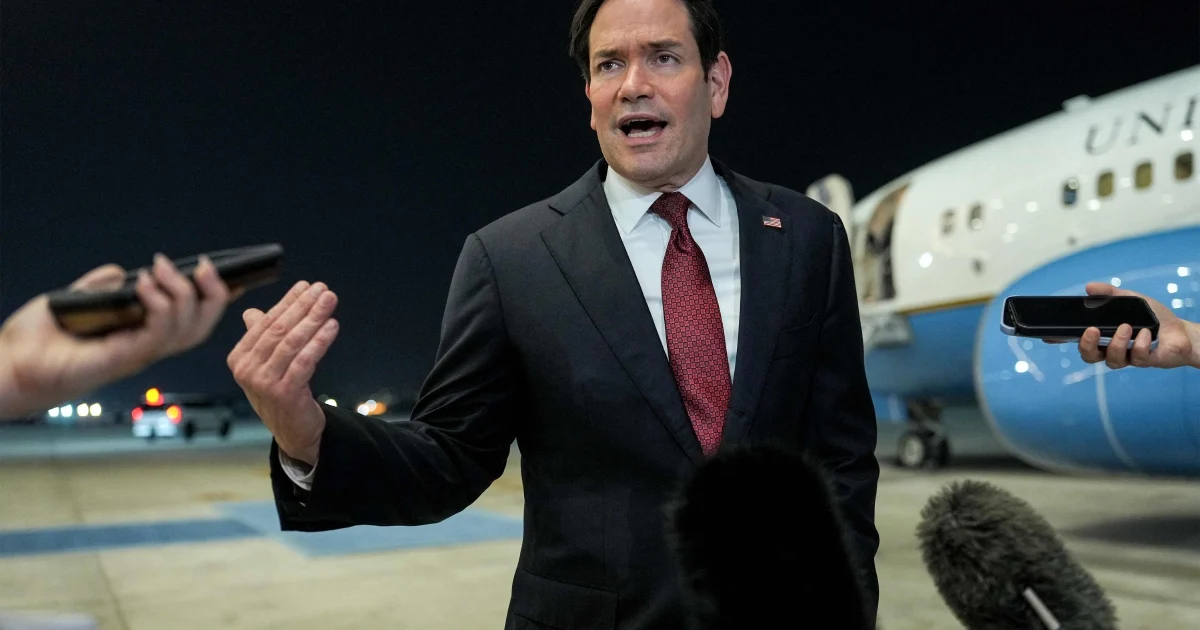
Diplomatic tensions have surfaced early in negotiations aimed at resolving Middle East conflicts, with US Secretary of State Marco Rubio pointedly rejecting Iranian demands for toll revenues on the Strait of Hormuz. The rejection came on Tuesday during exchanges between Washington and Tehran that have already become strained over competing interests spanning maritime commerce, nuclear oversight, and weapons capabilities.
The Strait of Hormuz remains one of the world's most strategically critical chokepoints, with roughly one-fifth of global oil traffic transiting through its narrow passages. Any regime imposing unilateral charges on commercial vessels would effectively grant extraordinary leverage over the international energy market and the economies dependent on it. Rubio's firm dismissal reflects Washington's determination to preserve the principle of freedom of navigation through international waters—a cornerstone of post-Second World War maritime law that underpins global trade patterns.
Iranian proposals for toll mechanisms would fundamentally alter the balance of power in the Persian Gulf region and extend Tehran's economic reach far beyond its borders. Such arrangements would give Iran considerable influence over shipping routes and pricing structures affecting energy supplies to Asia, Europe, and beyond. For Malaysia and other Southeast Asian nations heavily dependent on Middle Eastern oil and gas imports, any disruption to Hormuz traffic carries immediate economic consequences that ripple through inflation pressures, energy costs, and supply chain stability.
The dispute over Hormuz tolls represents just one layer of friction emerging from these preliminary negotiations. Nuclear inspection protocols have emerged as another contentious issue, with fundamental disagreements over verification mechanisms and the scope of international monitoring. Iran's historical resistance to intrusive inspections clashes with Western insistence on robust oversight capable of detecting potential weapons development programs, creating a gap unlikely to narrow without significant concessions from either side.
Missile capabilities have added further complexity to the negotiating landscape. The United States and its regional allies view Iran's expanding arsenal and precision-strike capabilities as destabilizing threats requiring strict limitations, while Tehran regards its missile programs as essential deterrents against hostile neighbors and external intervention. This philosophical divide—where each side interprets military strength through the lens of its own security imperatives—suggests deep structural obstacles to comprehensive agreements.
The convergence of disputes on maritime access, nuclear transparency, and weapons development indicates that informal talks have already encountered the same fundamental incompatibilities that derailed previous diplomatic efforts. Each issue touches upon core national interests: Iran seeks economic relief through unfettered access to maritime revenues and recognition of its regional role, whilst Washington prioritizes constraining Iranian power projection and maintaining international order based on established conventions.
For regional observers in Southeast Asia, these early ruptures carry troubling implications. Unresolved Middle East tensions inevitably create market volatility in energy prices, insurance costs on shipping, and broader geopolitical uncertainty that discourages investment and complicates long-term planning. Malaysia's position as a maritime trading nation with significant energy sector interests means that any prolonged conflict or instability in the Gulf directly affects domestic economic performance and regional development trajectories.
Rubio's public rebuttal of Iranian toll proposals also signals that the Trump administration intends to take a maximalist stance in negotiations, rejecting concessions that earlier administrations might have entertained as confidence-building measures. This harder-line approach contrasts sharply with attempts to revive the Iran nuclear deal that characterized previous diplomatic cycles, suggesting a fundamentally different strategic calculus governing current American engagement with Tehran.
The timing of these disputes—emerging so rapidly in preliminary exchanges—raises questions about whether negotiating partners genuinely intend to reach compromises or are simply performing opening positions before inevitable breakdown. Experienced diplomats recognize that early public rejections can be tactical theatre designed for domestic audiences, yet the breadth of disagreement spanning multiple domains suggests divisions run deeper than mere rhetorical posturing.
Observers in Kuala Lumpur and across Southeast Asia will likely monitor whether negotiators can establish procedural frameworks allowing discussions to progress despite fundamental disagreement on substance. Previous Middle East initiatives have foundered on exactly these issues, leaving the region trapped in cycles of tension punctuated by temporary ceasefires rather than durable settlements.
The strain visible in these early exchanges underscores the magnitude of obstacles separating the parties. Without movement on tolls, nuclear inspections, and missiles simultaneously, achieving comprehensive agreements appears increasingly remote. Southeast Asian policymakers can reasonably anticipate continued instability in the Persian Gulf extending well into the coming years, requiring contingency planning around energy security, maritime safety, and broader regional alignment strategies.