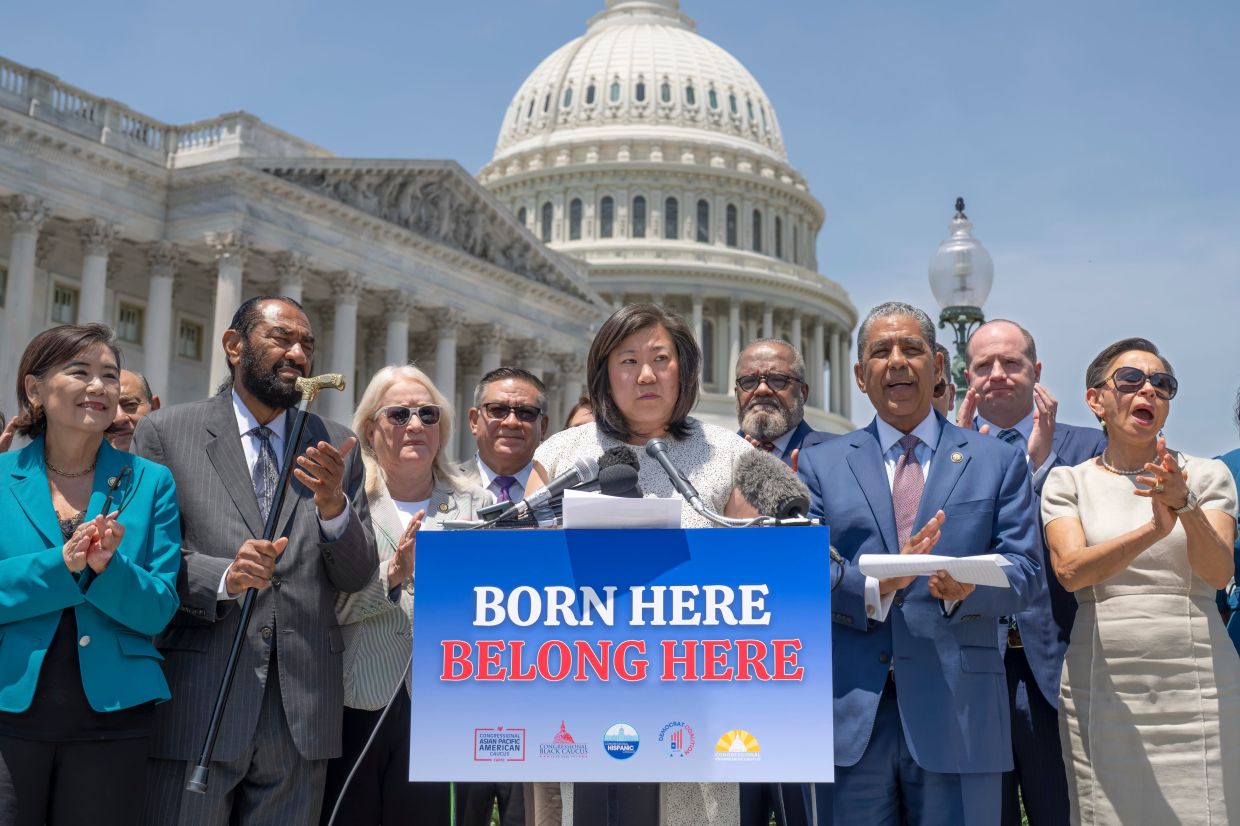
The United States Supreme Court has dealt a significant blow to President Donald Trump's hardline immigration agenda by striking down his executive order targeting birthright citizenship. In a 6-3 decision in the case Trump vs Barbara, the court affirmed that children born on American soil to undocumented parents or those on temporary visas are entitled to full US citizenship, upholding a constitutional principle established over 150 years ago.
Trump had signed the executive order in early 2025 with the intention of eliminating citizenship rights for children born to undocumented immigrants and temporary visa holders. The policy was meant to take effect the following month but faced immediate legal challenges that ultimately reached the nation's highest court. The ruling represents a major setback for a cornerstone initiative of Trump's second-term immigration platform, which had positioned restricting birthright citizenship as a key policy objective.
In characteristic fashion, Trump responded to the decision with defiance, initially congratulating China on a "massive Birthright Citizenship WIN" before pivoting to criticism of the court. He dismissed the ruling as "too bad" for the country and suggested that Congress could legislatively achieve what the courts had blocked, claiming that no constitutional amendment would be necessary. Trump subsequently urged Congress to begin immediate work on ending what he termed "expensive and unfair" birthright citizenship, promising his complete support for any legislative efforts in that direction.
The executive order had cast a far wider net than typical immigration debates might suggest. Rather than focusing solely on undocumented immigrants, as public rhetoric often implies, the Trump administration's order specifically targeted individuals who were lawfully present in the United States and pursuing permanent legal status. This included highly skilled workers on H-1B and L-1 visas, foreign students, workers on temporary labour schemes, and individuals on achievement visas—all categories classified by the US Citizenship and Immigration Services as "lawful but temporary" residents. The one exception in the order provided that if one parent was already a US citizen, the child would retain birthright citizenship rights.
Chief Justice John Roberts, writing for the majority, grounded the decision in the historical significance of the 14th Amendment's Citizenship Clause, which was adopted in 1866 and ratified in 1868 specifically to protect the rights of newly freed slaves and other minority groups following the Civil War. Roberts emphasised that citizenship has always represented "the right to have rights—to freely participate in our political community," and that the Framers of the amendment extended this promise to "every free-born person in this land." The court's reasoning aligned with over a century of constitutional interpretation establishing that nearly all persons born on US soil acquire citizenship automatically.
The legal foundations for modern birthright citizenship trace back to the landmark 1898 Supreme Court case involving Wong Kim Ark, a Chinese-American whose descendants have become symbolic figures in immigration debates. Wong had been denied re-entry to the United States following a visit to China, with authorities claiming he was not a citizen because of his parents' immigration status. The court's 1898 ruling established that parental nationality and immigration status could not be used to strip citizenship from those born on American territory. That precedent has survived multiple subsequent challenges, including the era of Jim Crow racial segregation and now Trump's executive order.
Norman Wong, a great-grandson of Wong Kim Ark, released a statement following Tuesday's decision emphasising that his ancestor "was one man, only a cook, and yet he stood up for what was right." Wong reflected that his great-grandfather never intended to become a symbol but recognised that his legal victory has reverberated through generations, safeguarding the rights of countless Americans. The ruling demonstrated, Wong argued, that the principles established in 1898 remain equally vital in the contemporary policy environment.
Civil rights advocates highlighted the particular significance of the ruling for Asian-American communities, drawing explicit connections to Wong Kim Ark's historical struggle. Krish O'Mara Vignarajah, president of Global Refuge, an organisation focused on refugee advocacy, noted that birthright citizenship has now survived the Chinese Exclusion Act, the Jim Crow era, and an executive order that would have effectively converted American maternity wards into immigration checkpoints. Stop AAPI Hate similarly emphasised that the ruling carries special resonance for Asian-American populations, arguing that the Trump administration's attempt to restrict birthright citizenship was precisely designed to limit the political power and demographic growth of communities of colour.
Underlying much of the contemporary debate has been focus on so-called birth tourism—the practice of foreign nationals deliberately travelling to the United States to give birth and secure citizenship for their children. The Trump administration and its allies, particularly Solicitor General D. John Sauer during Supreme Court oral arguments in April, characterised this as a sprawling industry involving "uncounted thousands of foreigners from potentially hostile nations." Allegations have specifically targeted Chinese nationals, with birth tourism emerging as a flashpoint in Trump's broader immigration campaign against China.
A concrete example cited by the Justice Department involved a 2024 case where Michael Wei Yueh Liu and Jing Dong, a married couple, were each sentenced to 41 months in prison for operating a birth tourism scheme that charged Chinese clients tens of thousands of dollars to facilitate births in the United States. Following Tuesday's Supreme Court decision, Justice Department officials issued a memo directing federal prosecutors to prioritise investigations and prosecutions of birth tourism operations. Colin McDonald, a senior Justice Department official, wrote that the department would "zealously protect the sanctity of United States citizenship by investigating and prosecuting those who fraudulently exploit our immigration system."
For Malaysia and Southeast Asia, this decision carries implications beyond American borders. The ruling reinforces constitutional protections that have become foundational to American identity and diversity, even as it frustrates policymakers seeking to restrict immigration. While birth tourism may occur among wealthy individuals from various nations, the broader principle at stake—whether children born on a country's soil automatically acquire citizenship—resonates across the region. Several Southeast Asian nations maintain jus soli citizenship rules, and the American court's reaffirmation of birthright citizenship provides a counterweight to global trends toward more restrictive citizenship policies.
The Supreme Court's decision also reflects deeper ideological divisions within the United States about immigration, national identity, and the proper scope of executive power. Trump's willingness to pursue aggressive restrictions through executive order, combined with his immediate call for Congressional action and dismissal of constitutional concerns, demonstrates that birthright citizenship will remain a contentious political issue regardless of judicial outcomes. The 6-3 ruling suggests the court's current composition still recognises historical constitutional principles, yet the closeness of immigration-related votes in recent years indicates that future challenges to birthright citizenship could yield different results if the court's composition shifts further.
As the debate continues, the practical implementation of the court's decision in early 2025 will determine how quickly the Trump administration's executive order is fully dismantled. The ruling affirms that children born to temporary visa holders and undocumented immigrants retain their constitutional right to citizenship, fundamentally preserving an American principle that has shaped the nation's demographic and political evolution since the Civil War era.

