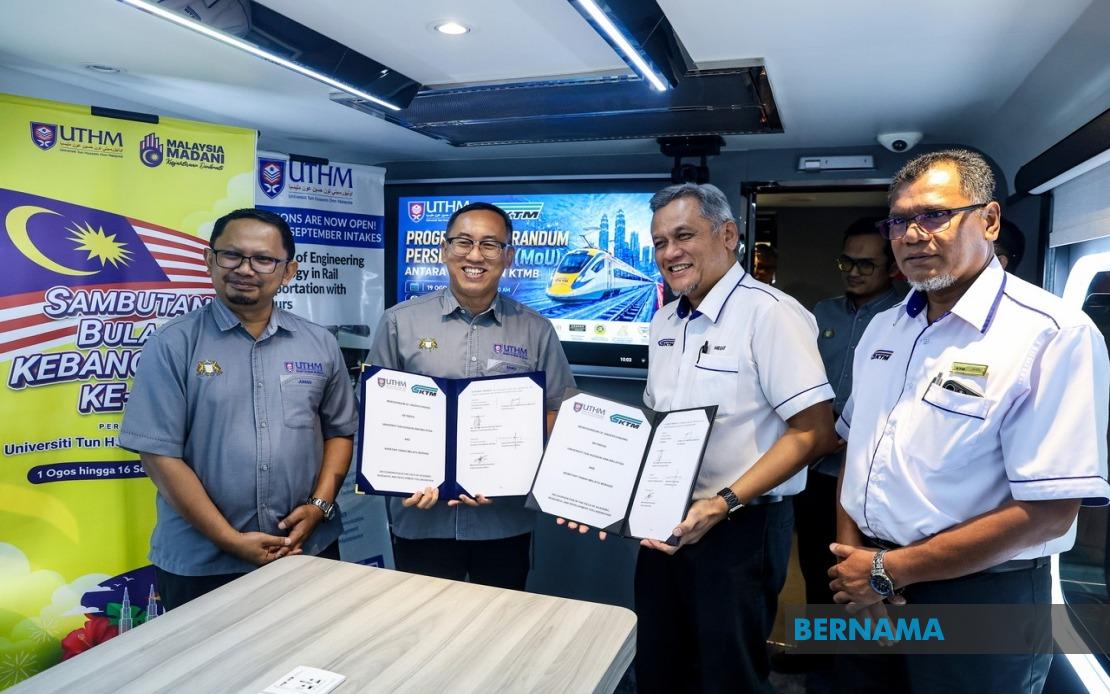
Universiti Tun Hussein Onn Malaysia (UTHM) and Keretapi Tanah Melayu Bhd (KTMB) have formalized an extended collaboration spanning three years from October 2026 through July 2029, building on foundational work begun in 2019 to strengthen Malaysia's rail sector workforce. The renewed partnership represents a significant investment in bridging the gap between academic learning and industry application, combining classroom theory with practical exposure to one of the country's most critical transportation infrastructure operators. The agreement, exchanged aboard a KTMB chartered train journeying from Kluang Station to KL Sentral, underscores the symbolic and practical union between educational innovation and operational excellence in the nation's rail network.
UTHM vice-chancellor Prof Dr Mas Fawzi Mohd Ali emphasized that this extended cooperation amplifies the university's commitment to developing competent talent attuned to real-world industry demands. The initiative encompasses multiple dimensions of collaboration: work-based learning opportunities that immerse students in active rail operations, joint research initiatives leveraging academic and operational expertise, targeted competency development programmes, and structured knowledge exchange between institutional and industry practitioners. These elements collectively address a persistent challenge in Malaysian higher education—the need to ensure graduates possess not merely theoretical knowledge but also practical capabilities and industry awareness essential for immediate workplace effectiveness.
Work-based learning forms the cornerstone of this partnership, providing UTHM students with direct engagement in rail operations, contemporary technology deployment, and the multifaceted challenges confronting modern rail systems. Rather than limiting student exposure to case studies and simulations, the framework enables learners to observe and participate in KTMB's daily operations, troubleshoot actual technical problems, and grasp the organizational dynamics governing a major public utility. This experiential dimension proves particularly valuable in engineering disciplines where hands-on comprehension of complex systems—signalling, rolling stock maintenance, track infrastructure, passenger operations—cannot be adequately conveyed through lectures alone.
The partnership aligns with UTHM's aspirational framework, the Global Technopreneur University 2030 (GTU2030) initiative, which seeks to synthesize knowledge, technological innovation, and entrepreneurial thinking within its talent development ecosystem. By embedding students within KTMB's operational context, the university advances this vision by demonstrating how academic rigour, technological application, and business acumen converge in solving tangible industry problems. This orientation differs markedly from traditional university models that treat industry engagement as peripheral; instead, it positions such collaboration as central to pedagogical philosophy and institutional identity.
The historical trajectory of this partnership provides concrete evidence of its efficacy. Since the initial 2019 agreement, the Bachelor of Rail Transportation Engineering Technology with Honours programme has graduated nearly 200 students, many of whom now occupy positions throughout the rail industry and related sectors. Notably, some graduates have secured employment internationally, in Singapore and Saudi Arabia, suggesting that the programme's reputation for producing competent, industry-ready professionals extends beyond Malaysia's borders. This export of expertise carries implicit prestige and validates the local model's viability.
UTHM's contribution to this partnership encompasses its academic infrastructure, research laboratories, and faculty expertise concentrated in rail-related engineering disciplines. By providing access to these resources, the university enables KTMB to address operational challenges through evidence-based research and technological innovation rather than relying solely on experience-based problem-solving. The joint research component explicitly targets technical issues inherent to rail systems—infrastructure durability, rolling stock efficiency, safety protocols—where academic investigation can yield improvements benefiting not only KTMB but potentially the broader rail industry across Southeast Asia.
KTMB's chief corporate officer Megat Khairulazhar Khairodin articulated the operator's interest in leveraging UTHM's technological capabilities and research infrastructure to resolve persistent operational and technical obstacles. For a major infrastructure operator managing aging assets, competing maintenance demands, and the imperative to enhance service reliability, access to university-level research and innovation capacity represents a strategic asset. This represents a mature understanding that public utilities in developing economies cannot rely indefinitely on technical knowledge accumulated decades ago, but must continuously refresh expertise through engagement with contemporary research and emerging technologies.
The collaboration extends to capacity-building within KTMB's own educational apparatus. KTM Academy (MyRA), KTMB's training institution, will benefit from academic consultation in designing and delivering diploma, bachelor's, and postgraduate curricula in rail transportation engineering technology. This reflects recognition that the operator's internal talent development must align with academic standards and contemporary industry practices. Additionally, KTMB has sponsored five staff members to pursue master's degrees in rail-related fields at UTHM, signalling a commitment to upgrading the technical qualifications of its workforce and ensuring leadership positions are occupied by individuals with advanced expertise.
The broader implications for Malaysia's infrastructure sector merit consideration. Rail transportation faces renewed strategic importance as governments prioritize sustainable mobility and reduce reliance on automobile-dependent transport patterns. Regional initiatives, including the proposed expansion of rapid rail corridors connecting major urban centres, require sustained input of skilled professionals across engineering, operations, maintenance, and planning domains. By cultivating talent through programmes like UTHM's rail engineering track, supported by systematic industry exposure through KTMB partnerships, Malaysia positions itself to fill these roles with domestically educated professionals rather than importing expertise at considerable expense.
Furthermore, this model of university-operator collaboration offers a template applicable to other critical infrastructure sectors. Malaysia's energy utilities, telecommunications operators, and ports authority could potentially adopt similar frameworks to address their respective talent and innovation challenges. The demonstration effect of UTHM-KTMB cooperation, particularly as it produces measurable outcomes in graduate employment and research applications, may catalyze similar partnerships across the infrastructure ecosystem.
The timing of this renewed commitment, formalized during the 69th National Month Celebration, carries symbolic weight within Malaysia's development narrative. As the nation aspires to advanced economy status, the quality and relevance of human capital in strategic sectors increasingly determines competitiveness. Universities and operators working in concert to develop such capital represent a pragmatic acknowledgement that neither institution alone can adequately prepare the skilled workforce required for contemporary challenges. The extended partnership through July 2029 provides institutional stability and long-term commitment necessary for meaningful outcome achievement, distinguishing this arrangement from episodic collaborations that fail to generate sustained impact.
Looking forward, the success of this initiative will depend on sustained commitment from senior leadership at both institutions, adequate resource allocation, and mechanisms ensuring that learning and research outcomes translate into operational improvements at KTMB and enhanced employability for UTHM graduates. As Malaysia navigates an era of infrastructure modernization and digital transformation, such partnerships bridging academia and industry will prove increasingly indispensable for maintaining technological competitiveness and ensuring that the nation's rail sector remains a capable, modern transportation network serving the traveling public and freight industry effectively.

