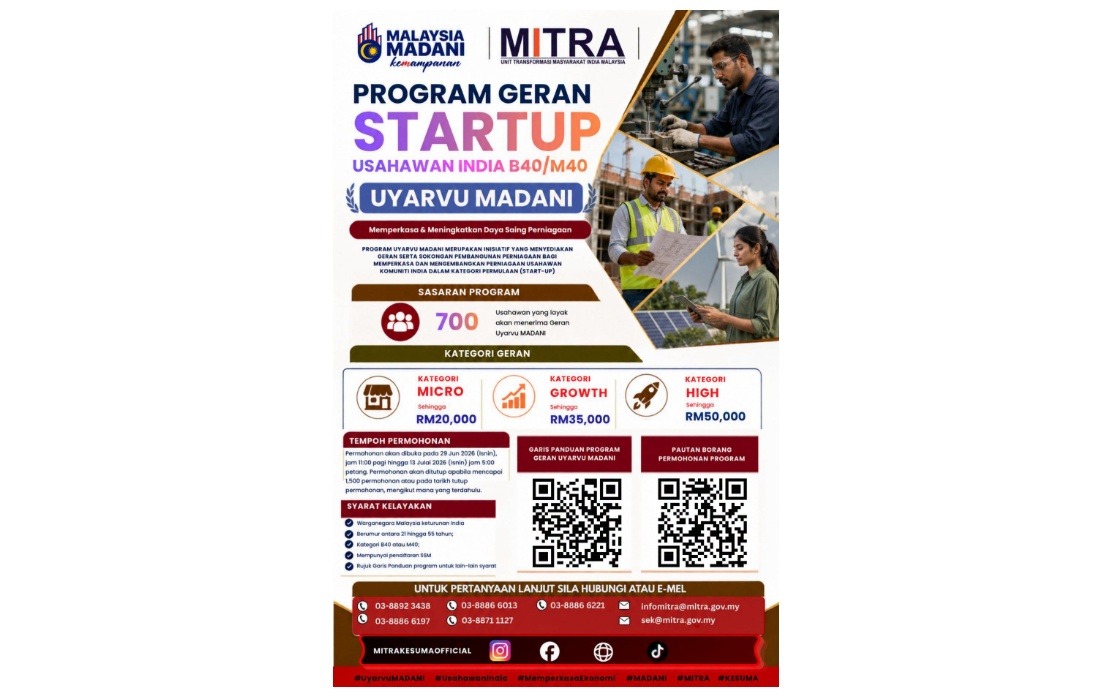
The Malaysian Indian Transformation Unit (MITRA) has commenced a fresh round of applications for its Startup Accelerator Grant Assistance Programme, known as Uyarvu MADANI, which will remain open until 5 pm on July 13. The initiative represents one of six strategic programmes unveiled by MITRA for 2026, backed by a comprehensive allocation of RM65.5 million designed to foster entrepreneurial growth within Malaysia's Indian community.
The grant scheme specifically targets entrepreneurs from the Indian community who fall within Malaysia's B40 and M40 income brackets, addressing the need for accessible startup capital among lower and middle-income segments of this demographic. Successful applicants stand to receive financial support ranging from RM20,000 to RM50,000, with the intention of helping early-stage business owners overcome initial capital constraints that often impede venture establishment and growth.
MITRA has established an ambitious recruitment target of 700 entrepreneurs for this funding cycle, indicating a substantial commitment to broadening the entrepreneurial base within the Indian Malaysian community. Beyond the monetary grants themselves, the programme incorporates business development support mechanisms designed to equip recipients with the knowledge and tools necessary to enhance their market competitiveness and facilitate sustainable business expansion. This dual approach recognises that capital alone is insufficient without accompanying mentorship and strategic guidance.
The application portal will operate on a first-come-first-served basis with an important early closure provision. Should MITRA receive 1,500 applications prior to the July 13 deadline, the application window will terminate immediately rather than remain open until the scheduled end date. This stipulation creates urgency for interested entrepreneurs and reflects MITRA's confidence in generating substantial demand for the programme.
The Uyarvu MADANI initiative emerges within a broader context of targeted community development initiatives in Malaysia, where federal authorities have increasingly recognised the economic potential of minority entrepreneurship. The programme's specific focus on the Indian community addresses historical underrepresentation in formal entrepreneurial spaces and seeks to unlock economic participation among segments facing systemic barriers to business formation. By targeting B40 and M40 households specifically, the scheme directs resources toward those with genuine financial need rather than dispersing funds broadly.
For Malaysian readers, this development carries several implications regarding community economic mobility and federal inclusivity policies. The substantial RM65.5 million allocation across MITRA's six 2026 programmes signals a renewed governmental commitment to minority community economic empowerment at a time when income inequality remains a policy concern. The specificity of targeting Indian entrepreneurs suggests recognition of distinct community needs and the tailored approach required to address them effectively.
The business development support component deserves particular emphasis, as it distinguishes this programme from simple cash handouts. Startups in Southeast Asia frequently fail not from insufficient capital but from operational inexperience, poor market strategy, and inadequate financial management. By coupling grants with structured support services, MITRA attempts to address these often-overlooked success factors. The combination enhances the likelihood that recipients will convert initial investment into sustainable enterprises capable of generating employment and contributing meaningfully to economic activity.
For potential applicants, the deadline of July 13 and the closure trigger of 1,500 applications create a narrow window requiring prompt action. Those genuinely interested in accessing these funds should complete applications without delay, recognising that programme capacity may fill faster than expected. The straightforward eligibility criteria—community membership combined with income classification—removes procedural complexity and should encourage broader participation across diverse business sectors and entrepreneurial experience levels.
The timing of this announcement in late June, shortly before the application window closes in mid-July, aligns with standard government budgeting cycles and allows sufficient promotional period for MITRA to reach target communities through various media channels. The Facebook announcement referenced in the original statement suggests the organisation is leveraging social media platforms to communicate opportunities, a recognition that digital channels often prove more effective than traditional methods for reaching younger, tech-savvy entrepreneurs who represent the programme's likely beneficiaries.
From a Southeast Asian perspective, Malaysia's initiative reflects a broader regional trend toward community-targeted entrepreneurship support. Similar programmes exist across other ASEAN nations, though the precise structuring and funding levels vary considerably. Malaysia's approach of combining direct grants with business development support positions it competitively within regional best practices, potentially offering lessons for neighbouring countries seeking to replicate successful models.
Integrating this programme within MITRA's broader 2026 strategic framework suggests long-term institutional commitment rather than ad-hoc policy gestures. The existence of five complementary initiatives alongside Uyarvu MADANI indicates comprehensive community development thinking. Malaysian policymakers appear to recognise that sustainable economic transformation requires multifaceted approaches addressing distinct barriers simultaneously, from capital access to skills development to market connectivity.

