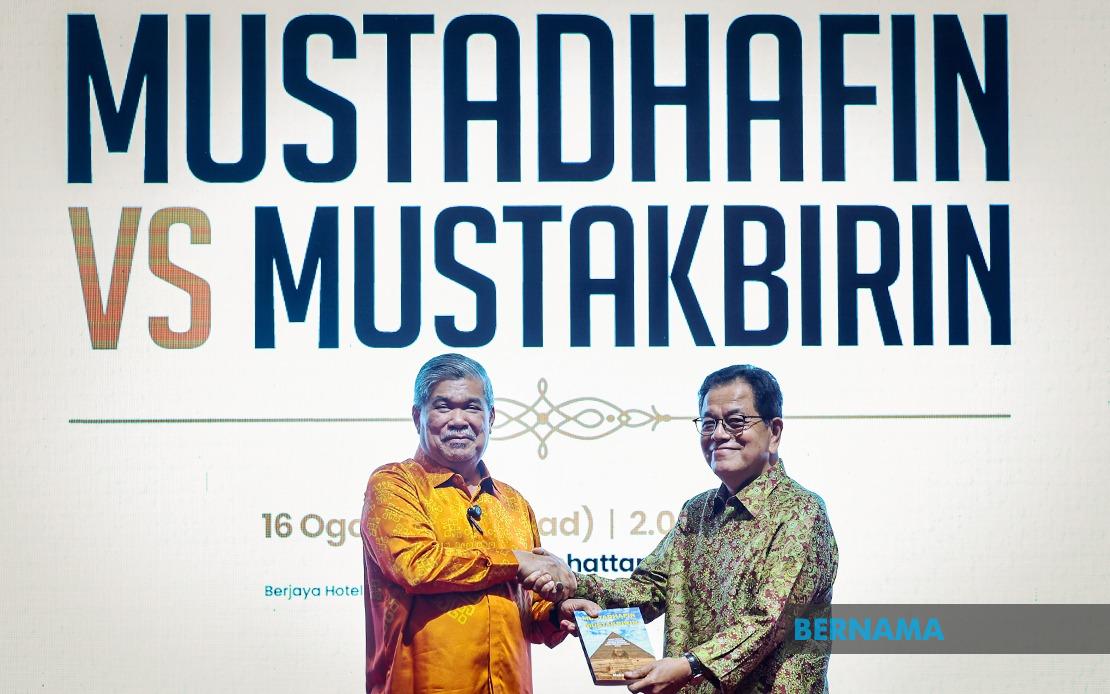
Datuk Seri Mohamad Sabu has issued a pointed warning to Malaysians to exercise critical thinking before accepting political allegations circulating in the country's increasingly polarised landscape. Speaking after launching his book in Kuala Lumpur on August 16, the Amanah president emphasised that swallowing claims without scrutiny breeds 'asabiyyah'—a phenomenon where individuals instinctively defend their own group regardless of merit while dismissing the accomplishments of rivals. His remarks reflect growing concerns among moderate political voices about the erosion of rational debate and the rise of tribalism in Malaysian public discourse.
The Agriculture and Food Security Minister stressed the importance of fact-checking and developing independent understanding before adopting a political position. Rather than passively absorbing narratives fed through mainstream and social media channels, citizens must undertake their own investigations to grasp the complexities of contemporary political questions. This approach, he suggested, should become the norm when evaluating divisive national issues, particularly those involving coalition partners and ideological disputes that have become flashpoints in Malaysian politics.
Mohamad Sabu took direct aim at a recurring allegation that has plagued Malaysian political discourse for decades: the claim that DAP harbours communist sympathies and that cooperation with the party amounts to complicity in a broader communist agenda. He pointedly questioned whether such characterisations withstand factual examination, implying that they do not. This intervention addresses a persistent attack line that continues to circulate, particularly during election campaigns and moments of political tension, despite DAP's evolution into a mainstream democratic party that has governed Penang and contested numerous elections within Malaysia's constitutional framework.
A fundamental obstacle to rational public discourse, according to Mohamad Sabu, lies in the psychological asymmetry between accusations and facts. Allegations and suspicions spread with remarkable velocity, particularly through social media platforms where sensationalism often outcompetes accuracy. Knowledge and verifiable facts, by contrast, demand sustained cognitive effort and patience to absorb and internalise. This structural disadvantage means misinformation frequently outpaces truth in the court of public opinion, a challenge that democracies worldwide struggle to manage effectively.
The Amanah leader drew on personal experience to illustrate his point. From childhood, he cultivated a practice of independent verification rather than passively accepting information presented to him. Rather than succumbing to propaganda narratives—whether from political actors, media outlets, or social networks—he made it his practice to investigate matters directly and form conclusions grounded in reality. This biographical detail underscores the intentionality required to resist tribalism and manufactured consensus in an environment saturated with competing claims and counter-narratives.
His newly launched book represents an attempt to model this investigative approach for a broader audience. The volume documents his personal trajectory of engaging with diverse political actors, ideological movements, and international developments while maintaining a commitment to ground-truthing rather than accepting secondhand accounts. By recounting meetings with various parties and his efforts to understand issues through direct observation rather than hearsay, Mohamad Sabu offers readers a framework for their own political thinking.
Beyond domestic Malaysian politics, the book extends to geopolitical analysis informed by Mohamad Sabu's travels, observations, and reflections on major global transformations. He addresses historical phenomena including colonialism's lasting legacies, trajectories of Islamic movements across the Muslim world, the Palestinian-Israeli conflict, and shifting distributions of global power in an era of rising Asian economies and contested international hierarchies. For Malaysian readers, these international perspectives provide context for understanding how external developments influence domestic political choices and alliance-building.
The book's launch was presided over by National Journalism Laureate Tan Sri Johan Jaaffar, a prominent media figure and director of Star Media Group Berhad. The involvement of a respected journalist in publicising the work lends credibility to its intended project of encouraging evidential thinking in Malaysian political culture. This symbolic pairing—between a politician committed to fact-based reasoning and a journalism luminary—reflects a shared concern among certain quarters that Malaysian public discourse requires reinforcement of epistemological rigour.
For Malaysian readers navigating an increasingly complex and contested political environment, Mohamad Sabu's message carries particular resonance. The country's multiethnic, multireligious composition means that political narratives often exploit communal anxieties and historical grievances to mobilise support. The recurrent invocation of communism as a spectre threatening national cohesion exemplifies how unexamined claims can drive political behaviour despite questionable empirical foundations. By urging citizens to distinguish between allegations and evidence, Mohamad Sabu advocates for a more mature democratic discourse grounded in facts rather than fear.
The warning also reflects tensions within Malaysia's reform movement regarding coalition politics and how to build broad-based alliances across ideological and communal lines. Critics of DAP cooperation argue that doing so compromises Islamic principles or Chinese communal interests, depending on their perspective. Mohamad Sabu's insistence on fact-checking implicitly challenges such framing, suggesting that political cooperation decisions should rest on objective assessment of parties' actual policies and track records rather than inherited suspicions or imported rhetoric. This distinction matters enormously for Malaysia's trajectory as a polarising nation seeking common ground.
More broadly, the Amanah president's intervention addresses a governance challenge confronting many Southeast Asian democracies: how to maintain public trust in institutions and rational deliberation amid information abundance and algorithmic amplification of divisive content. Malaysia, with its history of communal tensions and electoral competitiveness, faces acute vulnerabilities to misinformation and tribal mobilisation. Voices calling for epistemological discipline and independent verification represent a counterweight to centrifugal forces fragmenting the national conversation.
Mohamad Sabu's emphasis on personal investigation and resistance to propaganda resonates with Enlightenment ideals of rational autonomy and democratic citizenship. Yet in the Malaysian context, such appeals carry additional weight given the stakes involved in communal relations and the demonstrated capacity of unexamined allegations to inflame tensions and destabilise coalitions. His book, and the occasion of its launch, thus constitute not merely personal memoir but an intervention in national political culture aimed at elevating standards of evidence and reasoning in public debate.

