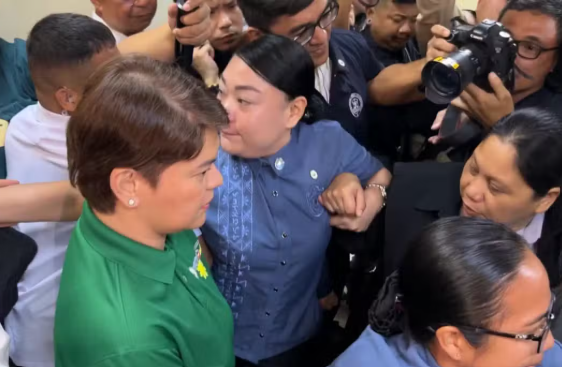
Vice President Sara Duterte arrived at the Philippine Senate on Tuesday to meet with her legal team, taking the opportunity to deliver a defiant statement about the impeachment proceedings against her. Drawing from William Ernest Henley's celebrated poem "Invictus," she declared that in the unfolding "bloodbath and bludgeoning," she would emerge "bloodied but unbowed"—a phrase that epitomises her framing of the trial as a test of personal fortitude rather than a routine constitutional process. The choice of language reflects her consistent rhetorical strategy of characterising the proceedings as an extraordinary political assault requiring exceptional resistance rather than conventional legal defense.
Duterte's invocation of the Henley poem, which explores themes of human perseverance against overwhelming odds, carries particular weight given her previous public statements about the impeachment process. In May 2025, she explicitly welcomed a "bloodbath," signalling her readiness for a protracted and intense confrontation with her political opponents. This language, while dramatic, has become emblematic of the polarised political environment in the Philippines, where constitutional mechanisms increasingly serve as battlegrounds for existential political struggles rather than technical accountability mechanisms.
The Vice President's willingness to engage with reporters during her Senate appearance stands in sharp contrast to her notable absence from most House impeachment proceedings in both 2025 and 2026. Critics and political rivals have seized upon this inconsistency, questioning whether her current rhetorical militancy reconciles with her earlier boycott of the lower chamber proceedings. The contradiction underscores the performative dimensions of contemporary Philippine politics, where messaging and public posturing frequently diverge from substantive participation in the constitutional process.
The impeachment case against Duterte encompasses four distinct articles that collectively paint a picture of systematic governance failures and alleged criminal conduct. The first article focuses on the alleged misappropriation of substantial public funds, claiming she diverted P612.5 million from her office as Vice President alongside an additional P112.5 million from the Department of Education. These figures represent significant portions of government resources entrusted to her administration, and the allegations suggest patterns of financial mismanagement at the highest levels of government.
Beyond the fund misuse allegations, the second article targets what prosecutors characterise as unexplained wealth accumulation. Specifically, the charge contends that Duterte failed to accurately disclose her assets and liabilities across multiple Statements of Assets, Liabilities and Net Worth filings between 2022 and 2024. Additionally, she allegedly maintained business interests that should have been divested upon assuming public office, a violation of Philippine conflict-of-interest legislation designed to ensure that high officials prioritise public service over personal financial gain.
The third article introduces allegations of direct abuse of office through bribery and procurement irregularities within the Department of Education. These accusations suggest coordination between Duterte and departmental officials to circumvent transparent procurement processes, potentially directing lucrative contracts to preferred vendors in exchange for personal benefit. Such allegations, if substantiated, would demonstrate a pattern of leveraging bureaucratic authority for private enrichment.
Perhaps the most serious allegations appear in the fourth article, which charges Duterte with making assassination threats against President Ferdinand Marcos Jr., First Lady Liza Araneta-Marcos, and former House Speaker Martin Romualdez. These charges transcend typical accusations of administrative incompetence or financial impropriety, instead touching upon national security and the safety of the country's highest officials. The gravity of such allegations explains the intensity of the proceedings and the significant public interest surrounding the trial.
The constitutional architecture governing Philippine impeachment trials sets a formidable threshold for conviction. Under the 1987 Constitution, removing the Vice President from office requires a supermajority vote equivalent to at least two-thirds of all senator-judges. This high bar reflects the framers' intention to prevent impeachment from becoming a weapon of simple political majorities, instead reserving removal for cases of overwhelming constitutional violation. Consequently, Duterte's legal team need only secure sufficient senator support to prevent the supermajority, a considerably lower burden than proving her innocence.
The trial timeline projected by the Senate stretches across 92 days, meaning proceedings could extend into early 2027. This protracted schedule reflects the complexity of the allegations and the voluminous documentary evidence likely to be presented. The extended timeframe also means that the impeachment question will loom over Philippine politics for an extended period, potentially constraining the Vice President's ability to exercise her constitutional functions and dominating legislative attention.
For Malaysia and the broader Southeast Asian region, the Duterte impeachment carries significance beyond Philippine borders. The trial represents a critical test of whether constitutional checks can constrain powerful executive figures in a major regional democracy. The outcome will signal either the vitality of institutional accountability mechanisms or their vulnerability to political manipulation. Additionally, the case demonstrates how personalised leadership styles—characteristic of several Southeast Asian polities—can generate the conditions for such high-stakes constitutional confrontations when political cycles shift and new power configurations emerge.
Duterte's defiant posture, articulated through classical literary references and dramatic language, suggests she intends to fight vigorously rather than negotiate an exit from office. Her invocation of "Invictus" frames the impeachment not as a legal proceeding but as a spiritual or philosophical contest, potentially resonating with her supporters while hardening the resolve of her opponents. This rhetorical escalation may intensify rather than resolve the constitutional crisis, suggesting that the coming months will witness a particularly contentious and politically charged trial.

