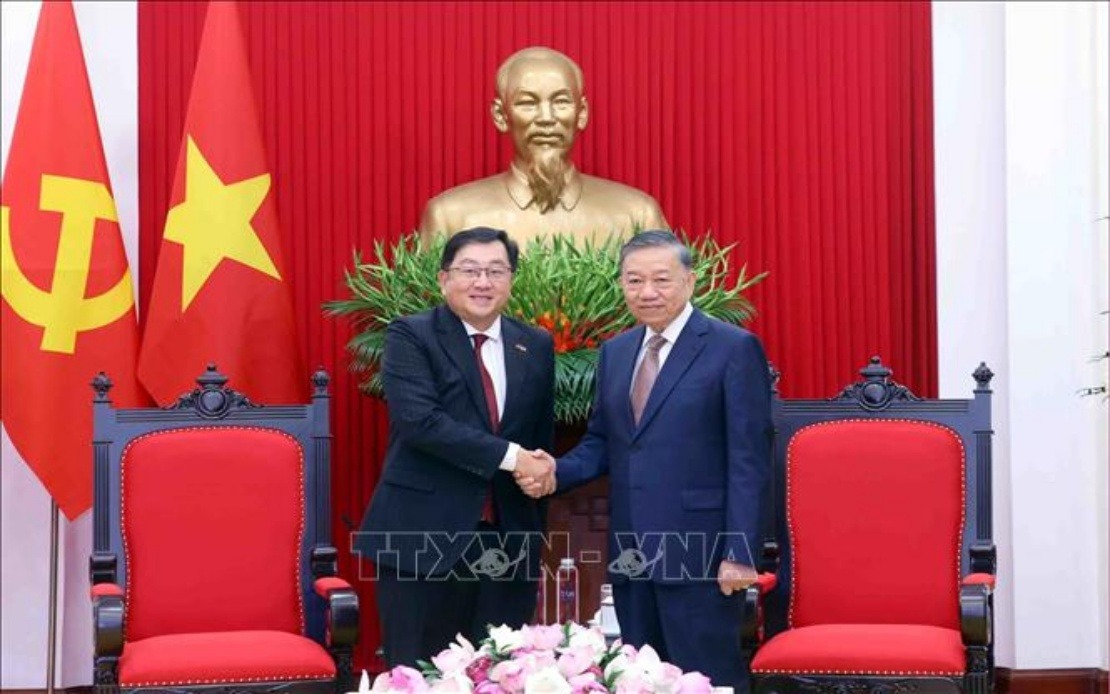
Vietnam's President To Lam has publicly affirmed that ties between Hanoi and Kuala Lumpur are entering an increasingly dynamic phase, built on foundations of mutual political confidence and expanding commercial engagement. The remarks came during an official audience with outgoing Malaysian Ambassador to Vietnam Datuk Tan Yang Thai, marking a formal recognition of the envoy's tenure and a reaffirmation of bilateral commitment as diplomatic representation changes hands. The timing of such high-level affirmations underscores the priority both nations attach to maintaining institutional continuity and momentum in their relationship, particularly as regional geopolitical currents shift.
At the heart of Vietnam's appreciation for the Malaysian partnership lies the concrete economic performance between the two Southeast Asian neighbours. Trade figures for the first half of 2026 reveal a commanding upward trajectory, with two-way commerce reaching US$10.8 billion and representing a year-on-year surge of 40 per cent. This growth rate substantially outpaces typical regional trade expansion and signals that bilateral commerce is accelerating beyond cyclical fluctuations. For Malaysian exporters and investors, Vietnam's buoyant market provides a crucial outlet and manufacturing base as supply chains diversify away from traditional hubs. Conversely, Vietnamese enterprises gain access to Malaysian expertise, capital, and distribution networks that bridge Southeast Asia and beyond.
Malaysia's standing as an investment partner deserves particular emphasis. The country ranks as the third-largest source of foreign direct investment among ASEAN member states into Vietnam, and globally stands at tenth position among 154 countries and territories channelling capital into Vietnamese ventures. This positioning reflects both the maturity of existing business relationships and confidence among Malaysian firms in Vietnam's investment climate and growth prospects. The continuity of such investment flows depends critically on the political stability and predictable governance frameworks that high-level diplomatic engagement helps secure.
President Lam's strategic framing of the partnership reveals Vietnam's broader foreign policy calculus. By explicitly positioning Malaysia as holding an important place in Vietnam's diplomatic architecture, the Vietnamese leader signals that deepening ties serves core national interests rather than constituting merely ceremonial engagement. This framing carries particular weight in Southeast Asia, where bilateral relationships often reflect calculations about regional balance, economic complementarity, and institutional coordination within ASEAN. Vietnam's emphasis on Malaysia's role suggests recognition of Kuala Lumpur's influence within the regional grouping and the value of maintaining alignment on key issues.
The enumerated mechanisms through which both nations intend to deepen cooperation reveal sophisticated understanding of contemporary strategic challenges and opportunities. Regular high-level visits across party, state, government, and parliamentary channels create multiple avenues for dialogue and relationship-building that insulate bilateral ties from fluctuations in any single channel. This diversified approach to official contact has proven resilient during periods of government transition in either country. Beyond formal state interactions, people-to-people exchanges serve as a social foundation for bilateral ties, fostering familiarity and mutual understanding among younger generations and civil society actors who will shape future relations.
The emphasis on digital and green economic development reflects both nations' positioning in regional and global economic transformation. Vietnam, with its large manufacturing base and growing tech sector, and Malaysia, with its established digital infrastructure and renewable energy ambitions, possess complementary strengths in these emerging domains. Collaboration in these fields offers mutual benefit: Vietnam gains access to Malaysian expertise and investment in digital transition, while Malaysian companies find partnership opportunities in Vietnam's vast market. Green economy cooperation takes on added significance given ASEAN's commitments to carbon reduction and regional energy security, particularly as both nations seek to balance development imperatives with environmental stewardship.
Energy and electricity connectivity represents another dimension with direct implications for the broader region. Vietnam's significant hydroelectric resources and expanding renewable capacity contrast with Malaysia's position as a regional energy exporter and hub for power infrastructure development. Strengthened cooperation in this sphere could facilitate more efficient resource allocation across Southeast Asia, reduce energy costs for consumers, and support the broader regional transition toward lower-carbon power systems. Maritime cooperation similarly addresses shared interests in sea lane security, fisheries management, and responses to climate-driven challenges like rising sea levels that threaten coastal communities in both nations.
The departing ambassador's remarks provide insight into how Malaysia views the partnership from its end. Datuk Tan Yang Thai's expression of confidence in Vietnam's development trajectory and commitment to strengthening ties across digital, green, and renewable energy domains aligns closely with Malaysian strategic priorities under Prime Minister Datuk Seri Anwar Ibrahim's administration. Malaysia's particular emphasis on these future-oriented sectors reflects efforts to position the country as a technology-enabled, environmentally conscious economy rather than one anchored primarily in resource extraction or traditional manufacturing.
The exchange of reciprocal invitations for presidential and royal visits carries diplomatic significance beyond ceremonial consideration. Such visits at the highest levels typically coincide with negotiation and signature of substantive bilateral agreements, institutional frameworks, and commitments that shape the relationship's practical trajectory for years ahead. The invitation extended to President To Lam to visit Malaysia, conveyed through the departing ambassador, indicates Malaysian eagerness to reciprocate Vietnamese hospitality and create occasion for face-to-face engagement between leaders that can only occur on home soil.
For Malaysian audiences, this development carries several implications. The robust trade growth and investment expansion create business opportunities across sectors ranging from manufacturing to technology to renewable energy. The strengthening strategic partnership between Vietnam and Malaysia may also influence regional alignments and Malaysia's positioning within ASEAN as it navigates relations with larger powers and addresses transnational challenges. The emphasis on maritime cooperation and energy connectivity touches directly on issues affecting Malaysian economic interests and regional stability.
The relationship's evolution also reflects broader ASEAN dynamics. Both Vietnam and Malaysia have stated commitment to maintaining ASEAN centrality and unity, yet the grouping faces internal strains and external pressures. Bilateral relationships that function effectively and deliver tangible benefits to both populations serve as ballast for the broader regional organisation, demonstrating that cooperation within ASEAN can generate prosperity and security. Vietnam's explicit acknowledgment of Malaysia's importance to its foreign policy, conversely, underscores that even as Vietnam pursues great power relationships and navigates great power competition, it continues investing significantly in Southeast Asian partnerships.
Looking forward, the trajectory of Vietnam-Malaysia relations appears set to continue upward, supported by political will from both leaderships, economic complementarity, and alignment on key strategic priorities. The transition of ambassadorial representation provides opportunity for renewed momentum and refinement of bilateral mechanisms. For regional observers and business communities alike, the vitality of this partnership serves as a useful barometer of ASEAN's institutional health and the capacity of Southeast Asian nations to maintain robust internal cohesion while managing external relationships and competing development challenges.

