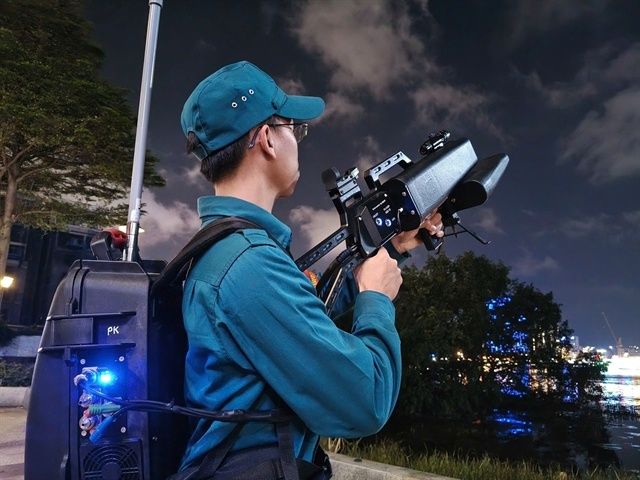
Vietnam's authorities are moving to stamp out a dangerous and costly trend: the proliferation of unauthorised drone flights in restricted airspace around the country's airports. The Immigration Department, operating under the Ministry of Public Security, has sounded the alarm over what it describes as a rapidly escalating threat to aviation safety, backed by mounting evidence of disruptions, substantial financial losses, and the ever-present danger of a catastrophic mid-air collision.
The scale of the problem has become impossible to ignore. Last year, Vietnamese authorities recorded 34 separate instances of drones or other unauthorised aircraft penetrating restricted airspace at airports across the nation. The situation has only deteriorated this year, with 17 additional violations recorded in just the first six months of 2026 alone. This trajectory suggests the problem is not plateauing but accelerating, raising questions about enforcement capacity and public awareness of the regulations governing drone operations in sensitive areas.
Each incursion into airport airspace triggers an immediate cascade of emergency procedures. Air traffic controllers must halt aircraft preparing for departure, suspend landing operations, or redirect incoming planes to alternative airports to eliminate any possibility of collision. These decisions, while necessary for safety, create substantial operational disruptions that ripple throughout the aviation system. The knock-on effects extend far beyond the immediate airport, affecting not just the aircraft involved but entire networks of scheduled flights and connecting services.
The financial consequences have been staggering. Vietnam Airlines quantified the damage from just a single week of drone incidents occurring between February 17 and 24, calculating losses of approximately VNĐ5.6 billion, equivalent to around US$215,000. During that same brief period, roughly 9,200 passengers experienced disrupted travel plans through delays and schedule modifications. Meanwhile, Danang International Airport has separately reported direct losses exceeding VNĐ10 billion, or US$384,000, a figure that excludes indirect costs absorbed by airlines, logistics operators, freight forwarders, and individual travelers who suffered schedule disruptions.
Beyond the economic dimensions lies a more sobering reality: the potential for tragedy. Officials have emphasised that a drone striking an aircraft during the critical phases of takeoff or landing could produce a catastrophic accident with loss of life. While recreational or commercial drones are typically smaller than manned aircraft, the impact of a collision at high speed or low altitude could prove fatal to passengers and crew, a scenario that explains the zero-tolerance approach authorities have adopted toward unauthorised flights in airport zones.
The regulatory framework governing drone operations in Vietnam is comprehensive and well-established. Drone operators are required to register their aircraft and secure a flight permit before conducting any flights, with registration alone providing no authorisation to fly. Permits issued by authorities specify precise parameters for each operation: the geographic area where flying is permitted, the maximum altitude, the time window for operations, and the scope of permitted activities. Violation of these conditions carries consequences ranging from administrative penalties through civil liability to criminal prosecution depending on the severity of the infringement.
A government decree enacted in 2025 established a graduated enforcement system. Lower-level violations can result in financial fines, confiscation of the drone equipment, and suspension of the operator's flight privileges. However, more serious infractions—specifically those where a drone obstructs air traffic operations or poses a genuine threat to aviation safety—cross into criminal territory. Notably, authorities do not require an actual accident to have occurred to pursue criminal charges; the creation of a genuine collision risk is sufficient to trigger prosecution.
The criminal penalties for serious violations are severe. Flying a drone into an aircraft's approach corridor, takeoff path, or landing zone—thereby creating a real and substantial risk of collision—can result in fines ranging from VNĐ10 million to VNĐ50 million (approximately US$384 to US$1,920), non-custodial reform of up to two years, or incarceration for three months to two years. Additionally, convicted individuals face potential bans from employment in certain professions or government positions for periods ranging from one to five years, a collateral consequence that extends well beyond the immediate legal penalty.
In the most egregious cases, where a drone incident genuinely endangers aviation safety, sentences can reach up to 15 years imprisonment. This severity reflects the seriousness with which Vietnamese authorities regard threats to civil aviation and the safety of the travelling public. The willingness to pursue criminal prosecution without requiring a collision to have actually occurred demonstrates a preventive legal approach: authorities aim to deter risky behaviour through credible threat of significant punishment before accidents happen rather than after.
The enforcement challenges facing authorities are substantial. Despite clear regulations, violations continue to occur with alarming frequency. This disconnect between rules and compliance suggests that either public awareness of drone regulations remains inadequate or enforcement capacity is insufficient to deter violations consistently. The department has responded by calling on all drone operators to strictly comply with their permits, adhering precisely to the time, geographic area, and operational conditions specified in their authorisation documents.
Crucially, the authorities have also appealed directly to the general public to participate in enforcement by reporting suspicious drone activity near airports to police, military personnel, or airport security officials. This crowdsourcing of surveillance reflects a recognition that government agencies alone cannot monitor all airspace and a strategy to create multiple reporting channels that enhance the likelihood of detecting violations quickly.
Vietnamese officials have framed the broader issue as a collective responsibility that transcends government action. Aviation safety, they argue, depends on a shared commitment to safety across society. The Immigration Department's warnings emphasise that irresponsible drone use does not merely inconvenience travellers or impose financial costs on airlines; it directly endangers human lives, threatens the viability of air transportation systems, and potentially compromises national security. This resonates particularly in Southeast Asia, where aviation infrastructure has become increasingly critical to regional economic integration and where safety incidents can have far-reaching consequences across borders.

