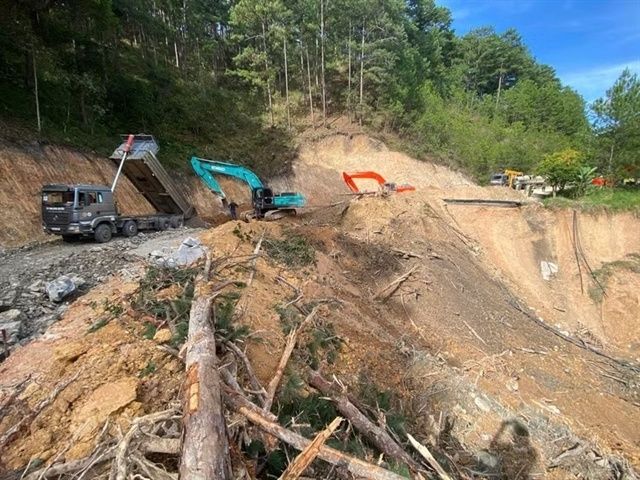
Vietnam's Ministry of Construction has formally declared a natural disaster emergency affecting a crucial stretch of Ho Chi Minh Road that passes through Tuyen Quang Province, following a month of relentless heavy rainfall that inflicted substantial damage on the critical transport corridor. The emergency declaration focuses on the road section at the Km115+000 position, where Ho Chi Minh Road intersects with National Highway 2C, an area falling under the operational purview of Road Management Zone I. The decision underscores official concerns about the safety risks posed to both civilians and commercial traffic utilising this essential north-south route.
The cascade of severe rainfall events that battered the region throughout June created conditions that led to marked deformation of the road structure and supporting infrastructure. The Tuyen Quang Provincial Hydrometeorological Station and the National Centre for Hydrometeorological Forecasting documented a succession of heavy precipitation episodes spanning from June 1 through June 30, establishing the meteorological basis for the emergency declaration. Such concentrated rainfall patterns, increasingly common in Vietnam's monsoon climate, overwhelm drainage systems and destabilise road foundations, particularly in hilly and mountainous terrain typical of Tuyen Quang Province.
The infrastructure damage at this specific location carries significant implications for regional connectivity. Ho Chi Minh Road, also known as Vietnamese National Route 1, functions as the nation's primary arterial highway linking Hanoi with Ho Chi Minh City and intermediate provinces. Disruptions to this corridor ripple across the entire supply chain, affecting commercial transport, passenger movement, and economic activity throughout central and northern Vietnam. For Malaysian businesses engaged in trade with Vietnam or operating along Southeast Asian transport networks, such stoppages represent tangible logistical risks and potential cost increases.
Responding to the emergency, the Ministry of Construction has activated a coordinated response mechanism. The Department for Roads of Vietnam and Road Management Zone I have been designated as primary agents responsible for conducting comprehensive damage assessments and formulating repair strategies. These organisations are required to issue an Emergency Construction Order that will facilitate rapid deployment of repair works while navigating normal procurement and approval procedures. The emergency framework allows authorities to mobilise resources and contractors without the standard bureaucratic delays that would typically accompany routine road maintenance projects.
Parallel to the principal damage site, authorities have identified a secondary flooded section extending from Km124+600 to Km128 on Ho Chi Minh Road, where the highway overlaps with National Highway 2. Managing congestion and maintaining vehicular flow through this waterlogged stretch demands immediate attention, as stalled traffic compounds economic losses and creates safety hazards during extended wet weather. The Director General of the Department for Roads of Vietnam and the Director of Road Management Zone I face direct accountability to the Minister of Construction for orchestrating these congestion mitigation efforts while repair work proceeds.
The accountability framework embedded in the emergency response reflects Vietnam's administrative approach to natural disaster management. Officials are tasked not merely with overseeing repairs but with supervising real-time traffic management, documenting infrastructure conditions, and providing regular status reports to the ministry. This hierarchical reporting structure ensures that decision-makers at the national level maintain situational awareness and can allocate additional resources if circumstances warrant escalation. The Transport and Road Safety Division assumes responsibility for coordinating across multiple government agencies and ensuring that local authorities comply with ministry directives.
Once emergency repairs reach completion, the Department for Roads of Vietnam must formally report back to the Ministry of Construction, providing technical documentation of restoration efforts and confirming that safety standards have been restored. Only upon receipt and review of this report can the ministry declare an end to the emergency status. This staged deactivation process prevents premature reopening while ensuring that temporary repairs evolve into permanent solutions as conditions stabilise and traffic pressures ease.
The incident highlights broader vulnerabilities within Vietnam's road infrastructure system as climate patterns become increasingly erratic. Tuyen Quang Province, located in the country's northwest, sits within a region historically prone to flash flooding and landslides during monsoon seasons. Infrastructure built to historical rainfall averages now faces conditions that exceed design specifications, necessitating either upgraded construction standards or more frequent emergency interventions. For Malaysia and other ASEAN nations sharing similar geographic and climatic characteristics, Vietnam's experience offers instructive lessons about infrastructure resilience and adaptation costs.
The emergency declaration also reflects Vietnam's growing sophistication in disaster management protocols. Rather than ad hoc responses, the country has developed systematic frameworks for identifying natural disasters, mobilising resources, and tracking recovery. This institutionalisation of emergency procedures, though sometimes bureaucratic, ensures consistent standards and prevents critical infrastructure from deteriorating during the interval between initial damage and eventual repair. The explicit assignment of responsibility to named officials creates accountability mechanisms that encourage timely action rather than prolonged neglect.
For regional observers and businesses dependent on Vietnamese transport networks, this emergency underscores the importance of maintaining diversified logistics routes and supply chain flexibility. Ho Chi Minh Road remains Vietnam's backbone transportation artery, but weather-related disruptions will likely recur with increasing frequency. Companies operating across Southeast Asia should anticipate periodic closures and plan accordingly, considering alternative corridors or modal shifts to aviation and maritime transport when ground routes become unreliable. The incident also suggests that infrastructure investment in Vietnam will need to accommodate climate resilience alongside capacity expansion.

