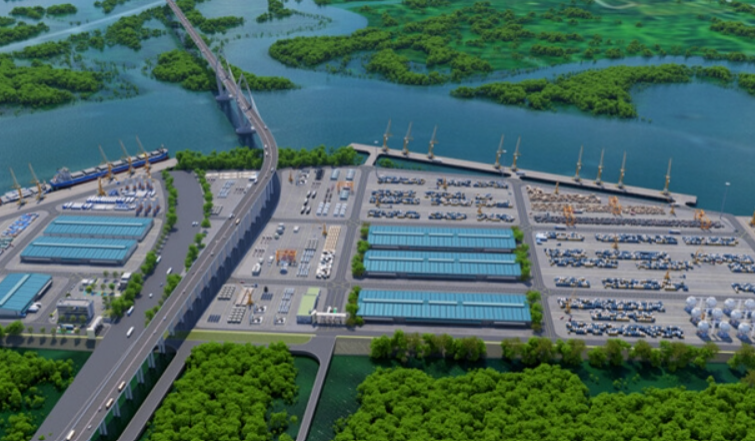
Vietnam's economic powerhouse, Ho Chi Minh City, launched construction on Sunday on the QTM International Port, a VNĐ6.9 trillion (US$261 million) facility intended to significantly strengthen the nation's position as a regional logistics hub. Situated within the sprawling Cai Mep-Thi Vai deep-water port complex in Phu My Ward, this strategic investment underscores Hanoi's commitment to modernising maritime infrastructure along its southern growth corridor at a time when regional supply chains are increasingly contested between major trading powers.
The port development strategy responds to acute infrastructure pressures unleashed by HCM City's recent administrative consolidation of three neighbouring localities. Authorities contend that this territorial expansion has exponentially amplified the volume of goods and raw materials requiring transit, straining existing transport networks and compelling substantial capital investment. The expansion programme unfolds across two construction phases extending from 2026 through 2034, with the completed facility projected to process 16 million tonnes annually across more than 80 hectares of operational space. The accompanying logistics complex will encompass approximately 200,000 square metres of integrated warehousing and distribution infrastructure, designed to establish seamless connectivity between maritime, road, and inland waterway transport modes.
The port's configuration reflects contemporary global maritime standards, incorporating eight berths initially capable of servicing vessels up to 60,000 deadweight tonnes, with architectural provisions for future accommodations of 100,000 DWT container ships. This phased expansion pathway acknowledges the evolving demands of containerised trade whilst maintaining operational flexibility as regional commerce volumes fluctuate. Such specifications position the facility competitively within Southeast Asia's congested port network, where capacity constraints have created persistent bottlenecks impeding efficient goods movement throughout the region.
Hoang Nguyen Dinh, vice chairman of HCM City's People's Committee, articulated the fundamental challenge driving the investment. Speaking at the groundbreaking ceremony, he emphasised that cargo transport demand has intensified substantially following the municipal merger, necessitating comprehensive development of integrated logistics networks capable of servicing both regional markets and international trading partners. This assessment aligns with measurable performance data demonstrating that maritime and inland waterway cargo volumes in HCM City expanded by 7.3 per cent during the first half of 2024, signalling robust and accelerating demand trajectories across Vietnam's primary commercial gateway.
Deputy Prime Minister Pham Gia Tuc provided crucial macroeconomic context illuminating why port development ranks among Vietnam's strategic priorities. Current logistics expenditures consume between 14 and 16 per cent of national gross domestic product, substantially undermining the cost competitiveness of Vietnamese manufactured exports and agricultural products in increasingly price-sensitive global markets. By developing modern, high-capacity port infrastructure, Vietnam aims to reduce per-unit transport costs and enhance the overall profitability of its export sectors, thereby sustaining the double-digit economic growth targets that Hanoi has established for HCM City's development trajectory.
The temporal urgency embedded within governmental messaging deserves particular attention. Pham Gia Tuc exhorted project developers to accelerate construction scheduling and achieve operational status for the facility's initial phase within approximately eleven months, an extraordinarily compressed timeline reflecting political determination to realise economic benefits rapidly. Such ambitious deadlines, whilst publicly pronounced, present formidable logistical and financial challenges in Vietnam's construction environment and may require substantial resource mobilisation and regulatory accommodation to achieve feasibility.
The Cai Mep-Thi Vai complex itself constitutes one of the world's premier containerised cargo hubs, commanding strategic positioning within global maritime trade architectures. The facility provides direct shipping connections to major transpacific routes linking East Asian manufacturing centres with North American markets, whilst simultaneously serving European destination ports via extended Indian Ocean transit corridors. For Malaysian and Southeast Asian stakeholders, HCM City's port expansion carries significant implications, as enhanced Vietnamese logistics capacity may attract regional shipping traffic and industrial investment away from competing facilities throughout the broader region, potentially reshaping intra-Asian trade patterns.
Ho Chi Minh City's geographic endowment—approximately 110 kilometres of coastline and positioning as host to one of Vietnam's most sophisticated maritime transport systems—provides inherent advantages supporting large-scale port development. However, the city simultaneously faces intense competition from other Southeast Asian ports seeking to capture expanding regional trade volumes. Thailand's eastern seaboard ports, Singapore's world-class facilities, and emerging Indonesian port systems all represent alternative logistics routes for regional commerce. Vietnam's investment strategy appears designed to consolidate HCM City's competitive position by substantially augmenting capacity during a period when regional economic integration and trade volumes are expanding significantly.
The political messaging surrounding this port investment reflects broader Vietnamese governmental priorities emphasising infrastructure modernisation as a pathway towards sustained economic development and enhanced regional influence. By positioning HCM City as a preeminent regional logistics centre capable of efficiently servicing high-volume containerised trade, Vietnam seeks to attract manufacturing operations, facilitate export activities, and generate employment across its southern provinces. For Malaysian policymakers and businesses engaged in regional commerce, Vietnam's port expansion warrants close monitoring, as enhanced infrastructure may alter competitive dynamics within Southeast Asia's logistics sector and influence supply chain routing decisions across the region.
The investment's significance extends beyond immediate commercial considerations. Successfully implementing this port project within compressed timelines whilst maintaining quality standards will demonstrate Vietnamese technical and managerial competence in executing major infrastructure initiatives. Such demonstration effects influence investor confidence and perceptions regarding Vietnam's ability to deliver on subsequent development commitments, potentially affecting foreign direct investment flows across multiple economic sectors. Meanwhile, the project's financing structure—whilst not detailed in initial announcements—may involve international development finance, private capital participation, or public-private partnerships, reflecting contemporary infrastructure development models increasingly prevalent throughout Southeast Asia.

