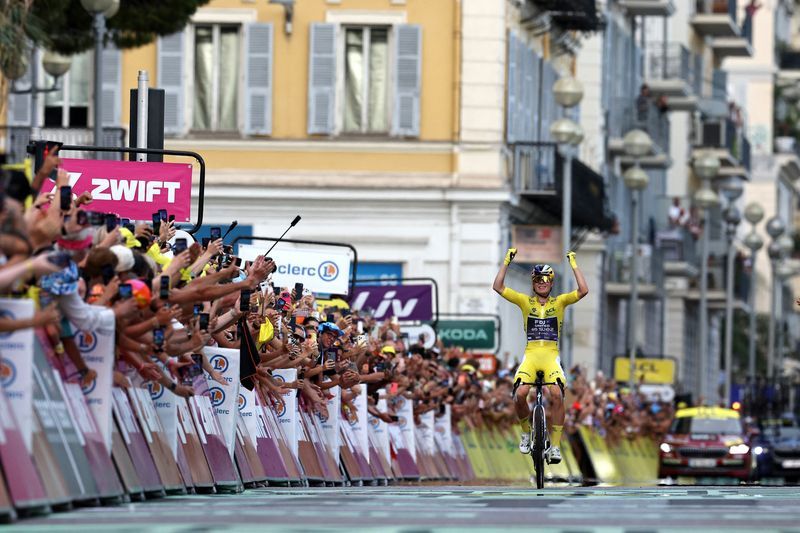
Demi Vollering of the Netherlands has captured her second Tour de France Femmes crown, the sport's most prestigious women's cycling competition, after a dominant display on the race-concluding stage held near Nice on Sunday. The 29-year-old FDJ-Suez team member arrived at the final 99.2-kilometre leg with an eight-second advantage over Poland's Katarzyna Niewiadoma-Phinney, a margin she had secured the previous day by seizing the coveted yellow jersey.
Vollering's career trajectory has been marked by an extraordinary series of achievements that underscore her status among the sport's elite performers. Beyond her two Tour de France Femmes victories—2023 being her maiden triumph—she captured the 2026 Giro d'Italia Women and claimed consecutive La Vuelta Femenina titles in 2024 and 2025. This combination of results across cycling's most demanding stage races reflects not merely consistent excellence but a rare ability to peak when competition reaches its fiercest.
The decisive moment arrived during the fourth and final ascent of the Col d'Eze, where treacherous mountain terrain typically determines a rider's championship credentials. It was precisely at this juncture that Vollering launched her attack against Niewiadoma-Phinney, who at 31 years old remains a formidable competitor despite falling short on this occasion. The manoeuvre proved immediately decisive, as Vollering surged clear and maintained her advantage all the way to the finish line in Nice, underscoring the physical superiority she demonstrated throughout the three-week competition.
Vollering's reflection on her victory revealed the psychological dimensions that separate exceptional athletes from merely talented ones. She acknowledged harbouring doubts about whether she had previously won while wearing the yellow jersey, suggesting that winning in the colours of the race leader carried special significance for her personally. Her commentary also emphasised the collective nature of professional cycling, mentioning teammate Celia Gery and the broader support structure that enabled her triumph.
The Dutch champion articulated a philosophy that extended beyond individual glory. She spoke of her dream not simply to win races but to execute those victories with both humility and pride, framing her achievement within a team context rather than as a solitary triumph. This perspective reflects a maturation in how elite cyclists, particularly in the women's category, understand their role within professional cycling infrastructure.
Vollering's final margin over second-placed Niewiadoma-Phinney reached one minute and 18 seconds in the general classification, a substantial gap by modern cycling standards that underscored how thoroughly she dominated the race's concluding chapters. Italy's Elisa Longo Borghini completed the podium in third position, while Spain's Paula Blasi finished second on the final stage, crossing the line one minute and four seconds after Vollering, with Niewiadoma-Phinney taking third on the day.
The stage victory represented Vollering's third in this edition and her sixth overall appearance on Tour de France Femmes stage podiums, demonstrating her consistency across varying terrain and racing conditions. These statistics indicate an athlete capable of producing her best performances not simply on one particular type of terrain but across the diverse challenges that a three-week stage race presents.
Vollering's dominance in the women's race comes as professional cycling continues its trajectory toward genuine parity in investment, media coverage, and competitive prestige between men's and women's disciplines. The Tour de France Femmes itself was revived in 2022 after a 33-year absence, and performances like Vollering's contribute to building the narrative weight and sporting credibility that the race requires to secure its position within cycling's hierarchy.
For Southeast Asian cycling enthusiasts and observers, Vollering's achievements carry broader significance regarding how the sport is evolving globally. While cycling remains dominated by European athletes, the international expansion of professional cycling, particularly in women's categories, continues to reshape the sport's landscape. The competitive quality displayed across the Tour de France Femmes podium positions demonstrates that women's cycling has reached a maturity where multiple athletes from different nations can mount genuine title challenges, creating the kind of compelling narratives that build sport audiences.
Vollering's approach—emphasising teamwork, preparation, and calculated aggression—offers insights into what separates consistent champions from occasional winners. Her capacity to identify decisive moments and execute attacks with precision reflects both natural talent and sophisticated tactical understanding. As professional cycling continues evolving, performances like hers establish benchmarks for what elite female cyclists can accomplish and the standards toward which emerging riders aspire.
Meanwhile, the men's cycling season had earlier concluded with Slovenia's Tadej Pogacar extending his dominance, having claimed a record-equalling fifth Tour de France title in July through securing an unprecedented third consecutive victory in cycling's flagship event. The contrast between Pogacar's extraordinary run and Vollering's multi-year superiority across different grand tours highlights how contemporary professional cycling has become genuinely competitive across both categories, with athletes capable of sustained excellence competing at the sport's highest levels.

