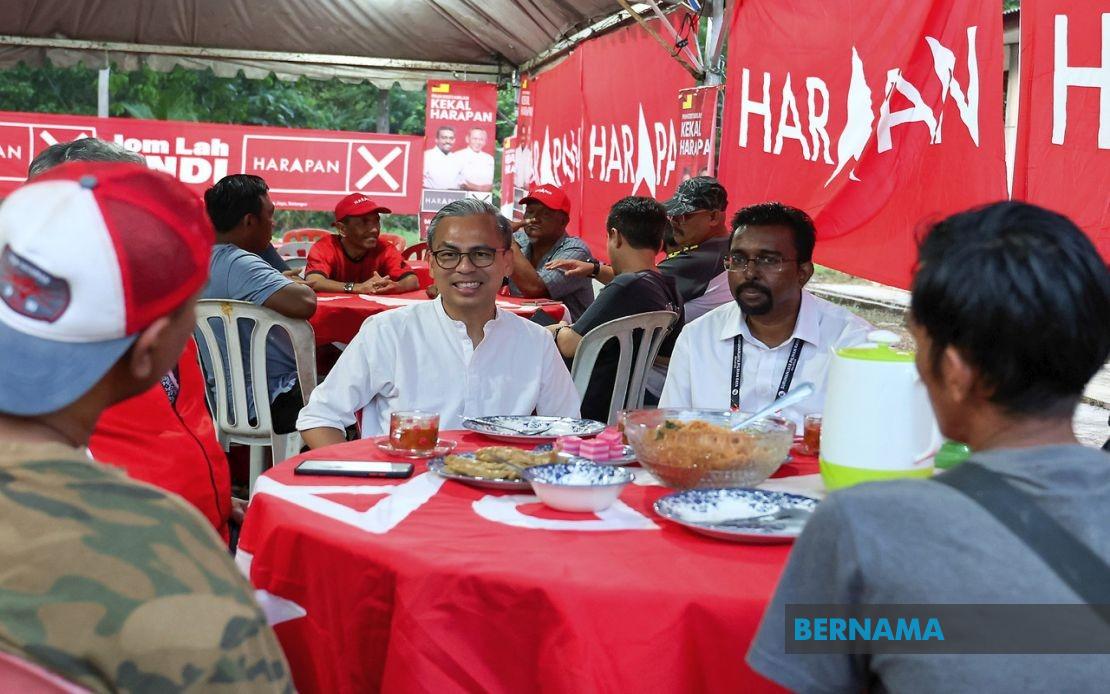
The ultimate arbiters of the 16th Negeri Sembilan state election outcome will be ordinary voters, not political analysts or survey statisticians, according to Pakatan Harapan communications director Datuk Seri Fahmi Fadzil. Speaking during a community gathering in Jempol on July 28, Fahmi dismissed various pre-election forecasts about which parties might claim seats, framing such predictions instead as motivation for his coalition's candidates to intensify their on-the-ground efforts and connect more meaningfully with residents across the state.
Fahmi's remarks carried a pointed subtext. He was responding to recent election forecast analysis by Dr Ong Kian Ming, the former Bangi Member of Parliament, who had offered his assessments about competitive constituencies in the Negeri Sembilan contest. Rather than treating such projections as settled conclusions, Fahmi repositioned them as challenges that demanded redoubled campaigning rather than fatalistic acceptance. This rhetorical move reflected a broader PH strategy to emphasise voter agency and grassroots mobilisation in the final days of campaigning, countering any perception that the race had been decided by expert opinion or polling data before election day arrived.
The PKR information chief drew a parallel from his own electoral history to illustrate his point about the unpredictability of voter behaviour and the limitations of pre-election surveys. During the 14th General Election in 2018, multiple opinion polls and early forecasting had pointed toward his defeat in the Lembah Pantai parliamentary seat—yet he ultimately secured victory when actual voting took place. That experience, Fahmi suggested, testified to the gap between what surveys predict and what ballot boxes reveal, reinforcing his conviction that earned media through direct voter engagement matters far more than statistical models.
According to Fahmi, the internal feedback Pakatan Harapan had been receiving from across Negeri Sembilan indicated positive momentum, particularly among swing voters and undecided electors who remained open to persuasion. He stressed that despite these encouraging signals from campaign teams and community interactions, the decisive moment would arrive only when voters went to the polls on Saturday. The coalition's message to its candidates was clear: continue knocking on doors, listen to residents' concerns, and work to convert soft support into firm commitments, right up until the polling stations closed.
A significant component of Fahmi's messaging focused on tangible state government accomplishments that he believed resonated with voters. He pointed to several welfare and economic assistance initiatives delivered by the PH-led Negeri Sembilan administration, including entrepreneurship incentive schemes, financial support programs for newly married couples, and subsidised laptop distribution to students. By highlighting these concrete benefits, Fahmi attempted to anchor PH's campaign narrative around delivery and practical governance rather than abstract political arguments, appealing to voters' self-interest and immediate experience of state services.
As the election campaign entered its final seventy-two hours, Fahmi issued a forceful warning about the proliferation of misleading content and disinformation across digital platforms, particularly through WhatsApp messaging groups and social media channels. He anticipated that opponents would attempt to exploit the closing campaign period to disseminate false or distorted information, capitalising on the compressed timeframe when fact-checking becomes more difficult and emotionally charged messages spread rapidly through networks. This predictable late-campaign surge in problematic content, Fahmi suggested, represented standard political practice that voters needed to guard against actively.
The nature of the misinformation circulating concerned Fahmi deeply. Rather than entirely fabricated claims, much of it consisted of partial truths, decontextualised fragments of statements, or recycled footage from years earlier being misrepresented as recent remarks. He cited a specific example: an older video of Prime Minister Datuk Seri Anwar Ibrahim from his opposition days had recently been recirculated with the false implication that he had made disparaging comments about Malaysia's armed forces. Such manipulation of context and timing, Fahmi argued, could significantly influence voters if left unchallenged, particularly among those less sceptical about digital content and more prone to sharing material without verification.
To counter this anticipated wave of disinformation, Fahmi offered voters practical guidance on source verification. He recommended that citizens apply a straightforward test before accepting or sharing political content: if the information had not been reported by established mainstream media outlets such as Berita Harian, TV3, RTM, Bernama, or Awani, or had not come through official government communication channels, then scepticism was warranted. This appeal to traditional journalistic gatekeeping, while potentially contentious in an era of declining trust in mainstream institutions, reflected PH's attempt to stabilise the information environment and prevent late-campaign volatility driven by social media rumours.
Fahmi's dual emphasis—on voter agency determining outcomes while simultaneously warning of misinformation threats—captured the tension in contemporary electoral politics throughout Southeast Asia. The rhetoric of voter empowerment sits uneasily with acknowledgement that voters' decisions can be shaped by false or misleading information. By highlighting both elements, Fahmi attempted to inspire confidence in the democratic process while acknowledging real vulnerabilities in how information circulates and influences political behaviour during high-stakes campaigns.
The Negeri Sembilan election carried broader implications for Malaysian politics beyond the state itself. As a relatively competitive state battleground without overwhelming dominance by any single coalition, the results would offer a significant test of PH's popularity and organisational capacity in the post-2022 coalition government period. The outcome would also signal whether the governing alliance could maintain electoral momentum and voter support for state-level contests, which often prove more unpredictable than national elections due to local grievances and regional personalities overshadowing national campaigns.

