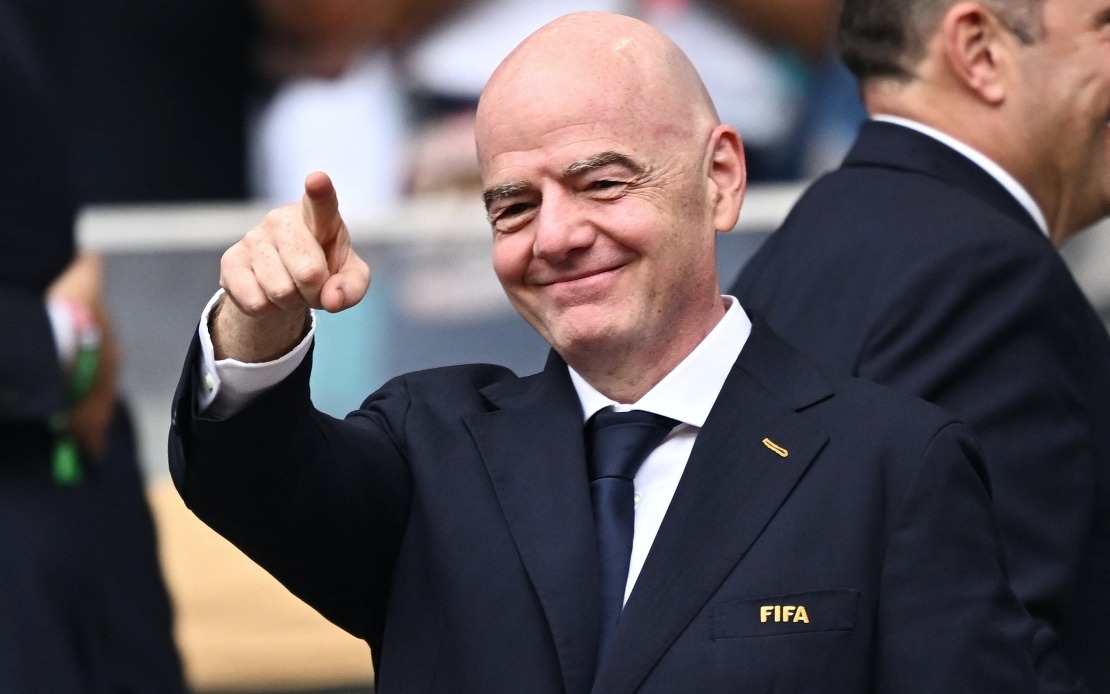
The Football Association of Wales has pulled its backing for FIFA president Gianni Infantino's bid to secure another term, marking a significant blow to the embattled leader's re-election prospects. The decision comes in the aftermath of Infantino's controversial attempt to create FIFA Forward Enterprise, a scheme designed to offload stakes in the World Cup tournament to private investors—a proposal that faced fierce resistance across the football world before being abandoned last week.
Infantino's governance crisis has now triggered a coordinated withdrawal of support from major football federations. The FAW's reversal is particularly notable because the Welsh body had previously signalled its willingness to back Infantino's continuation in office. However, the governing body issued a statement on Monday explicitly citing what it characterized as systemic failures in decision-making, transparency, and stakeholder engagement. The statement emphasized that Infantino had forfeited the confidence necessary to lead the world game, particularly by failing to prioritize football's fundamental interests.
The backlash extends far beyond Wales. England's Football Association has similarly conveyed to FIFA officials that it no longer supports Infantino's leadership, whilst UK Prime Minister Andy Burnham articulated the sentiment succinctly, declaring that Infantino is unsuitable for the FIFA presidency. The English FA demanded a comprehensive and rigorous examination of his entire tenure at the organization, signalling that isolated governance lapses are insufficient to explain the depth of institutional concern.
UEFA, European football's governing confederation, has adopted an unusually confrontational stance by explicitly refusing to rule out any mechanisms for removing Infantino from office. This calculated ambiguity has opened the door to extraordinary measures, including a potential vote of no confidence that could trigger an Extraordinary FIFA Congress. Under FIFA's constitutional framework, just 43 member associations out of 211 total are required to initiate such a procedure, though initiating it without reasonable confidence in a successful outcome would prove politically damaging.
The geographical distribution of support and opposition reveals important patterns within global football governance. CONCACAF, representing 41 North American, Central American and Caribbean associations, has similarly called for a thorough review of Infantino's performance. Speculation has already surfaced regarding Victor Montagliani, CONCACAF's president and current FIFA vice-president, as a potential alternative candidate should the political situation deteriorate further for Infantino. Combined, UEFA and CONCACAF command influence over approximately 96 associations, representing substantial voting power within FIFA's congress.
Counterbalancing these defections, several confederations have issued supportive statements towards Infantino. Associations from Africa and Asia, including those from Morocco, Egypt and Qatar, have publicly backed the incumbent, suggesting that Infantino retains meaningful support in regions where FIFA's development investments and tournament hosting opportunities carry particular strategic weight. This regional polarization underscores how FIFA politics often reflects broader geopolitical and economic interests rather than pure governance considerations.
The FIFA Forward Enterprise debacle represents more than a failed business proposal; it symbolizes deeper anxieties within football governance circles regarding institutional accountability and decision-making processes. The scheme's architects apparently underestimated the degree to which major football federations would reject what they perceived as an attempt to commodify football's crown jewel without adequate consultation or transparent justification. That Infantino proceeded despite opposition from three major confederations suggests either a fundamental miscalculation about his political capital or a concerning disregard for consensus-building.
For Southeast Asian readers, these developments carry particular significance given FIFA's strategic investments in regional football development and the Asian Football Confederation's growing influence within global governance structures. Malaysia's football administration, whilst not explicitly mentioned in current proceedings, exists within an Asian context where FIFA's institutional credibility and governance stability directly affect investment flows and tournament allocation decisions. A prolonged crisis of leadership confidence at FIFA could create uncertainty around development funding and competition scheduling that ripples throughout Asian football.
The mechanics of potential removal remain complex and uncertain. Whilst 43 associations could formally trigger an Extraordinary Congress, orchestrating a majority coalition among 211 member federations represents a substantially higher threshold. Many smaller associations value their relationships with FIFA's central bureaucracy and the financial support it provides through development programs, making them reluctant to participate in what might be perceived as an institutional coup against the sitting president. Infantino's supporters appear to be banking on this structural inertia to weather the current storm.
Infantino's decade-long presidency has been marked by considerable controversy beyond the FFE episode. Questions surrounding ethics, transparency, and conflict-of-interest management have dogged his tenure, but they have rarely coalesced into organized political action until now. The FIFA Forward Enterprise proposal appears to have served as a crystallizing moment—a specific, bounded grievance that could rally opposition from disparate confederations that might otherwise tolerate institutional ambiguity.
The road ahead remains uncertain. Infantino could potentially stabilize his position if African and Asian federations maintain solidarity with his presidency, or the opposition could build additional momentum and engineer his removal. The football world is now watching closely to determine whether governance concerns will ultimately overcome institutional inertia and regional interests. For global football's credibility, the resolution of this leadership crisis will matter considerably, regardless of which direction the process ultimately moves.

