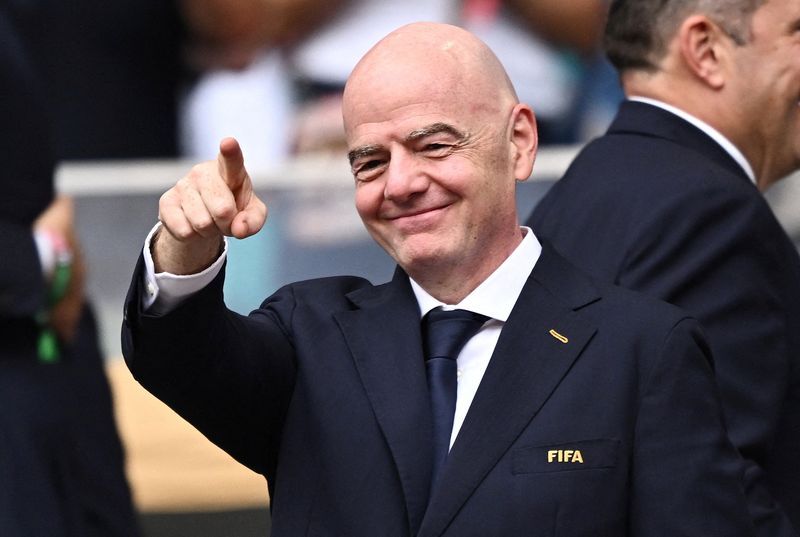
Wales has formally withdrawn its backing for FIFA President Gianni Infantino's candidacy in the upcoming 2027-2031 leadership election, dealing a significant blow to the embattled executive whose grip on world football governance has visibly weakened following the spectacular failure of an ambitious privatisation scheme. The Football Association of Wales made the announcement after FIFA abandoned plans to raise up to $4.2 billion by selling approximately 20% of a newly created commercial entity that would oversee major tournaments including the World Cup.
The proposed divestment, which Infantino had championed as a revenue-generating masterstroke, faced insurmountable opposition from key stakeholders across FIFA's membership. The scheme collapsed on Friday following weeks of mounting pressure from regional confederations and national associations who viewed the plan as fundamentally undermining the sport's governance structures. The retreat represents a rare public defeat for Infantino, whose tenure since 2016 has been characterised by considerable control over FIFA's decision-making apparatus and a seeming imperviousness to criticism from within the organisation.
The Welsh FA's statement is notably unsparing in its critique of the FIFA president's leadership. Beyond merely withdrawing electoral support, the federation explicitly cited "failures in good governance, processes, leadership, values, stakeholder management, communications and sound judgement" as the primary reasons for its decision. The language employed suggests deep institutional concerns extending well beyond the failed privatisation initiative, indicating that frustration with Infantino's stewardship had been accumulating among smaller football nations for some time.
Wales' move carries particular significance as it establishes a precedent that others may now follow. As the first national federation to formally renounce support for Infantino's re-election, the Welsh association has essentially lowered the political cost for similar withdrawals elsewhere. This could potentially trigger a cascade effect as other federations, particularly those from European and North American regions, evaluate their own positions ahead of the March Congress scheduled in Morocco.
Infantino's difficulties have multiplied significantly in recent days as major continental confederations have also signalled their loss of confidence. Both UEFA, European football's governing body which spearheaded resistance to the stake sale proposal, and CONCACAF, representing North American nations, publicly stated on Saturday that they had lost trust in Infantino's leadership. UEFA's response proved particularly forceful, with the confederation issuing a document preservation order to prevent the destruction of communications and records as it presumably prepares for potential legal action against FIFA over the controversy.
For Southeast Asian readers and regional football authorities, this crisis at FIFA's headquarters carries substantial implications. Malaysia and other ASEAN nations are among FIFA's 211 member associations, and shifts in global football governance directly influence how international tournaments are structured, revenue is distributed, and governance standards are enforced. The proposed stake sale would have concentrated commercial decision-making among private investors, potentially reducing the influence of smaller football nations on key decisions affecting international competitions they participate in.
Infantino's path to re-election, which appeared straightforward merely months ago, has become decidedly uncertain. The Swiss executive initially announced his intention to seek a fourth consecutive term in April, and until recently, his candidacy seemed assured given his two previous unopposed re-elections. His apparent invulnerability within FIFA's machinery has now been exposed as conditional, dependent on maintaining sufficient support from regional confederations and major national federations. Experts suggest that while Infantino's re-election had been viewed as administratively routine, the backlash against the failed privatisation scheme has revealed substantial underlying dissatisfaction that remained dormant while the proposal was being negotiated.
The immediate context of FIFA's failed privatisation effort cannot be separated from broader global financial pressures and Infantino's vision for FIFA's evolution. Rather than viewing FIFA as a non-profit sports organisation serving national associations, Infantino had framed the stake sale as modernising world football's economic model and creating sustainable revenue streams. Proponents argued it would benefit smaller federations through improved distributions, while opponents contended it amounted to surrendering institutional control to corporate interests with fundamentally different objectives from football's traditional governance structures.
The European confederation's particularly forceful response reflects long-standing tensions between UEFA and FIFA's central authority. UEFA has historically exercised substantial influence over FIFA's direction given Europe's commanding position within global football, both in terms of commercial value and sporting prestige. By directly challenging Infantino's commercial vision and threatening legal action, UEFA has essentially positioned itself as guardian of FIFA's traditional governance model against what it views as corporate encroachment on football's institutional autonomy.
As the March Congress in Morocco approaches, member associations will begin evaluating alternative candidates and determining their voting strategy. The machinery of FIFA elections remains largely opaque compared to other international sports organisations, but the Welsh federation's action signals that the outcome cannot be predetermined by administrative preference alone. For the first time in his presidency, Infantino faces the prospect of genuine electoral competition, potentially from candidates representing traditional football governance values rather than corporate modernisation.
The collapse of the privatisation plan simultaneously raises questions about FIFA's internal decision-making processes. The fact that such an ambitious restructuring could reach an advanced stage before encountering resistance sufficient to force abandonment suggests either inadequate consultation mechanisms or a disconnect between what Infantino believed to be consensus and what member associations actually supported. This governance deficit, alongside the failed initiative itself, forms the basis for the Welsh FA's broader critique of leadership quality.
Looking forward, Southeast Asian football federations should monitor how this leadership challenge evolves, as FIFA's governance trajectory will influence everything from tournament structure to revenue allocation formulas to regulatory standards. The weakness Infantino has demonstrated creates space for alternative visions of FIFA's future, and member associations from developing football regions may find greater opportunity to influence world football's direction during a transition period than would exist under an unopposed incumbent.

