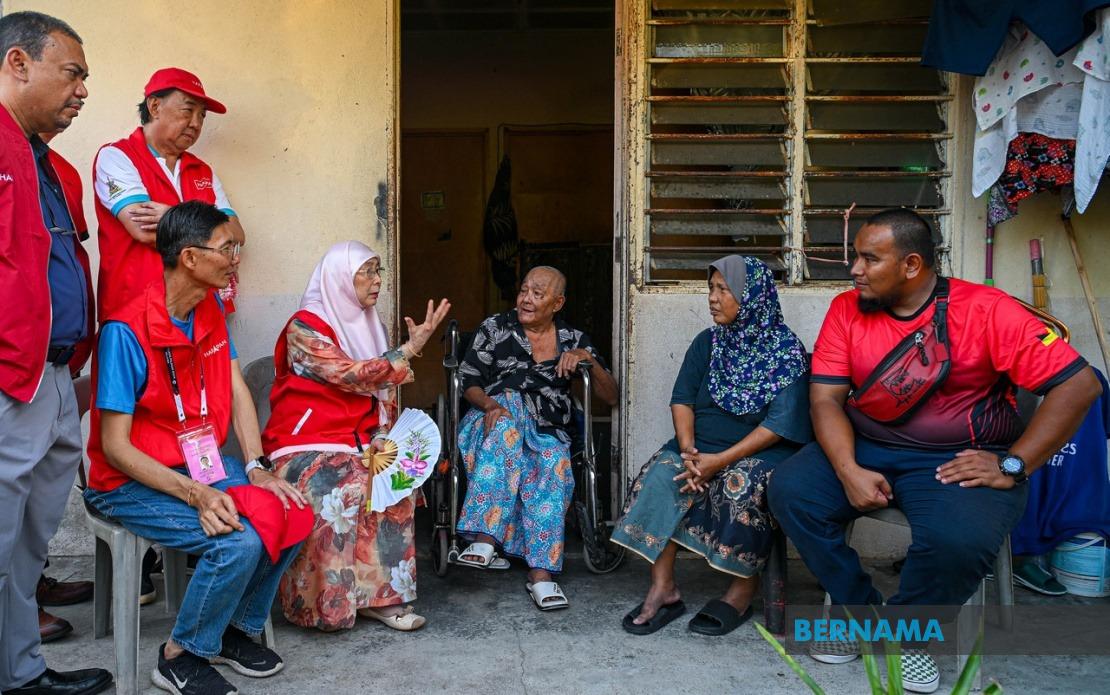
In a campaign visit that underscored Pakatan Harapan's focus on grassroots engagement, party leader Wan Azizah spent roughly twenty minutes at the home of Zaiton Hasan and Paimin Sapari in the Chuah constituency, directly addressing the challenges confronting one of Negeri Sembilan's vulnerable households. The visit, conducted alongside PH's state assembly candidate Datuk Yew Boon Lye, highlighted the coalition's strategy of connecting senior party figures with voters facing acute personal difficulties as the state election enters its final fortnight.
The couple's circumstances reflect broader struggles affecting Malaysia's elderly population. Sixty-year-old Zaiton manages high blood pressure while her seventy-one-year-old husband Paimin contends with diabetes, both chronic conditions that compound financial strain for pensioners living on limited income. Their story represents the intersection of health vulnerability and economic insecurity that characterises the lives of many Malaysians in their later years, a demographic reality that political parties across the spectrum have increasingly highlighted during campaign periods.
The emotional impact of the visit was evident in Zaiton's reaction afterward. Speaking to Bernama, she described the encounter as dreamlike, emphasising that no major political figure had previously visited their residence. Her gratitude reflected both the rarity of such direct engagement from senior leaders and the significance that vulnerable households attach to being acknowledged by those in positions of influence. The couple's positive reception of Wan Azizah and Yew suggested that personal attention and demonstrated concern, alongside practical assistance, resonate strongly with voters confronting daily hardship.
Beyond symbolic engagement, the visit included material support that addressed immediate mobility challenges facing Paimin. The Port Dickson People's Spirit Welfare Association donated a wheelchair to the household, a practical intervention that eases the pensioner's movement and independence. Such assistance demonstrates how campaign visits can translate into concrete welfare outcomes, though observers might note that systemic solutions to elderly poverty remain absent from such individual interventions.
The Chuah contest itself carries significance as a three-way engagement within the broader Negeri Sembilan state election framework. Datuk Yew Boon Lye faces a straight fight against Pau Jeou Ching representing Perikatan Nasional, with both candidates competing for a constituency where personal connection and demonstrated concern for residents' welfare carry electoral weight. The visit positioned Yew as an incumbent seeking to consolidate support through high-profile backing from Wan Azizah, signalling to voters that the constituency enjoys access to party leadership.
The timing of such outreach activities coincides with the election schedule set by the Election Commission. Early voting for the sixteenth Negeri Sembilan State Election occurs on July 28, providing opportunity for voters who cannot participate on polling day. The main election takes place on August 1, compressed within a brief campaign window that concentrates political activity and media attention on policy priorities and personal credentials simultaneously.
For Malaysian voters observing state-level campaigns, the Chuah visit exemplifies how contemporary electoral politics increasingly emphasises personal touch and emotional connection. Rather than purely addressing policy platforms or partisan ideology, candidates and senior party figures now regularly engage in welfare-focused constituency work that demonstrates attentiveness to individual suffering. This approach reflects broader recognition that electoral outcomes often depend on voters' perceptions of which leaders genuinely understand their circumstances.
Wan Azizah's presence in Negeri Sembilan carries particular weight given her national profile and historical role within PH. As a recognisable figure associated with the coalition's 2018 electoral victory and subsequent governance, her appearance alongside local candidates implicitly endorses their candidacy while raising the profile of local contests beyond purely state-level significance. Such strategic deployment of senior party figures targets voters who might otherwise view state elections as secondary to federal politics.
The broader context of elderly care and social support in Malaysia remains contested political territory. While welfare associations like Port Dickson People's Spirit Welfare Association step into gaps providing practical assistance, critics argue that systematic government support for pensioners managing chronic illness requires expansion. Individual political visits, however well-intentioned, cannot substitute for comprehensive social safety nets that elderly Malaysians need regardless of election cycles.
As Negeri Sembilan voters prepare for balloting within weeks, such constituency-level interactions shape perceptions of candidate accessibility and party commitment to community welfare. Whether through direct home visits, donation coordination, or listening sessions, parties compete not only on policy platforms but on demonstrated capacity to respond to residents' immediate needs. The Chuah visit thus functions simultaneously as welfare engagement, campaign strategy, and political messaging to a constituency determining electoral outcomes in a state election observers view as significant barometer for federal political dynamics.

