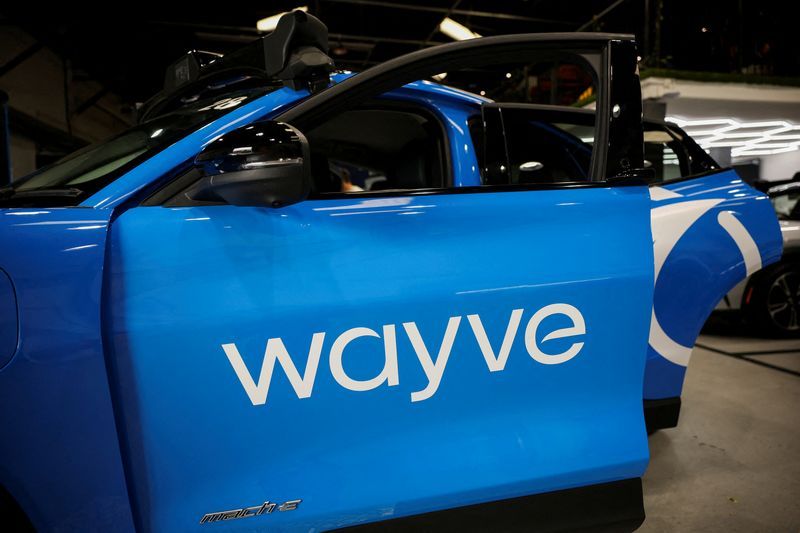
Wayve, a London-based autonomous-driving startup, is capturing significant momentum in the race to perfect self-driving technology, having secured $2.8 billion in funding from a formidable coalition of investors that spans Silicon Valley giants and established automotive manufacturers. The funding roster includes Nvidia, Mercedes-Benz, and Nissan, underscoring broad confidence in the company's technological approach. Most notably, Wayve recently announced it would deploy its autonomous system in robotaxis manufactured by Stellantis, the world's fourth-largest automaker, with vehicles destined for Uber's ride-hailing network starting this year.
The fundamental distinction between Wayve's methodology and competing approaches lies in its deployment of end-to-end machine learning, an artificial-intelligence framework that mimics human driver cognition by translating sensor data directly into driving decisions without relying on pre-programmed rules. This contrasts sharply with traditional autonomous-driving architectures, which combine rule-based software coding with high-definition mapping to anticipate and respond to specific scenarios. The difference matters profoundly for development timelines and global scalability, since Wayve's approach theoretically eliminates the laborious process of mapping roads and encoding local driving conventions for each new market.
CEO Alex Kendall, a 33-year-old New Zealander who founded Wayve in 2017 immediately after earning his doctorate in AI deep learning from Cambridge University, articulates an expansive vision for the company's trajectory. Speaking from a Ford Mustang Mach-E equipped with Wayve's autonomous technology as it navigated San Francisco Bay Area streets on its own, Kendall declared the company's ambition to democratize self-driving capabilities across all vehicle platforms and geographies. Unlike Tesla's competing end-to-end approach, which relies exclusively on camera-based perception, Wayve's architecture accommodates multiple sensor types and compatible AI chips, enabling the company to function as a technology licensor rather than solely as a vehicle manufacturer. This licensing potential fundamentally broadens Wayve's addressable market and explains the appeal to traditional automotive suppliers and manufacturers seeking autonomous-driving solutions.
The autonomous-driving sector has experienced a dramatic recalibration following years of overhyped timelines and unfulfilled promises. Alphabet's Waymo division has reignited investor enthusiasm through tangible commercial progress, now operating paid robotaxi services across roughly a dozen American cities after more than a decade of development. This visible market validation has resuscitated interest in autonomous-vehicle developers broadly, creating favorable financing conditions for companies demonstrating genuine technological differentiation. A decade ago, end-to-end machine learning was confined to academic research; Kendall himself championed the approach as a relatively obscure experimental direction. Today, the methodology has achieved mainstream adoption within the autonomous-driving industry, with numerous developers incorporating end-to-end elements into their systems.
However, the AI-centric approach introduces a significant challenge that neither Wayve nor its competitors have fully resolved: the interpretability problem. End-to-end learning systems function as "black boxes," making it extraordinarily difficult for engineers and regulators to explain precisely why the vehicle made a particular driving decision. Earlier driverless-car systems, constructed through explicit software coding, offered far greater transparency because developers could trace the logic chain leading to each behavioral choice. This opacity presents regulatory and safety-assurance complications as autonomous vehicles move toward large-scale deployment in densely populated areas.
Wayve's engineering team contends that conventional, code-intensive approaches actually compromise safety in unusual scenarios because programmers cannot feasibly write rules addressing every conceivable edge case. When unexpected situations arise—an unpredicted debris field, an unconventional gesture from a traffic officer, or an uncharted construction zone—pre-programmed safety logic becomes rigid and potentially dangerous. Vijay Badrinarayanan, Wayve's vice president of AI, argues that human drivers excel precisely because they conservatively adapt their behavior when confronted with uncertainty rather than defaulting to predetermined algorithms. This philosophical distinction—adaptive learning versus rigid rule application—undergirds Wayve's technological differentiation and its claim that end-to-end systems will ultimately prove safer in real-world conditions.
Waymo, despite pioneering end-to-end AI adoption, maintains dual-layered safety protocols combining machine learning with traditional rule-based approaches achieved through software coding and mapping. The company explicitly states that end-to-end models alone cannot guarantee safety at scale, requiring supplementary conventional architecture. This cautious stance reflects Waymo's decade-plus operational experience and suggests that the industry's leading deployed system still views pure end-to-end learning as insufficient for comprehensive autonomous operation. The divergence between Wayve's confidence in its approach and Waymo's more conservative stance reveals unresolved tensions within autonomous-driving development.
Nissan, one of Wayve's strategic customers, exemplifies manufacturer hesitation regarding end-to-end systems. The Japanese automaker's technology chief, Eiichi Akashi, acknowledges Wayve's technology as "the most advanced" available but expresses difficulty understanding how the system makes real-time decisions. Nissan intends to deploy Wayve's technology in its Elgrand people-mover van domestically during the fiscal year ending March 2028, yet the company is conducting extensive safety validation before proceeding. This cautious approach reflects broader automotive industry uncertainty: established manufacturers possess enormous liability exposure and cannot afford to deploy technologies whose decision-making processes remain opaque. Akashi's candid admission that the system functions as a difficult-to-penetrate "black box" will likely characterize many manufacturers' initial posture toward Wayve's solution.
Wayve's geographic expansion strategy leverages its technology's reduced requirements for conventional preparatory work. With major operational hubs in Tokyo, Stuttgart, and Vancouver, the company argues it can enter new markets substantially faster than competitors because it eliminates the tedious road-mapping and rule-coding phases. Wayve claims successful testing across hundreds of global cities without such preliminary infrastructure development, theoretically enabling rapid international scaling. This advantage could prove transformative if regulatory frameworks evolve to accept end-to-end learning systems, particularly across Asia-Pacific markets where standardized regulations remain nascent.
Academic researchers remain divided regarding end-to-end learning's ultimate safety advantages. Siddartha Khastgir, a safe autonomy professor at the University of Warwick, suggests that end-to-end models should accelerate commercial deployment timelines compared to traditional approaches, yet he explicitly declines to assert that one technological pathway proves inherently safer than alternatives. Phil Koopman, a Carnegie Mellon University autonomous-technology expert, characterizes Wayve's unusual-situation handling as one viable approach among several potentially successful methodologies. Koopman projects that safely deploying driverless systems across America will require at least another decade and continued technological breakthroughs, tempering expectations about imminent widespread autonomous-vehicle availability despite recent funding enthusiasm.
For Malaysian and Southeast Asian stakeholders, Wayve's approach carries particular significance given regional enthusiasm for autonomous-vehicle adoption without corresponding regulatory infrastructure. Many Southeast Asian cities feature chaotic traffic patterns, informal driving customs, and minimal high-definition mapping coverage—conditions that theoretically favor Wayve's adaptive learning approach over rule-based systems. However, the unresolved interpretability challenge remains problematic for regulators seeking accountability frameworks. Malaysia's automotive sector, increasingly intertwined with global supply chains and technology platforms, faces pressure to accommodate autonomous-vehicle manufacturers, yet the industry must simultaneously protect public safety and maintain transparent governance. Wayve's success could accelerate autonomous-vehicle deployment regionally, or regulatory skepticism toward opaque AI systems could create adoption barriers that favor more interpretable, traditional approaches.

