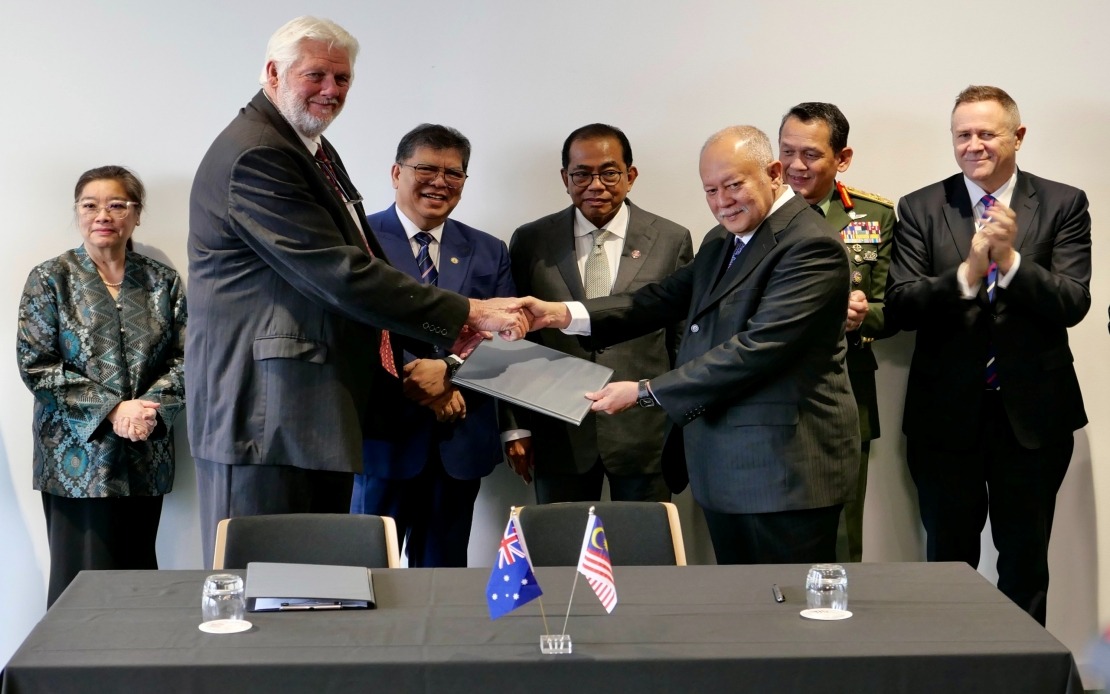
Malaysia's defence ambitions received a substantial boost this week through a landmark partnership between local company Weststar Defence Industries and Australian firm Rocket Technologies International, a collaboration expected to fundamentally reshape the country's capacity to develop and manufacture advanced weaponry domestically. Defence Minister Datuk Seri Mohamed Khaled Nordin announced the deal during an official visit to Australia, positioning the agreement as a watershed moment for Malaysia's push toward greater strategic autonomy in defence procurement—an increasingly critical objective as regional security challenges evolve across the Indo-Pacific.
The partnership represents far more than a simple commercial arrangement between two companies. It embodies Malaysia's determination to reduce dependence on foreign defence suppliers while simultaneously building expertise in rocket and missile technologies, domains historically dominated by a handful of advanced industrial nations. By facilitating Weststar's investment in a dedicated Malaysian production facility, the agreement directly supports the government's National Defence Industry Policy, which prioritises the development of indigenous defence manufacturing capabilities and the cultivation of specialised technical knowledge within the domestic sector.
Operationally, the collaboration will unfold in phases, with rocket manufacturing anticipated to commence within two years of the partnership's formalisation. This staged approach allows Malaysian firms to absorb technological know-how progressively while building the necessary infrastructure, workforce expertise, and quality control mechanisms essential for producing sophisticated defence systems. The subsequent expansion into missile production represents an even more ambitious leap, signalling confidence from both parties in the foundation being established through the initial rocket manufacturing stage.
Beyond the immediate manufacturing benefits, the deal opens pathways for Malaysian companies to integrate into RTI's international supply chains, presenting opportunities previously unavailable to the domestic defence sector. Such integration would expose local firms to global standards, competitive pressures, and advanced manufacturing practices whilst potentially positioning them as suppliers to other countries' defence programmes. This international dimension transforms the partnership from a bilateral arrangement into a potential gateway for Malaysian defence industry participation in broader geopolitical competition and cooperation.
The strategic dimensions of this partnership extend well beyond industrial production metrics. Malaysia's ability to design, test, and manufacture rocket and missile systems domestically grants the nation greater flexibility in responding to regional security developments without the political complications or delays inherent in relying on foreign suppliers. For a country navigating complex relationships with major powers whilst maintaining regional balance, such self-sufficiency carries profound implications for decision-making autonomy and deterrent credibility.
Mohamed Khaled's three-day Australian visit underscored the institutional depth supporting this commercial agreement. The Defence Minister's delegation, comprising the Royal Malaysian Air Force chief and leadership from the National Defence University and the National Aerospace Industry Corporation, toured advanced facilities at the University of Southern Queensland, including laboratories focused on composite manufacturing and hypersonic technologies. These visits served dual purposes: demonstrating Malaysia's serious commitment to learning advanced manufacturing methodologies and establishing direct relationships between Malaysian defence officials and Australian academic institutions that could facilitate ongoing technology transfer and collaborative research.
The Australian government's explicit approval and support for the Weststar-RTI arrangement deserves particular attention, as it signals Canberra's willingness to strengthen Malaysia's defence industrial base despite potential sensitivities around technology sharing. This stance reflects deepening bilateral defence relationships between Malaysia and Australia, relationships increasingly important as both nations navigate challenges in the Indo-Pacific region. Mohamed Khaled's concurrent meetings with Deputy Prime Minister and Defence Minister Richard Marles underscored mutual interest in broadening defence cooperation beyond this single transaction.
The parliamentary dimension of the visit further reinforced the partnership's significance within formal state structures. Meetings between Dewan Rakyat Speaker Tan Sri Johari Abdul and Australian parliamentarians, including House Speaker Milton Dick, positioned the Weststar-RTI deal within a broader architecture of Malaysia-Australia strategic partnership, suggesting that defence industrial cooperation carries support across political and military institutions in both countries. Such high-level engagement legitimises the arrangement domestically whilst demonstrating to regional observers Malaysia's commitment to deepening ties with a significant democratic partner.
For Malaysia's defence industry ecosystem, the ramifications extend across multiple dimensions. The partnership validates Weststar's strategic positioning as a credible defence technology company capable of managing complex international collaborations, potentially enhancing its standing for future government contracts and private sector partnerships. Simultaneously, the arrangement signals to other Malaysian companies that serious opportunities exist within the defence manufacturing sector, potentially stimulating broader private sector interest in developing specialised defence capabilities rather than remaining passive recipients of government procurement decisions.
Regionally, Malaysia's advancement in rocket and missile production capabilities carries implications for the balance of military power across Southeast Asia. As the region becomes increasingly contested between major powers with competing strategic interests, nations like Malaysia that develop autonomous defence manufacturing capacity enhance their relative bargaining position and reduce vulnerability to external pressure through supply dependencies. This dynamic has particular resonance given ongoing tensions in the South China Sea and broader Indo-Pacific strategic competition.
The timing of this partnership also reflects evolving Australian strategic thinking. Canberra has increasingly prioritised developing security relationships with Southeast Asian partners as part of broader efforts to maintain influence and stability in the region. Supporting Malaysian defence industrial development aligns with Australian interests in cultivating a strong, capable, and independently-minded regional partner capable of contributing to regional security architecture without complete reliance on any single major power.
Looking ahead, the success of the Weststar-RTI partnership will depend substantially on execution quality, including workforce development, quality assurance protocols, and maintenance of technological momentum as production scales up. The two-year timeline for commencing rocket manufacturing represents an ambitious schedule that will test both partners' commitment and capabilities. However, successful implementation could catalyse further defence industrial collaborations, positioning Malaysia as a meaningful player within regional and potentially global defence manufacturing networks rather than merely a consumer of foreign systems.

